


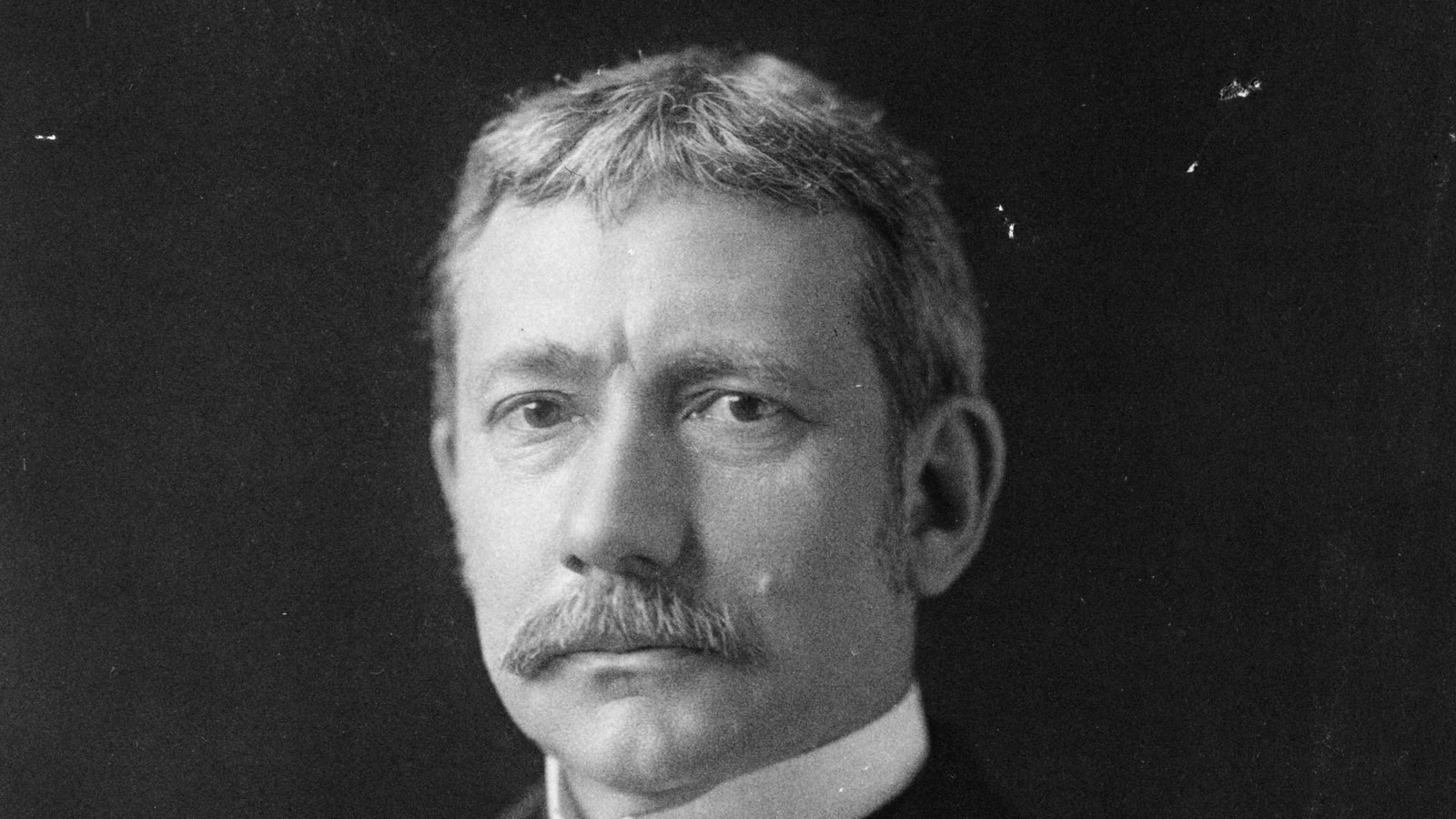
At Washington, the United States of America and His Britannic Majesty conclude on 11 January 1909 a treaty relating to boundary waters and to questions arising between the United States and the Dominion of Canada. The plenipotentiaries are Elihu Root, Secretary of State of the United States, and James Bryce, Ambassador Extraordinary and Plenipotentiary at Washington. The parties are equally desirous to prevent disputes regarding the use of boundary waters, to settle questions pending along the common frontier, and to provide for the adjustment of such questions as may hereafter arise.
The Preliminary Article defines boundary waters as the waters from main shore to main shore of the lakes and rivers and connecting waterways along which the international boundary passes, including bays, arms and inlets, but not tributary waters which in their natural channels would flow into such waters, waters flowing from them, or the waters of rivers flowing across the boundary. Article I keeps the navigation of all navigable boundary waters forever free and open for the purposes of commerce to the inhabitants and to the ships, vessels and boats of both countries equally. The same right of navigation extends to the waters of Lake Michigan and to canals connecting boundary waters. Rules, regulations and canal tolls apply alike to the subjects or citizens and to the ships of both parties.
Article II reserves to each party, on its own side of the line, exclusive jurisdiction and control over the use and diversion of waters which in their natural channels would flow across the boundary or into boundary waters. Any interference with or diversion from their natural channel resulting in injury on the other side of the boundary gives rise to the same rights and legal remedies as if the injury took place in the country where the diversion or interference occurs; this does not apply to cases already existing or to cases covered by special agreement. Neither party surrenders any right to object to an interference or diversion on the other side of the boundary the effect of which would be productive of material injury to the navigation interests on its own side.
Article III provides that, in addition to uses, obstructions and diversions already permitted or provided for by special agreement, no further uses, obstructions or diversions of boundary waters affecting the natural level or flow on the other side of the line shall be made except by authority of the United States or of the Dominion of Canada within their respective jurisdictions and with the approval of a joint commission, to be known as the International Joint Commission. Governmental works wholly on a party's own side of the line for deepening channels, breakwaters, harbours and other works for commerce and navigation remain permitted if they do not materially affect the level or flow on the other side; nor do the provisions interfere with ordinary use for domestic and sanitary purposes. Article IV requires Commission approval for dams or protective works on waters flowing from boundary waters, or in waters at a lower level than the boundary in rivers flowing across the boundary, if they raise the natural level on the other side. Boundary waters and waters flowing across the boundary shall not be polluted on either side to the injury of health or property on the other.
Article V limits diversion from the Niagara River above the Falls so that the level of Lake Erie and the flow of the stream shall not be appreciably affected. The United States may authorize, within the State of New York, a daily diversion for power not exceeding 20,000 cubic feet of water per second; the United Kingdom, by the Dominion of Canada or the Province of Ontario, may authorize within Ontario a daily diversion not exceeding 36,000 cubic feet per second. The prohibitions do not apply to diversion for sanitary or domestic purposes or for the service of navigation canals. Article VI treats the St. Mary and Milk Rivers and their tributaries in Montana, Alberta and Saskatchewan as one stream for irrigation and power, to be apportioned equally, though more than half may be taken from one river and less from the other. In the irrigation season, from 1 April to 31 October inclusive, the United States is entitled to a prior appropriation of 500 cubic feet per second of the Milk River, or so much as constitutes three-fourths of its natural flow, and Canada to the same quantity of the St. Mary River. The channel of the Milk River in Canada may be used by the United States for waters diverted from the St. Mary. Measurement and apportionment are made jointly under the direction of the Commission.
Article VII establishes and maintains an International Joint Commission of six commissioners: three appointed by the President of the United States and three appointed by His Majesty on the recommendation of the Governor in Council of the Dominion of Canada. Article VIII gives the Commission jurisdiction over cases involving the use, obstruction or diversion of waters for which its approval is required under Articles III and IV. Each party has, on its own side of the boundary, equal and similar rights in the use of boundary waters. The order of precedence is: (1) uses for domestic and sanitary purposes; (2) uses for navigation, including the service of canals for navigation; (3) uses for power and for irrigation. Existing uses are not disturbed. A majority of the Commissioners may render a decision; if the Commission is evenly divided, separate reports go to each Government.
Article IX provides that other questions or matters of difference along the common frontier shall be referred to the Commission for examination and report whenever either Government so requests. Such reports are not decisions and shall in no way have the character of an arbitral award. Article X allows questions to be referred for decision by consent of both parties, on the part of the United States by and with the advice and consent of the Senate, and on the part of His Majesty with the consent of the Governor General in Council. If the Commission is equally divided, the matter is referred to an umpire chosen under the fourth, fifth and sixth paragraphs of Article XLV of the Hague Convention for the Pacific Settlement of International Disputes. Article XI files duplicate originals of decisions and joint reports with the Secretary of State of the United States and the Governor General of the Dominion of Canada. Article XII requires the Commission to meet and organize at Washington; joint expenses are paid in equal moieties.
Article XIII treats special agreements as including not only direct agreements between the High Contracting Parties but also mutual arrangements between the United States and the Dominion of Canada expressed by concurrent or reciprocal legislation of Congress and of the Parliament of the Dominion. Article XIV provides for ratification by the President of the United States, by and with the advice and consent of the Senate, and by His Britannic Majesty; the treaty takes effect on the date of the exchange of ratifications at Washington, remains in force for five years from that day, and thereafter until terminated by twelve months written notice. It is signed in duplicate, with seals, by Elihu Root and James Bryce. This text is not the later treaty concerning diversion of the Niagara River.
Image: Elihu Root, Secretary of State of the United States; George Prince, 1902; public domain, Wikimedia Commons. Cropped to 16:9. Portrait of 1902, not the signing.
Source consulted: Boundary Waters Treaty of 1909. Treaty text: Treaty Relating to Boundary Waters, Washington, 11 January 1909.











0 Comments
No comments on this article yet. Be the first!