


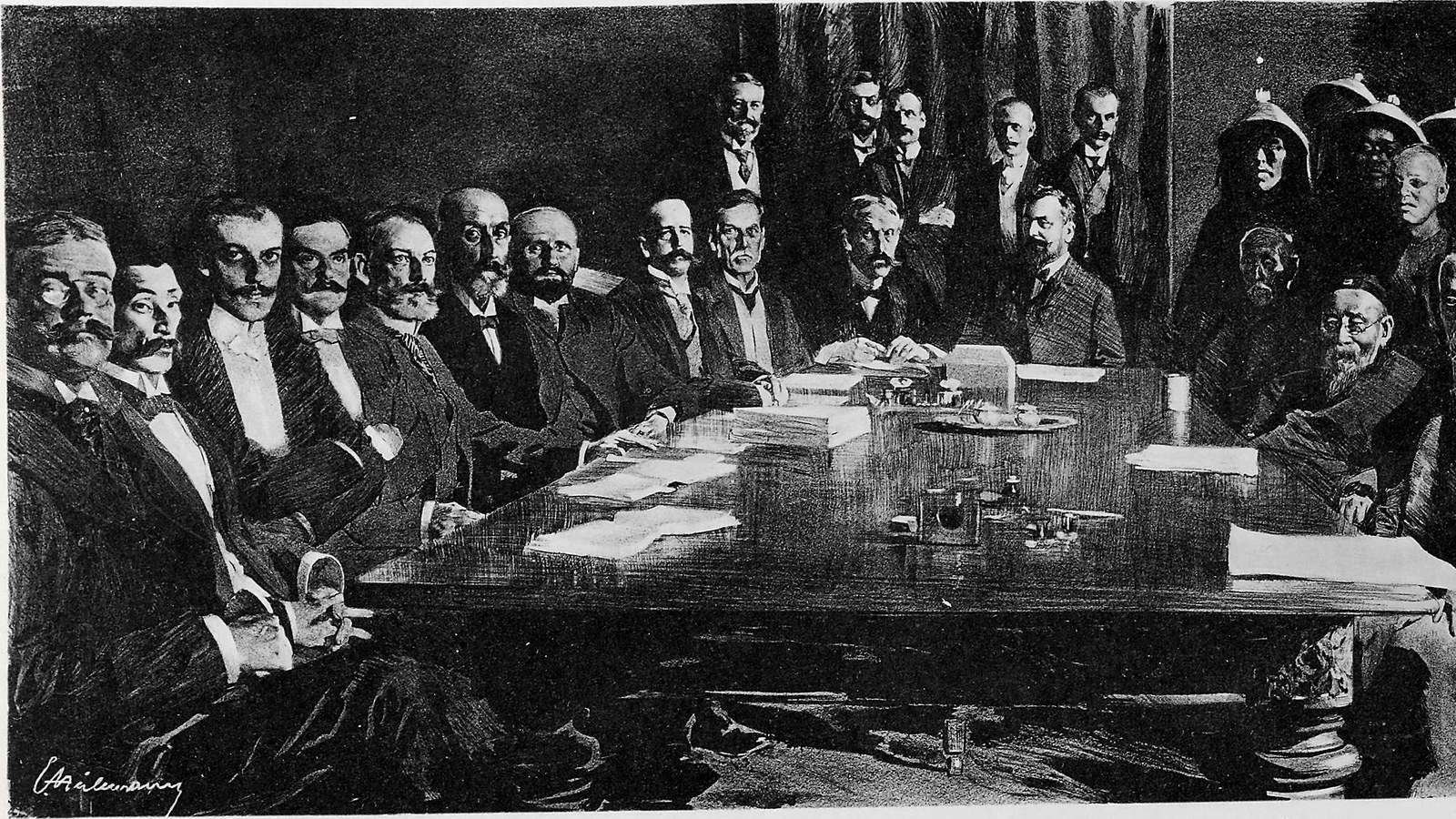
On 7 September 1901, at Peking, plenipotentiaries of eleven Powers and of the Qing court signed the Final Protocol for the Settlement of the Disturbances of 1900. China was represented by Prince Qing (Yi Kuang) and Li Hongzhang; the Spanish minister Bernardo J. de Cólogan, dean of the diplomatic corps, headed the foreign list. The French text alone is authentic. The instrument declares that China has complied with the note of 22 December 1900, accepted by imperial decree on 27 December.
Article I requires an apology to Germany for the assassination of Baron von Ketteler and a commemorative arch the width of the street, with an inscription in Latin, German and Chinese. Article III sends Na Tung, vice-president of the Board of Revenue, to express regret in Tokyo for the murder of chancellor Sugiyama. Article IV places expiatory monuments in the desecrated foreign cemeteries: ten thousand taels at Peking, five thousand in the provinces.
Article II records the punishments: Prince Tuan and Duke Tsai Lan, lifelong exile in Turkestan if the emperor spares their lives; Prince Chuang, Ying Nien and Chao Shu-chiao, suicide; Shanxi governor Yü Hsien, Chi Hsiu and Hsü Cheng-yu, death. General Dong Fuxiang was only dismissed, “pending the determination of the final punishment.” Official examinations are suspended for five years in cities where foreigners were massacred.
Article V forbids the import of arms, ammunition and materials for their manufacture, for two years, renewable. Article VI fixes the indemnity: 450 million Haikwan taels, a gold debt at 4 per cent a year, reimbursed in thirty-nine years, amortization from 1 January 1902 to the close of 1940. Security: the maritime customs after earlier loans, the native customs in the open ports and the gabelle, minus fractions already pledged. The import tariff rises to 5 per cent effective.
Article VII reserves the legation quarter, with no Chinese right of residence, and a permanent guard. Article VIII razes the Taku forts and anything impeding free communication between the capital and the sea. Article IX occupies twelve points: Huangcun, Langfang, Yangcun, Tianjin, Junliangcheng, Tanggu, Lutai, Tangshan, Luanzhou, Changli, Qinhuangdao, Shanhaiguan. Article X posts, for two years, edicts that forbid anti-foreign societies on pain of death and hold governors personally responsible.
Article XI opens revision of the commercial treaties and the Peiho and Whangpu works. Article XII turns the Zongli Yamen into the Waiwu Pu, ranking above the six boards. International troops evacuate Peking on 17 September and Chihli on 22 September, except the legation guards and the points in Article IX. This is not the rising of summer 1900, not the note of 22 December and not the Sino-American treaty of 11 January 1943, which terminated the protocol between Washington and Chongqing.
The signing of the protocol at Peking. Photograph: Alfons von Mumm, Wikimedia Commons, public domain.
For context: Boxer Protocol. The official American text: Boxer Protocol (United States Treaty Series).











0 Comments
No comments on this article yet. Be the first!