
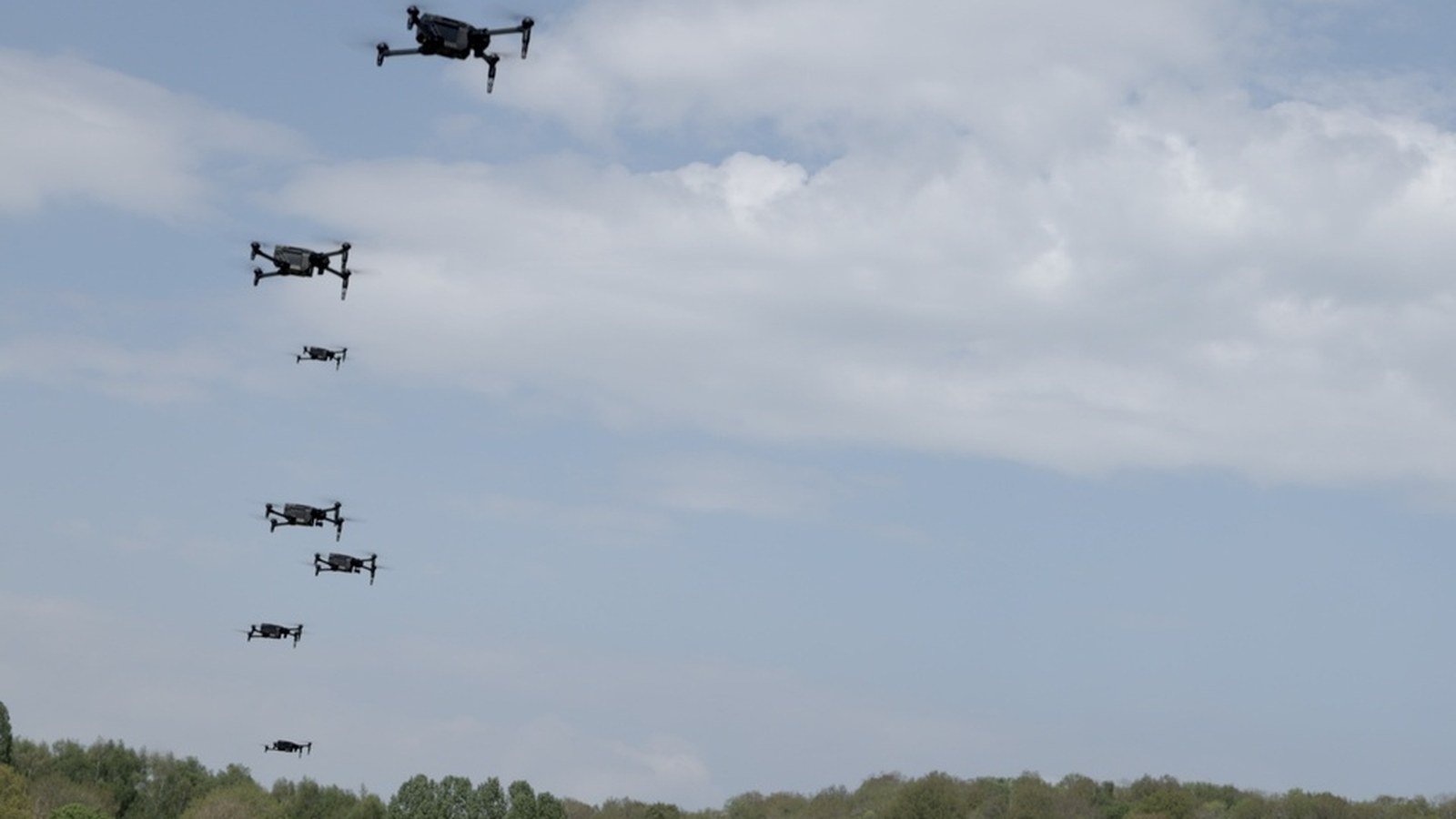
The British Army has tested a system in a realistic operational environment in which eight drones can operate collectively as a swarm, in a programme led by the Defence Science and Technology Laboratory, or Dstl, with industry partners.
Dstl published details on 16 September 2026 and describes the trials as a step forward for British Army autonomous capabilities.
The demonstrated system allows multiple drones to be coordinated as a group, reducing the need for every aircraft to be individually controlled at all times.
According to Dstl, the technology is the result of more than a decade of research into artificial intelligence, autonomy and swarm systems.
Experimentation took place over eight weeks with British soldiers involved, evaluating the technology under conditions closer to an operational environment than strictly laboratory-based testing.
A drone swarm does not simply mean several aircraft being in the air simultaneously. The concept involves coordination between platforms and a degree of autonomy that allows the group to pursue collective objectives with less human intervention than separately piloting each drone.
Eight drones were involved in the British demonstration. Dstl presents the system as part of the Army’s ambition to accelerate adoption of autonomy and test integration with existing personnel and procedures.
Autonomous technology has become a major research field for armed forces. Drones can perform roles including surveillance and reconnaissance, but this article should not turn Dstl’s announcement into a guide to offensive use.
The public-interest element is the technological development and the way artificial intelligence is changing the relationship between operators and uncrewed platforms.
Dstl says the programme also contributes to AUKUS Pillar 2. Pillar 2 of the partnership between the United Kingdom, United States and Australia covers cooperation in advanced technologies including AI and autonomy.
This is distinct from Pillar 1, associated with nuclear-powered submarines for Australia.
The AUKUS connection shows that British research into autonomous swarms forms part of a broader effort in interoperability and technological development among allies.
One intended advantage of swarm systems is scalability: one operator or a smaller team may coordinate multiple platforms.
Autonomy also raises questions about human control, safety, communications reliability and system behaviour when conditions change.
Dstl’s announcement focuses on technical progress and experimentation, not new rules on the use of force.
The article should therefore avoid claiming that the tested drones independently make attack decisions. A system can automate navigation or coordination without having autonomy over decisions to engage a target.
For the UK Ministry of Defence, testing with soldiers allows assessment not only of algorithms but also of how people understand and operate the system.
Dstl is the Ministry of Defence’s science and technology organisation and works with industry and academia to develop and assess technology.
The 16 September announcement does not mean the eight-drone system has become standard equipment across the British Army. It concerns experimentation and technological maturation.
A successful demonstration may lead to further development, procurement or additional testing, but those are separate stages.
For the public, the trial shows the technological direction: instead of treating each drone as an isolated platform, future systems may operate as coordinated groups.
Eight drones were sufficient for the current demonstration. The wider research goal is to develop architectures in which autonomy enables effective coordination of multiple platforms while retaining human control and accountability where required.
Image: Dstl / GOV.UK, Crown copyright, Open Government Licence. Photograph from the official 16 September 2026 release. Cropped to 16:9.
Source consulted: Dstl drone swarm accelerates Army autonomy ambition | GOV.UK.







0 Comments
No comments on this article yet. Be the first!