


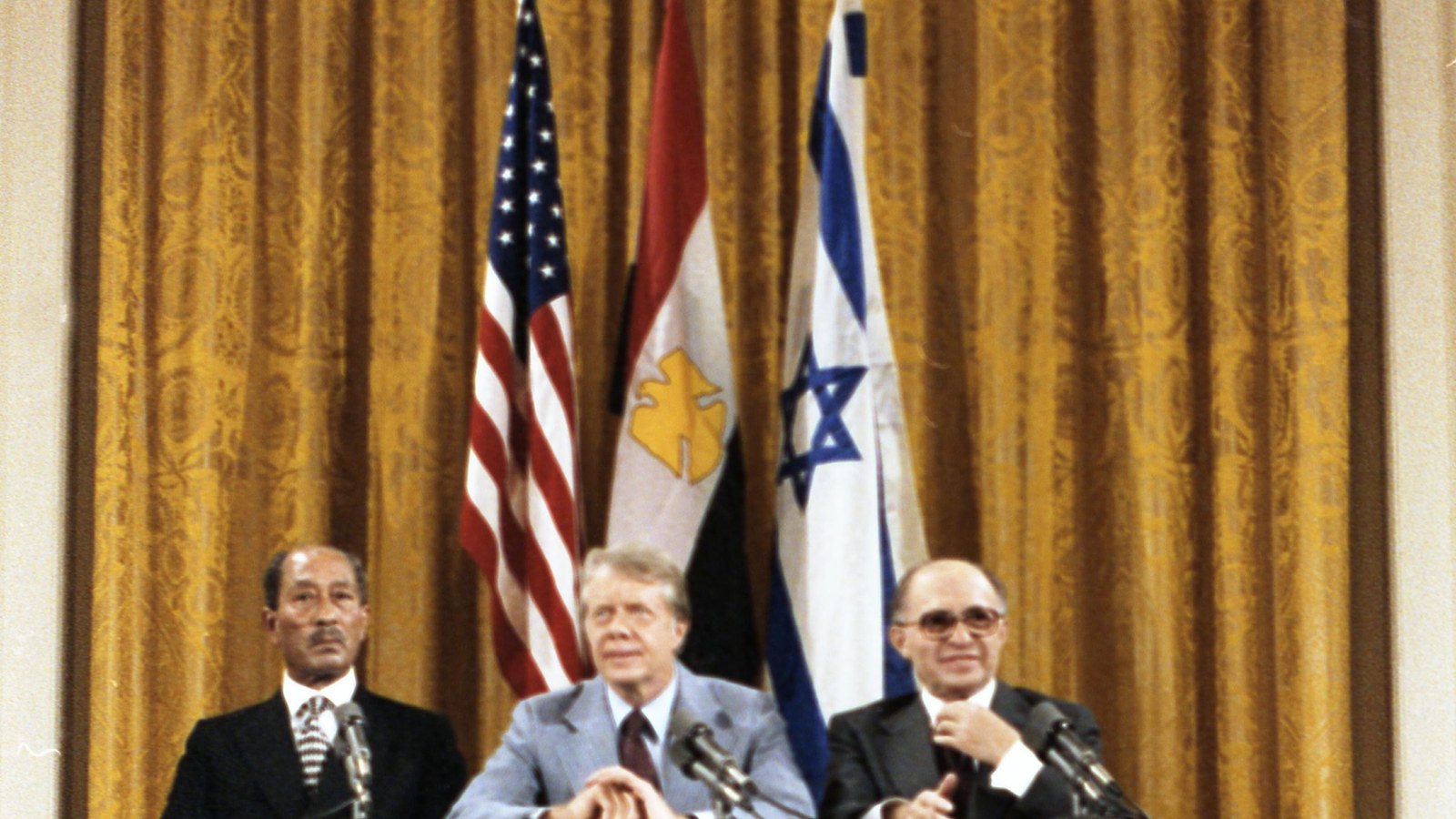
On 17 September 1978, in the East Room of the White House, Anwar al-Sadat and Menachem Begin signed the two Camp David frameworks, with Jimmy Carter as witness. The talks had been held at Camp David, Maryland, from 5 September to that day. The authentic text is English. The first instrument is A Framework for Peace in the Middle East; the second, Framework for the Conclusion of a Peace Treaty between Egypt and Israel. They are not the peace treaty of 26 March 1979.
The Middle East framework takes Security Council resolutions 242 and 338, in all their parts, as the basis and invites other parties to the Arab-Israel conflict to adhere. Egypt, Israel, Jordan and the representatives of the Palestinian people are to negotiate the Palestinian problem in all its aspects. Jerusalem is not mentioned.
For the West Bank and Gaza, transitional arrangements not exceeding five years: the Israeli military government and its civilian administration are withdrawn as soon as a freely elected self-governing authority replaces them. Remaining Israeli forces redeploy into specified security locations. A strong local police force; Israeli and Jordanian joint patrols. The five-year period begins when the authority is inaugurated. Not later than the third year, negotiations on final status open, based on 242, and must recognise “the legitimate right of the Palestinian peoples and their just requirements.”
The second framework calls for a peace treaty within three months, under a United Nations flag, to be implemented, unless otherwise agreed, between two and three years after signature. Egypt exercises full sovereignty up to the internationally recognised border with mandated Palestine. Israeli forces withdraw from Sinai; the airfields near al-Arish, Rafah, Ras en-Naqb and Sharm el-Sheikh remain civilian. Israeli ships have free passage through the Suez Canal on the Constantinople Convention of 1888; the Strait of Tiran and the Gulf of Aqaba are international waterways.
Force ceilings: no more than one Egyptian division about 50 km east of the Canal; only UN forces and civil police in a belt 20–40 km west of the border; Israel, at most four infantry battalions within 3 km. UN forces at Sharm el-Sheikh are not to be removed without a unanimous vote of the five permanent members. The interim withdrawal, three to nine months after the treaty, moves Israeli troops east of an El-Arish–Ras Muhammad line. Then normal relations: recognition, diplomacy, an end to boycotts.
This is not the peace of 26 March 1979, not the 1994 treaty with Jordan, not the Abraham Accords and not the Geneva conference. The Palestinians did not sign. The UN General Assembly later rejected the Middle East framework. The 1978 Nobel Peace Prize is a decision of the Norwegian committee, not a clause.
The signing in the East Room of the White House. Photograph: Central Intelligence Agency, Wikimedia Commons, public domain.
For context: Camp David Accords. The official text: Camp David Accords; September 17, 1978.











0 Comments
No comments on this article yet. Be the first!