


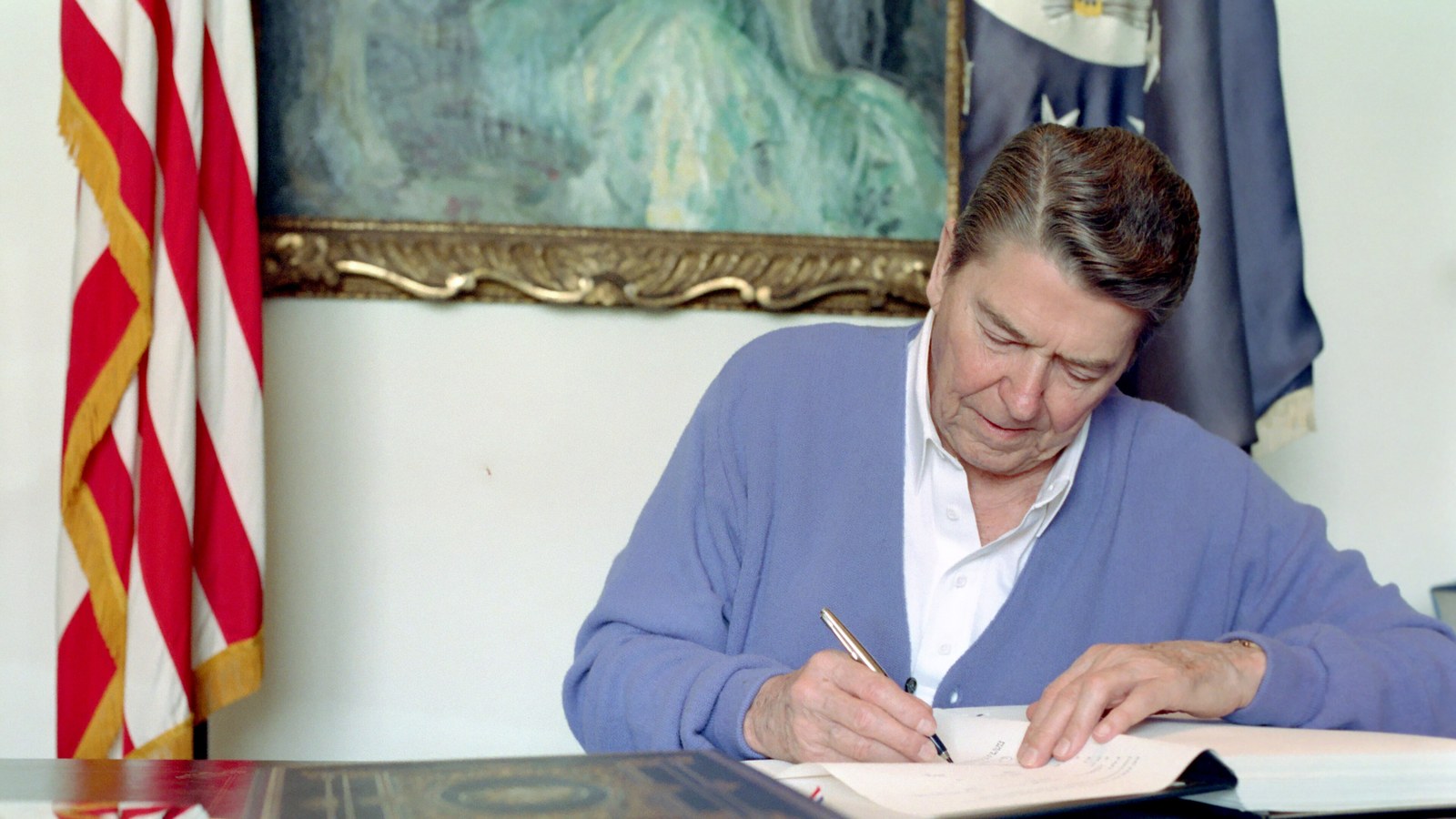
At Sunnylands, in Rancho Mirage, California, on 2 January 1988, the Government of Canada and the Government of the United States of America sign the Free Trade Agreement. Article 101, consistent with Article XXIV of the General Agreement on Tariffs and Trade, establishes a free-trade area between the two Parties.
Article 102 sets out the objectives, as elaborated more specifically in the provisions of the Agreement: to eliminate barriers to trade in goods and services between the territories of the Parties; to facilitate conditions of fair competition within the free-trade area; to liberalize significantly conditions for investment within that area; to establish effective procedures for the joint administration of the Agreement and the resolution of disputes; and to lay the foundation for further bilateral and multilateral cooperation to expand and enhance the benefits of the Agreement. Article 103 requires the Parties to ensure that all necessary measures are taken in order to give effect to its provisions, including their observance, except as otherwise provided, by state, provincial and local governments.
Article 401 prohibits, except as otherwise provided, any increase in an existing customs duty, or the introduction of any customs duty, on goods originating in the territory of the other Party. Each Party shall progressively eliminate its customs duties in accordance with Annex 401.2: staging category A becomes free of duty on 1 January 1989; category B is removed in five equal annual stages ending 1 January 1993; category C in ten equal annual stages ending 1 January 1998. Goods in category D continue to receive existing duty-free treatment. Article 301 sets out the general rules of origin; Article 407 concerns import and export restrictions, and Article 408 export taxes.
Part Two also covers national treatment, technical standards, agriculture and energy. Later chapters address services, investment, temporary entry for business persons and government procurement. Chapter 19 organises binational review of final antidumping and countervailing duty determinations: a panel may uphold a determination or remand it, and its decision is binding on the Parties with respect to the matter before the panel. Article 2005 exempts cultural industries from the provisions of the Agreement except as specifically provided in Article 401, paragraph 4 of Article 1607 and Articles 2006 and 2007; a Party may take measures of equivalent commercial effect in response.
Article 2105 provides that the Agreement enters into force on 1 January 1989 upon an exchange of diplomatic notes certifying the completion of necessary legal procedures by each Party. Article 2106 provides that it remains in force unless terminated by either Party upon six-month notice to the other Party. The Agreement is done in duplicate, in the English and French languages, each version being equally authentic. Under Article 2103 the Annexes constitute an integral part of the Agreement.
This instrument is not the North American Free Trade Agreement of 1994, which later superseded it, nor the Canada-United States-Mexico Agreement of 2018. The implementing statutes, including United States Public Law 100-449 of 28 September 1988 and Canada S.C. 1988, c. 65, are separate domestic instruments adopted after signature.
Image: signing at Sunnylands, Rancho Mirage, California, 2 January 1988; White House Photographic Office; public domain, Wikimedia Commons. Cropped to 16:9.
Source consulted: Canada-United States Free Trade Agreement. Treaty text: Free Trade Agreement between Canada and the United States of America, 2 January 1988, GAC text.











0 Comments
No comments on this article yet. Be the first!