


On 5 December 2002, in Washington, the Agreement between the Government of Canada and the Government of the United States of America for cooperation in the examination of refugee status claims from nationals of third countries was signed. Signatories: Bertin Côté, Minister and Deputy Head of Mission of Canada, and Arthur E. Dewey, Assistant Secretary of State for Population, Refugees and Migration. Authentic texts: English and French, in duplicate. It is not the 1951 Geneva Convention and not the 2023 expansion.
The preamble recalls that Canada is a party to the 1951 Convention and the New York Protocol of 1967, and that the United States is a party to the Protocol, and reaffirms non-refoulement obligations under those instruments and the 1984 Convention against Torture. It notes that refugee status claimants may arrive at the land border directly from the territory of the other Party, where they could have found effective protection, and invokes advice from the United Nations High Commissioner for Refugees on agreements that share responsibility.
Article 1 defines Country of Last Presence as Canada or the United States, the place in which the claimant was physically present immediately prior to a claim at a land border port of entry; Family Member includes the spouse, sons, daughters, parents, legal guardians, siblings, grandparents, grandchildren, aunts, uncles, nieces and nephews; Unaccompanied Minor means an unmarried claimant under 18 with no parent or legal guardian in either country. Article 2: the Agreement does not apply to citizens of Canada or the United States, nor to habitual residents of those countries who have no country of nationality.
Article 3: the Parties shall not return a claimant referred under Article 4 until an adjudication of the claim has been made, and shall not remove that person to another country under any other safe-third-country agreement. Article 4: subject to the exceptions, the Party of the country of last presence shall examine the claim of any person who arrives at a land border port of entry on or after the effective date. Responsibility shifts to the receiving country if there is a family member with refugee status or other lawful status other than as a visitor; an adult family member with a pending claim; an unaccompanied minor; or arrival with a valid visa or other admission document, other than for transit, issued by the receiving Party, or without a visa required only by that Party. Neither Party shall reconsider a decision that a person qualifies for an exception.
Article 5 governs claims made in transit during a removal: from Canada through the United States, the claim is examined in Canada; from the United States through Canada, if the claim has been rejected in the United States the person continues onward, and if it has not been determined the person is returned to the United States. Article 6: either Party may, at its own discretion, examine a claim where it determines that it is in its public interest to do so.
Article 7 allows exchange of information necessary for implementation, without placing claimants or their families at risk in their countries of origin. Article 8: standard operating procedures, advance notice of return, differences through diplomatic channels; the first review not later than 12 months from entry into force, with UNHCR invited. Article 9: assistance, upon request, in the resettlement of persons determined to require protection.
Article 10: the Agreement enters into force upon an exchange of notes confirming domestic legal procedures, hence on 29 December 2004; termination upon six months written notice; suspension for up to three months, renewable. It is not the 2001 Smart Border Declaration and not the initialling of the draft on 30 August 2002.
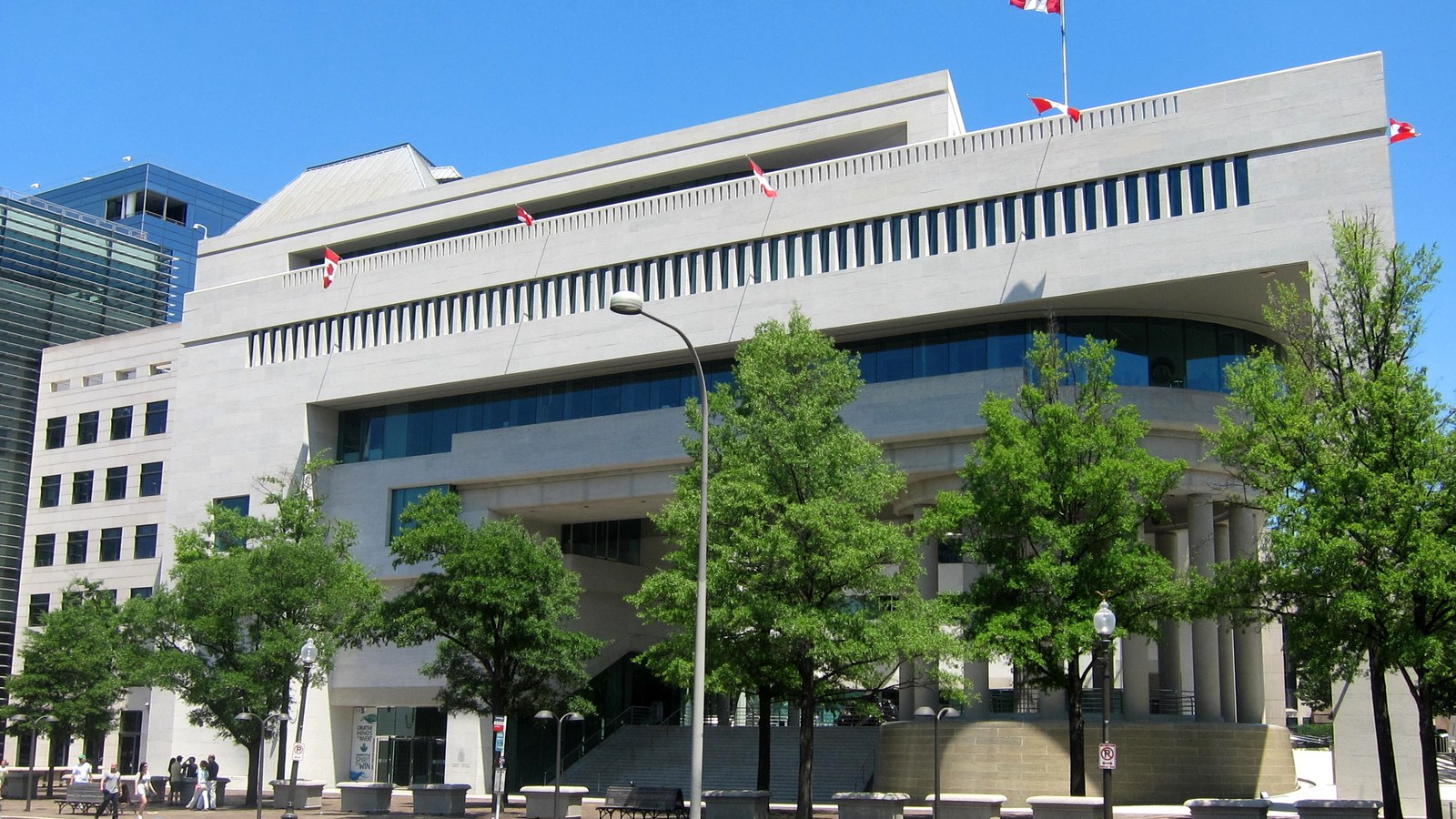
Image: Embassy of Canada, Washington; AgnosticPreachersKid, 30 May 2010; CC BY-SA 3.0, Wikimedia Commons. Cropped to 16:9.
Source consulted: Canada-United States Safe Third Country Agreement. Treaty text: Agreement for cooperation in the examination of refugee status claims, Washington, 5 December 2002.











0 Comments
No comments on this article yet. Be the first!