


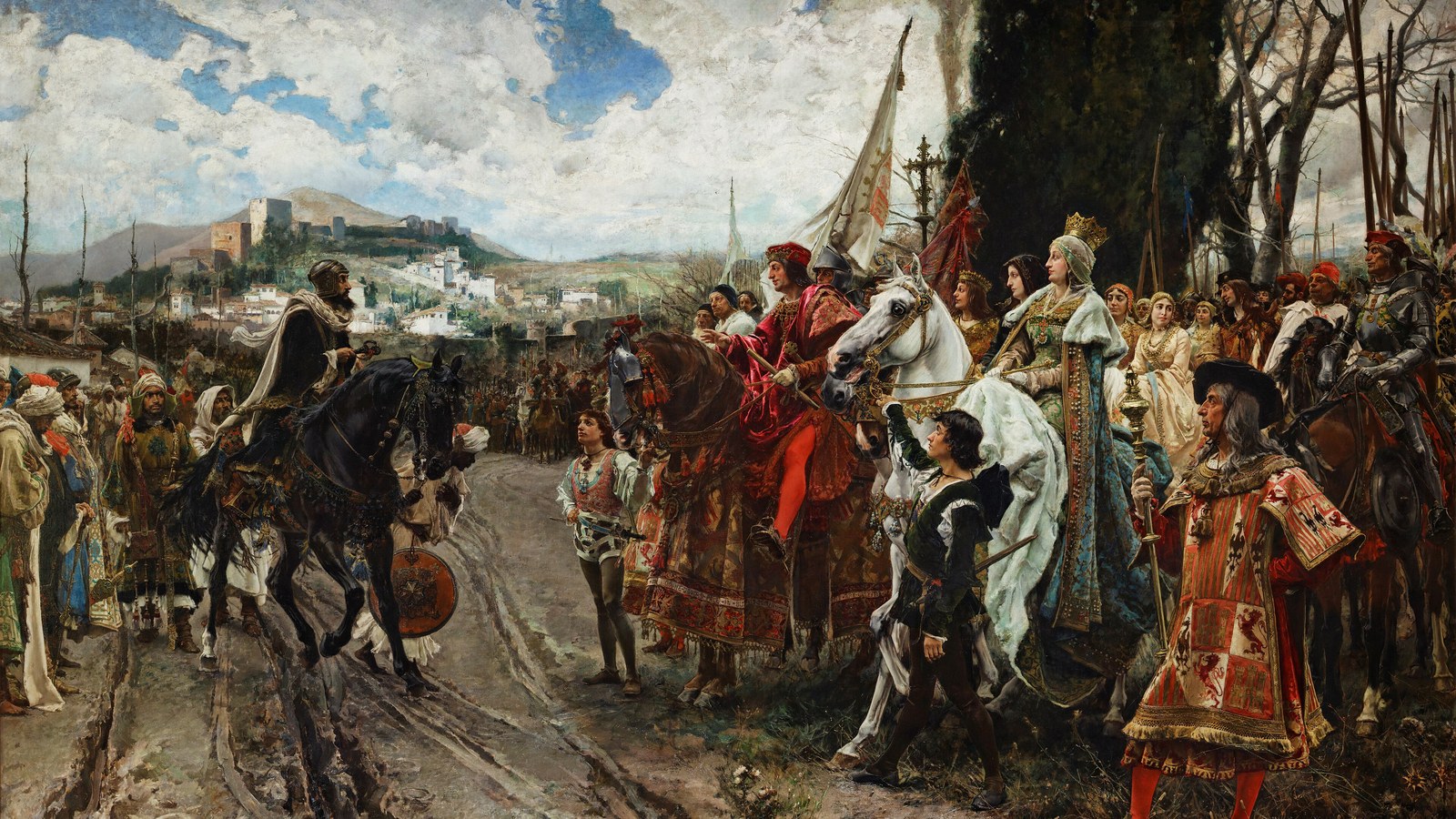
The Granada War, which began in 1482, found the Nasrid Emirate broken by the struggle between Boabdil (Muhammad XII) and his father and uncle. Ferdinand and Isabella took Málaga and Baza. In the spring of 1491 the siege closed a city packed with refugees, close to starvation. The capitulations were negotiated in secret, over months, to avoid a riot among inhabitants not yet ready to yield.
The Treaty of Granada was signed and ratified on 25 November 1491, between Boabdil, sultan of Granada, and Ferdinand II and Isabella I, sovereigns of Castile, León, Aragon and Sicily. The royal provision, countersigned by the secretary Hernando de Zafra at the camp in the Vega of Granada, bears the date 28 November. Within forty days the Moorish king, the alcaides, alfaquís, qadis and the commons are to deliver the Alhambra, the Alhizán and the other fortresses, towers and gates. Troops enter by Bib Lacha or Bibnest, not through the streets. The day before, Jucef Aben Comixa and 500 hostages from the leading families stay ten days at Their Highnesses’ disposal, until the citadels are occupied. Then Boabdil’s son and the hostages are returned, except those who have become Christians.
Their Highnesses and Prince Don Juan receive Boabdil and the people of Granada, the Albaicín, the Alpujarra and the places in the accord as natural vassals, in their houses and estates, “then and at all times and for ever”. They remain in their law: mosques, towers, muezzins and habices are not to be touched. Judgment is by the sharia, with the qadis; mixed suits by a Christian alcalde and a Muslim qadi. They wear no badges, as the Jews do. For three years they are exempt from pechos on houses; they pay only the August and autumn tithe and the livestock tithe. Arms and horses remain, except the guns, to be delivered promptly.
Those who wish to cross to Barbary may sell or leave their goods with third parties and are carried without tax, in ten large ships for seventy days, then three years without freight, then at a ducat a head. Jews born in Granada who have not been Christians must pass to Barbary within three years from 8 December. No Christian is to climb the wall between the Alcazaba and the Albaicín to look into Moorish houses. No Jew is to hold command over the Moors. No one is judged for another man’s deed. Christian captives in Granada are given up; Moorish captives in Andalusia are freed within five months, those in Castile within eight. The water of springs and acequias is not to be altered.
The Alhambra was handed over at the beginning of January 1492, after the forty-day term. At first a mixed municipal council functioned; Archbishop Hernando de Talavera preached by “Catholic reasoning”. Cardinal Francisco Jiménez de Cisneros, arriving in 1499, sent uncooperative nobles to prison until they agreed to convert. On 18 December 1499 he told Pope Alexander VI that three thousand had converted in a single day. That same month the Albaicín rose; Talavera and Tendilla negotiated, Cisneros obtained from the monarchs a collective pardon conditioned on baptism. The city became nominally Christian, and the capitulations came apart.
The surrender of Granada closed the last emirate of al-Andalus. Francisco Pradilla y Ortiz’s painting of 1882 shows Boabdil handing the keys to Ferdinand and Isabella on the plain of the Vega. The text of 1491 remains, even so, a contract of vassalage with guarantees of law, worship and property — broken in less than a decade.
Sources: Treaty of Granada (1491); Wikisource, Tratado de Granada.











0 Comments
No comments on this article yet. Be the first!