


At Sydney, the Government of Australia and the Government of the Democratic Republic of Timor-Leste conclude on 12 January 2006 a treaty on certain maritime arrangements in the Timor Sea. It is signed by Alexander Downer, Australian Minister for Foreign Affairs, and José Ramos-Horta, Senior Minister and Minister for Foreign Affairs and Cooperation of Timor-Leste. The parties note that they have not yet delimited their maritime boundaries. They take into account Articles 74 and 83 of the United Nations Convention on the Law of the Sea, which provide that delimitation of the exclusive economic zone and continental shelf shall be effected by agreement on the basis of international law in order to achieve an equitable solution, and, in the absence of delimitation, the obligation to enter into provisional arrangements of a practical nature which are without prejudice to the final determination.
Article 1 defines, among other terms, the Joint Petroleum Development Area established by the Timor Sea Treaty, the Sunrise IUA relating to the unitisation of the Sunrise and Troubadour fields, and the Unit Area described in Annex I of that agreement. Article 2 provides that nothing in the treaty shall be interpreted as prejudicing either party's legal position on delimitation, as a renunciation of any right or claim relating to the Timor Sea, or as recognition of any right or claim of the other party. No act taking place as a result of the treaty may be relied upon as a basis for asserting, supporting, denying or furthering either party's legal position on maritime boundary claims.
Article 3 replaces Article 22 of the Timor Sea Treaty: that treaty shall be in force for the duration of the present instrument and may be renewed by agreement; petroleum activities of limited liability entities entered into under its terms shall continue even if it is no longer in force, under equivalent conditions. Article 4 establishes a moratorium: neither party shall assert, pursue or further in relation to the other its claims to sovereign rights, jurisdiction and maritime boundaries for the period of this treaty. A party may continue activities, including the regulation and authorisation of existing and new activities, in areas in which its domestic legislation on 19 May 2002 authorised permission for petroleum or other seabed and subsoil resources. The Joint Petroleum Development Area continues to be governed by the Timor Sea Treaty. Neither party shall commence proceedings that would raise, directly or indirectly, issues of maritime boundaries or delimitation in the Timor Sea; any such comment or finding shall be of no effect. The parties shall not be under an obligation to negotiate permanent maritime boundaries for the period of this treaty.
Article 5 provides that the parties shall share equally revenue derived directly from the production of petroleum lying within the Unit Area insofar as the revenue relates to upstream exploitation. The value of petroleum upstream shall be determined on the basis of arm's length principles. The Australian revenue component comprises petroleum resource rent tax, company tax and first tranche petroleum and profit petroleum under the Timor Sea Treaty; the Timor-Leste revenue component comprises corresponding taxation collected by Timor-Leste, excluding value added tax or income tax withheld monthly. Each party notifies quarterly amounts; Australia makes a payment in United States dollars equal to half the aggregate of both components, less the Timor-Leste component.
Article 6 provides for an independent assessor if the parties do not agree on the amounts; if an assessor is not appointed in time, either party may request the Secretary-General of the International Centre for Settlement of Investment Disputes to appoint one. The assessor's conclusions are confidential to the parties. Article 7 provides that, except as otherwise provided in this treaty, nothing in it shall be interpreted as amending or revoking any terms of the Timor Sea Treaty or the Sunrise IUA.
Article 8 provides that, for the period of this treaty, Australia continues to exercise jurisdiction in relation to the water column, and sovereign rights over the resources of the water column, south of the line described in Annex II, and Timor-Leste north of that line; Timor-Leste's jurisdiction shall be exercised in a manner that does not unduly inhibit petroleum activities within the Joint Petroleum Development Area. Where the same stock or stocks of associated species straddle the line, the parties shall seek measures necessary to coordinate conservation and development. They shall make every effort to pursue cooperation in relation to highly migratory fish stocks as defined in Annex 1 to the 1982 Convention.
Article 9 establishes a Timor-Leste/Australia Maritime Commission as a focal point for bilateral consultations, comprising one minister or other government representative appointed by each party, meeting at least annually, to review maritime boundary arrangements, consult on maritime security including petroleum facilities, on the marine environment, on the management of natural resources, and on other maritime matters agreed by the parties. The Commission's proceedings are without prejudice to the contents of this treaty. Article 10 agrees that, notwithstanding Article 8 of the Sunrise IUA, there shall be no re-determination of the apportionment ratio during the period of this treaty. Article 11 provides that disputes about interpretation or application shall be settled by consultation or negotiation.
Article 12 keeps the treaty in force until the date 50 years after its entry into force, or until five years after exploitation of the Unit Area ceases, whichever occurs earlier. If a development plan for the Unit Area has not been approved within six years after entry into force, or production has not commenced within ten years, either party may notify termination, in which case the treaty ceases three calendar months after notice; should production subsequently take place, all the terms come back into force. Article 2, the second sentence of Article 4(5), and these survival rules continue to bind the parties after termination. The period may be extended by written agreement. Article 13 provides that the treaty enters into force on the day the parties have notified each other in writing that their respective requirements have been complied with. It is done at Sydney. This text is not the Timor Sea Treaty, nor the later treaty establishing maritime boundaries.
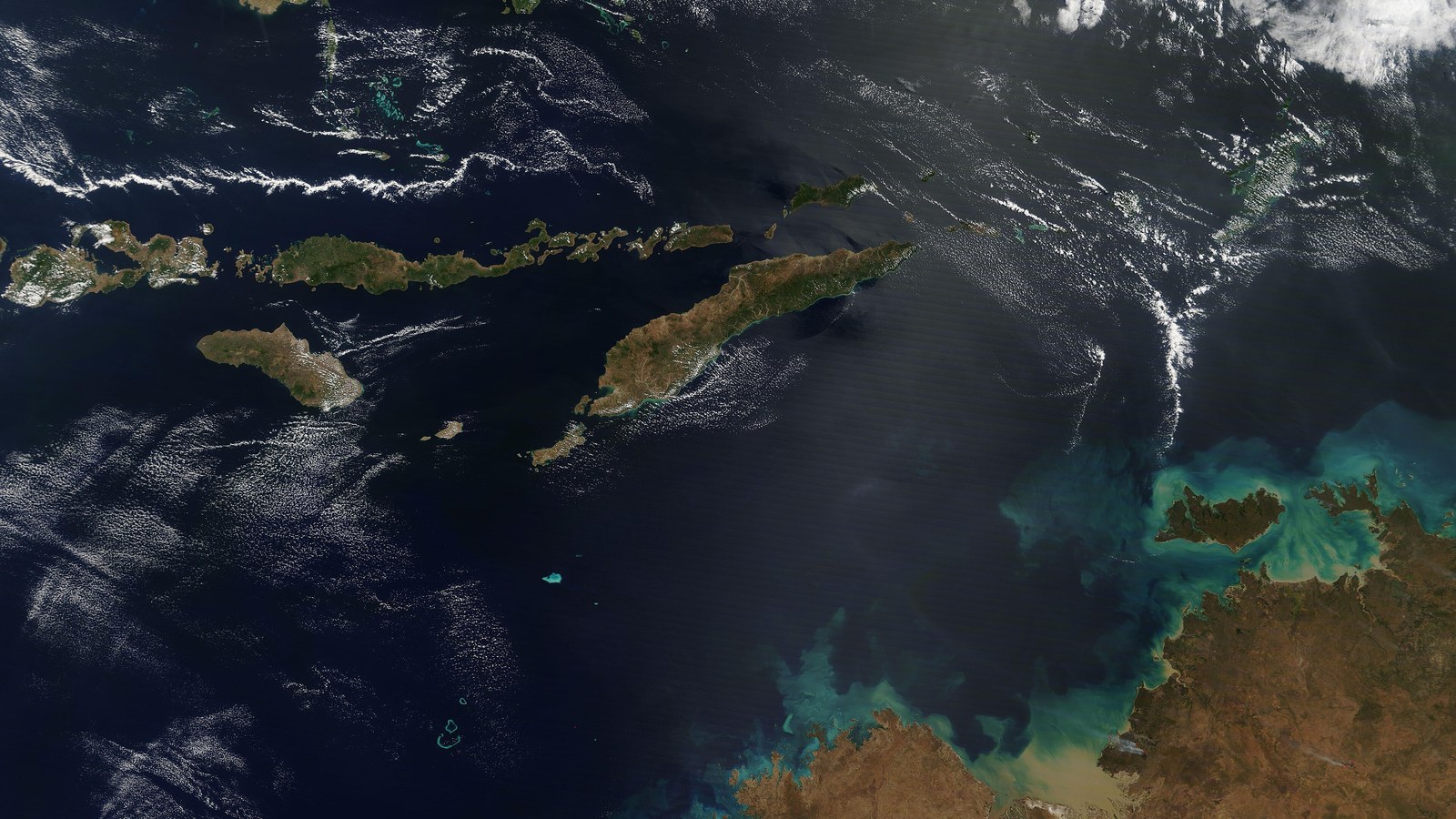
Image: Timor Sea; MODIS Land Rapid Response Team, NASA GSFC, 30 August 2019; public domain, Wikimedia Commons. Cropped to 16:9.
Source consulted: Treaty on Certain Maritime Arrangements in the Timor Sea. Treaty text: Treaty on Certain Maritime Arrangements in the Timor Sea, Sydney, 12 January 2006.











0 Comments
No comments on this article yet. Be the first!