


On 13 November 1979, in Geneva, the Convention on Long-range Transboundary Air Pollution was concluded, at the High-level Meeting within the framework of the United Nations Economic Commission for Europe on the Protection of the Environment. One original, in English, French and Russian, equally authentic, deposited with the Secretary-General of the United Nations. It is not the 1972 Stockholm Conference and not the 1985 Helsinki Protocol on sulphur emissions.
The preamble invokes the Helsinki Final Act and Principle 21 of the Stockholm Declaration: the sovereign right to exploit their own resources and the responsibility to ensure that activities within their jurisdiction do not cause damage to the environment of other States. Article 1: “air pollution” means the introduction by man, directly or indirectly, of substances or energy into the air resulting in deleterious effects on human health, living resources and ecosystems, material property and legitimate uses of the environment; “long-range transboundary air pollution” is air pollution whose physical origin is situated wholly or in part within the area under the national jurisdiction of one State and which has adverse effects in another State at such a distance that it is not generally possible to distinguish the contribution of individual emission sources.
Article 2: the Contracting Parties are determined to protect man and his environment against air pollution and shall endeavour to limit and, as far as possible, gradually reduce and prevent air pollution including long-range transboundary air pollution. Article 3: without undue delay, policies and strategies through exchanges of information, consultation, research and monitoring. Article 4: exchange of information on policies, scientific activities and technical measures. Article 5: consultations, upon request, at an early stage between Parties actually affected or exposed to a significant risk and Parties within whose jurisdiction a significant contribution originates or could originate.
Article 6: each Party undertakes to develop the best policies and strategies including air quality management systems and control measures compatible with balanced development, in particular by using the best available technology which is economically feasible and low- and non-waste technology, taking into account cost and effectiveness, in particular for new or rebuilt installations. Article 7: research on technologies for reducing sulphur compounds and other major air pollutants, instrumentation, transmission models, effects on health, agriculture, forestry, aquatic ecosystems and visibility, plus economic assessment and training. Article 8: exchange of emission data, starting with sulphur dioxide, from agreed grid-units or fluxes across national borders; major changes in industrial policy; control technologies; costs; meteorological data and effects.
Article 9: implementation of the existing Co-operative Programme for Monitoring and Evaluation of the Long-range Transmission of Air Pollutants in Europe (EMEP), as a first step based on sulphur dioxide; comparable procedures; monitoring stations remain under national jurisdiction. A footnote to the text: the Convention does not contain a rule on State liability as to damage. Article 10: the Executive Body, within the framework of the Senior Advisers to ECE Governments on Environmental Problems, meets at least annually; it uses the Steering Body for EMEP. Article 11: the Executive Secretary of the ECE carries out the secretariat functions. Article 12: amendments by consensus, in force on the ninetieth day after acceptance by two-thirds.
Article 14: open for signature at the United Nations Office at Geneva from the date of signature until 16 November 1979, by ECE member States, States having consultative status and competent regional economic integration organizations; in matters within their competence those organizations exercise the rights instead of their member States. Article 15: ratification, acceptance or approval; accession from 17 November; the depositary is the Secretary-General. Article 16: entry into force on the ninetieth day after the twenty-fourth instrument; the date retained is 16 March 1983. Article 17: withdrawal after five years, effective on the ninetieth day. Later protocols (EMEP financing 1984, Helsinki 1985, NOx 1988, VOCs 1991, Oslo 1994, heavy metals and POPs 1998, Gothenburg 1999) are separate instruments, not 1979 clauses.
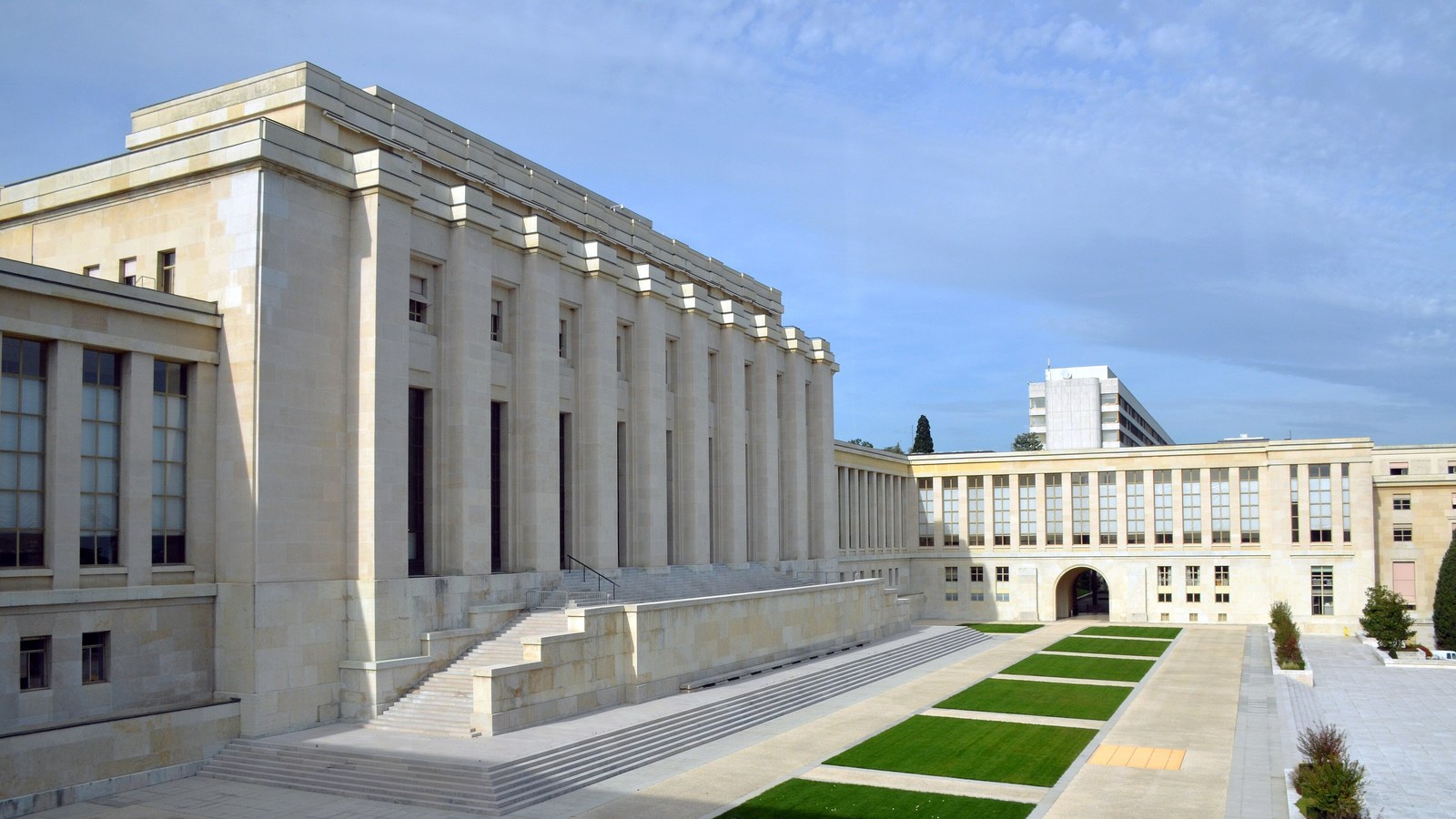
Image: Palace of Nations, Geneva, place of opening for signature; Vassil, 20 October 2014; CC0, Wikimedia Commons. Cropped to 16:9.
Source consulted: Convention on Long-Range Transboundary Air Pollution. Treaty text: Convention on Long-range Transboundary Air Pollution, Geneva, 13 November 1979 (UNTS 1302 I-21623).











0 Comments
No comments on this article yet. Be the first!