


The financial crisis of 1875 forced Khedive Ismail to sell Egypt’s shares in the Suez Canal Company to Great Britain. In 1879 the Great Powers replaced him with his son Tewfik. Ahmad Urabi’s nationalist revolt (1881) gave London a pretext to intervene: after the Anglo-Egyptian War of 1882, British troops physically controlled Egypt and the canal. France, whose capital still held a majority of the shares, pressed for internationalisation. The compromise was a treaty of neutralisation.
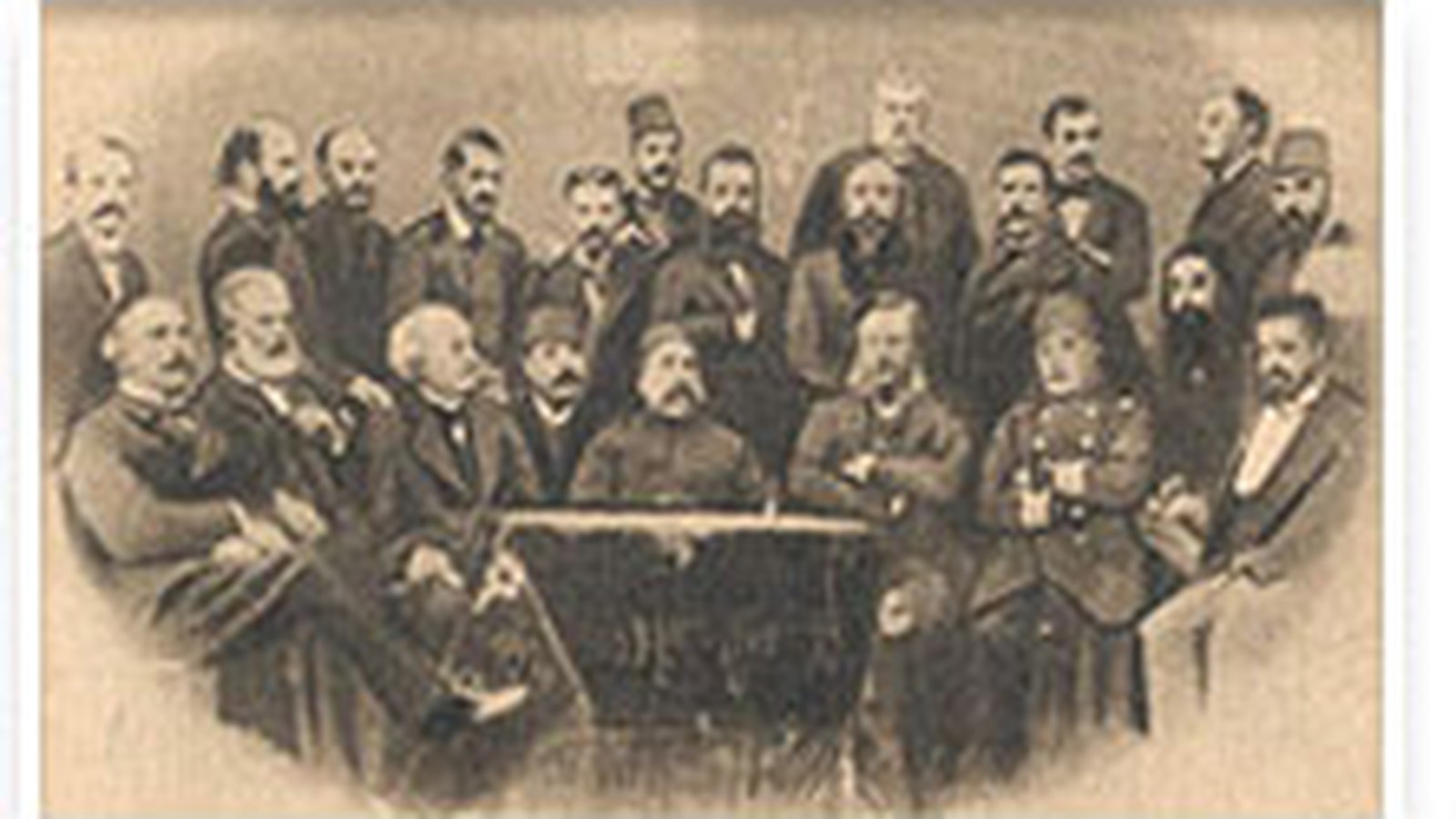
The Convention respecting the free navigation of the Suez Maritime Canal was signed on 29 October 1888 in Constantinople by Great Britain, the German Empire, Austria-Hungary, Spain, France, Italy, the Netherlands, the Russian Empire and the Ottoman Empire. The Khedivate of Egypt, through whose territory the canal ran and to which the shares were due to revert when the 99-year concession expired, was not invited to the talks and did not sign. The text had been drafted on 2 March. The Porte was depositary. The original language was French.
Article I declares the canal “always free and open, in time of war as in time of peace, to every vessel of commerce or of war, without distinction of flag” and forbids blockade. Article IV forbids any act of hostility in the canal and its ports of access, even if the Ottoman Empire is a belligerent: warships may re-victual only as strictly necessary, their stay at Port Said and in the Suez roadstead may not exceed 24 hours, and a day must elapse between the sailing of two belligerent ships. Article V forbids the landing of troops, with an exception of 1,000 men in case of accidental obstruction.
Article VII forbids warships in the waters of the canal, including Lake Timsah and the Bitter Lakes; at Port Said and Suez, no more than two vessels per Power, a right belligerents may not exercise. Article VIII charges the agents in Egypt of the signatory Powers with watching over execution, with an annual meeting under an Ottoman commissioner. Article X leaves the Sultan and the Khedive the right to take measures “for securing the defence of Egypt and the maintenance of public order” — a formula in tension with Article I. Article XIV states that the engagements are not limited by the duration of the Universal Company’s concession.
The British delegates lodged a general reservation: the provisions would not apply so far as they were incompatible with the “transitory and exceptional state” of the occupation. France noted that this left the convention a technically inoperative “academic declaration”. The reservation was lifted only by the Entente Cordiale; the convention came into force on 8 April 1904, and the supervisory commission of Article VIII was held in abeyance. In 1914, after the deposition of Abbas Hilmi II, London closed the canal to the Central Powers. In the Second World War Article X was used to shut out Axis shipping; after 1948 Cairo invoked it against Israeli vessels.
The British military presence lasted until 1956, when the Egyptian government nationalised the Company. Later wars with Israel blocked the canal for long periods: the closure of 5 June 1967 lasted until the reopening of 10 June 1975. Today the Suez Canal Authority owns and maintains the waterway; the Multinational Force and Observers oversees the terms of the peace. Under the navigation rules, Egypt cannot forbid a flag with which it is not at war.
Sources: Convention of Constantinople; Suez Canal Authority, Constantinople Convention.











0 Comments
No comments on this article yet. Be the first!