


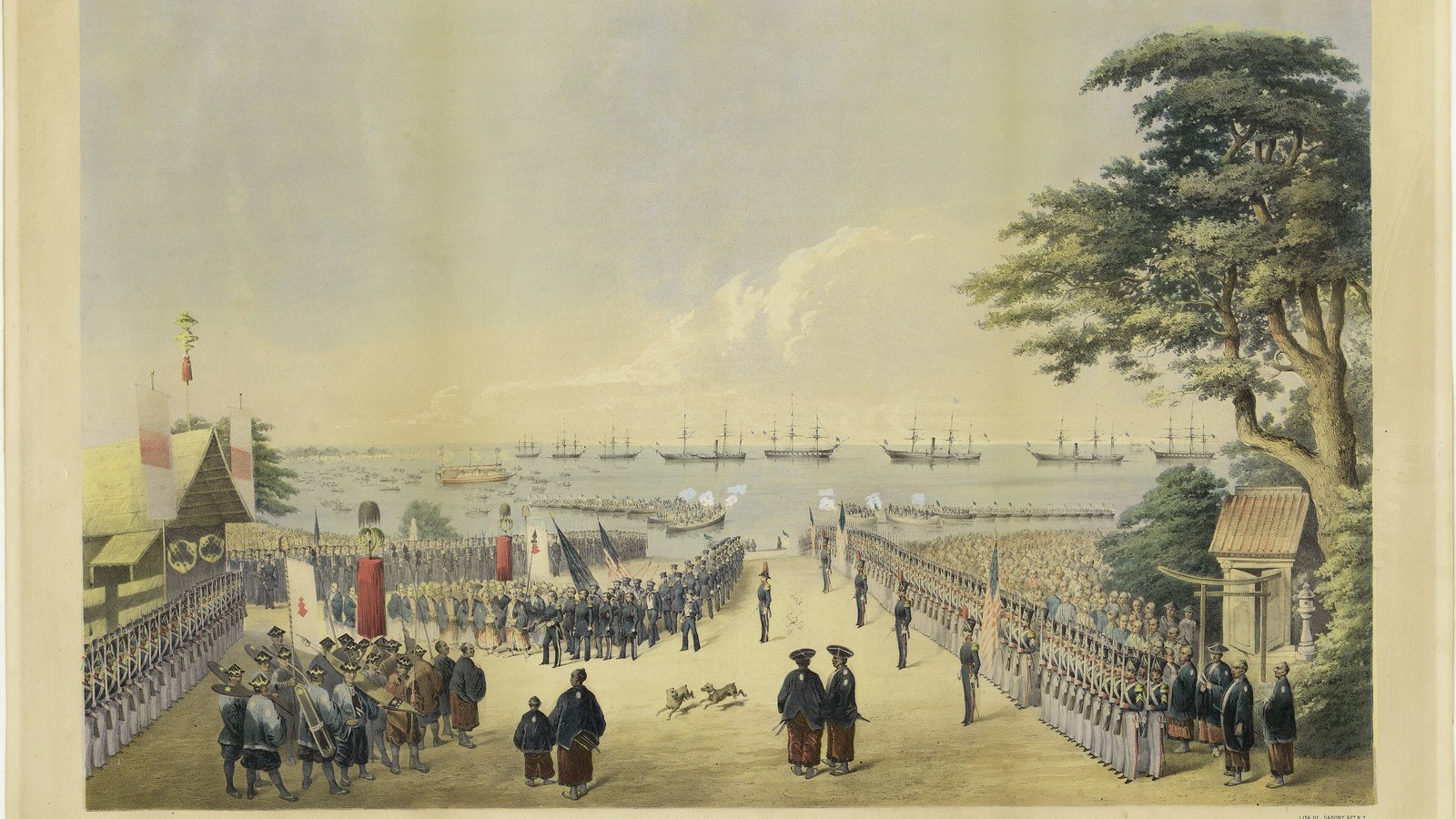
From the early seventeenth century the Tokugawa shogunate kept the country shut: trade only with the Dutch and the Chinese, and only at Nagasaki. In 1844 William II of the Netherlands wrote that they should open themselves, before others opened them. In 1846 Commodore James Biddle was sent away. On 8 July 1853 Matthew Calbraith Perry entered with four warships at Uraga, the mouth of Edo Bay; he refused Nagasaki, and landed on 14 July at Kurihama with President Millard Fillmore’s letter. Shogun Tokugawa Ieyoshi died a few days later; the sickly son Iesada left the Council of Elders, under Abe Masahiro. Abe polled the daimyo: of 61 replies, 19 yes, 19 no, the rest undecided.
Perry returned on 11 February 1854, with eight ships. Talks, from 8 March, lasted a month. The Americans showed machines; the Japanese, sumo. Perry rejected Nagasaki. The convention of peace and amity, in English, Dutch, Chinese and Japanese, was signed on 31 March 1854, at Kanagawa, now Port Opening Square in Yokohama, beside the Archives of History. For the United States: Perry. For the “august sovereign of Japan”: Hayashi Daigaku-no-kami; Ido, Prince of Tsushima; Izawa, Prince of Mimasaka; Udono, of the Board of Revenue. On the English copy the Japanese did not sign: their law forbade subjects to put their names to a paper in a foreign tongue.
Article I: perfect, permanent, universal peace, without distinction of persons or places. Article II: the port of Shimoda, in the principality of Izu, opens at once; Hakodate, in the principality of Matsumae, in the next Japanese year. Wood, water, provisions, coal, against a tariff paid in gold and silver. Article III: wrecked Americans are brought to Shimoda or Hakodate; expenses are not refunded, on either side. Article IV: they are not confined; they stand under just laws. Article V: at Shimoda they may move within seven ri of a small island in the harbour; at Hakodate, limits after the squadron’s visit. Not like the Dutch and Chinese at Nagasaki.
Article VI: other goods or business, by deliberation. Article VII: exchange of coin and goods, under temporary Japanese rules; what they will not exchange, the Americans carry away. Article VIII: wood, water, provisions and coal only through Japanese officers. Article IX: most-favoured-nation clause, without delay and without fresh consultation. Article X: no other port, except distress or weather. Article XI: an American consul at Shimoda, after eighteen months, if either government thinks it needful. Article XII: ratification by the President of the United States, with the Senate’s advice, and by the sovereign of Japan, exchange within eighteen months. The exchange, at Shimoda, on 21 February 1855.
It is not a commercial treaty. That, Harris, comes in 1858, with concessions, extraterritoriality and low duties. After Kanagawa: the British (October 1854), the Russians (Shimoda, 7 February 1855), the French (1858). Inside, the domains re-armed, the sonnō jōi movement, the shogun weakened, the Meiji Restoration. Emperor Kōmei endorsed the text reluctantly. The cover is Perry’s visit to Kanagawa, 1854, on Commons.
Sources: Convention of Kanagawa; Avalon Project, Treaty of Kanagawa; March 31, 1854.











0 Comments
No comments on this article yet. Be the first!