


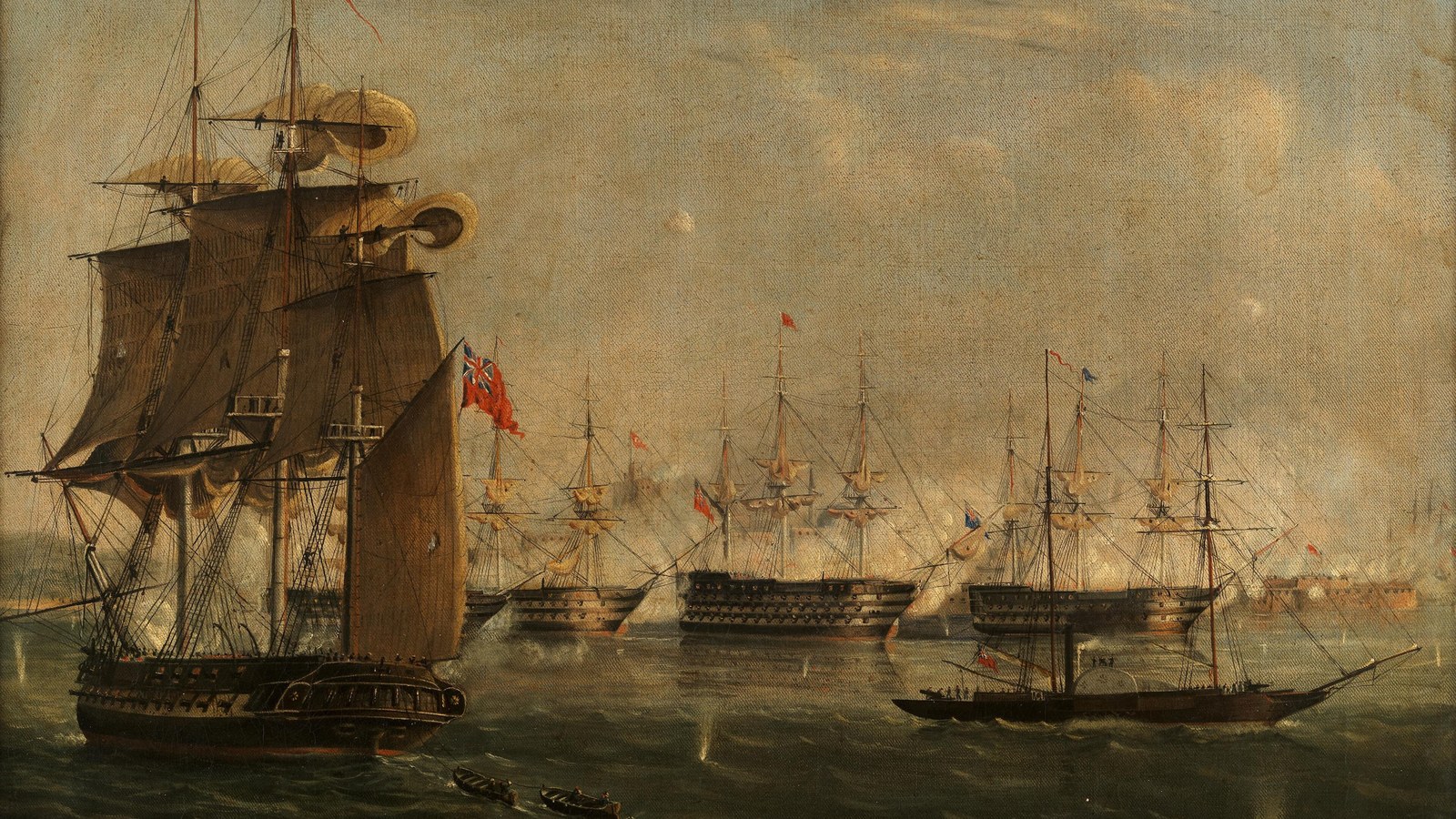
Sultan Abdülmecid I asked the Great Powers for support after the Ottoman defeat at Nezib (24 June 1839), the defection of the fleet to Alexandria and Ibrahim Pasha’s occupation of Syria. The Convention for the Pacification of the Levant was signed in London on 15 July 1840 between the United Kingdom of Great Britain and Ireland, the Austrian Empire, Prussia and Russia, on the one hand, and the Sublime Porte on the other. Plenipotentiaries, after exchange of full powers: Viscount Palmerston; Baron Philipp von Neumann; Heinrich von Bülow; Philipp von Brunnow; Chekib Effendi. France is not a party. The official English rendering is in FRUS 1879, document 518.
The preamble cites the collective note of the four courts’ representatives at Constantinople of 27 July 1839, the integrity of the Ottoman Empire, the independence of the Sultan’s throne and an end to the bloodshed in Syria. Article 1: the Sultan has agreed with the four Majesties on the conditions he intends to grant to Muhammad Ali, Pasha of Egypt, set out in the annexed separate act; the four courts engage to act in concert to induce him to comply, each with the means at its disposal.
Article 2: if the Pasha refuses the arrangement, communicated by the Sultan with the co-operation of the allies, they shall, on the Sultan’s requisition, take concerted measures. Great Britain and Austria, invited to interrupt sea communication between Egypt and Syria and to stop the sending of troops, horses, arms, ammunition and provisions of war, shall at once give the necessary orders to the commanders of their naval forces in the Mediterranean. The squadron commanders shall, in the name of the alliance, give such support as they can to those of the Sultan’s subjects who remain faithful.
Article 3: if Muhammad Ali, after refusal, directs his land and sea forces towards Constantinople, the parties, on the Sultan’s requisition to their representatives, have agreed, should the case require, to accept the invitation and provide for the defence of the throne by a concerted operation, placing the Bosphorus, the Dardanelles and the capital under protection against any aggression. The forces remain so long as the Sultan requires them; they withdraw simultaneously to the Black Sea and the Mediterranean. Article 4: that co-operation is an exceptional measure, at the Sultan’s express request, solely for his defence. It does not derogate from the ancient Ottoman rule that foreign ships of war shall not enter the Straits while the Porte is at peace. The Sultan maintains the rule; the four Majesties respect it. Article 5: ratification; instruments exchanged in London within two months, or sooner.
The separate act, of the same force as the convention, is the Sultan’s offer. I: administration of the Pashalic of Egypt for Muhammad Ali and his descendants in the direct line; for his life, with the title of Pasha of Acre and the command of the fortress of St John of Acre, the southern part of Syria, from Ras-el-Nakurah on the Mediterranean to the mouth of the Seisaban rivulet, the western shore of Lake Tiberias, the right bank of the Jordan, the western shore of the Dead Sea, then in a straight line to the Red Sea, the northern extremity of the Gulf of Akabah, its west coast and the east coast of the Gulf of Suez to Suez. Condition: acceptance within ten days of communication at Alexandria, and immediate orders to withdraw from Arabia and the holy cities, from Candia (Crete), from the district of Adana and from all other Ottoman territory not within Egypt and the Pashalic of Acre as defined.
II: if he does not accept within ten days, the Sultan withdraws the life offer of Acre; hereditary Egypt remains, to be accepted within the next ten days, that is twenty from the communication, with orders to withdraw within the limits and ports of the Pashalic of Egypt. III: the annual tribute is proportionate to the territory obtained. IV: in either alternative, before the term expires, he shall deliver the Turkish fleet, with crews and armaments, to the Turkish person authorised to receive it; the commanders of the allied squadrons shall be present. Maintenance of the fleet in Egypt shall not be deducted from the tribute. V: all treaties and laws of the Ottoman Empire apply to Egypt and Acre as to every other part of the Empire; revenues are collected in the Sultan’s name, as his delegates. VI: the land and sea forces of the Pasha form part of the forces of the Ottoman Empire. VII: ratification together with the convention.
The communication was made at Alexandria on 19 August 1840. Muhammad Ali rejected the terms on 28 August; after the second delay the consuls drew up a procès-verbal of refusal. On 11 September the Porte declared him forfeit. British and Austrian squadrons bombarded Beirut and Acre. The Napier–Boghos Yusuf Bey convention, signed at Alexandria on 27 November 1840, is not the London convention: Napier acted without instructions; Admiral Stopford disapproved it on 2 December. The powers nonetheless supported hereditary restoration in Egypt. The Sultan’s firman of February 1841 granted hereditary Egypt, without Syria; Nubia, Darfur, Kordofan and Sennar without hereditary tenure. This is not the Straits Convention of 13 July 1841, which includes France. The cover is the allied bombardment of Acre, 3 November 1840.
Sources: Convention of London (1840); Convention of 15 July 1840, FRUS 1879, No. 518.











0 Comments
No comments on this article yet. Be the first!