


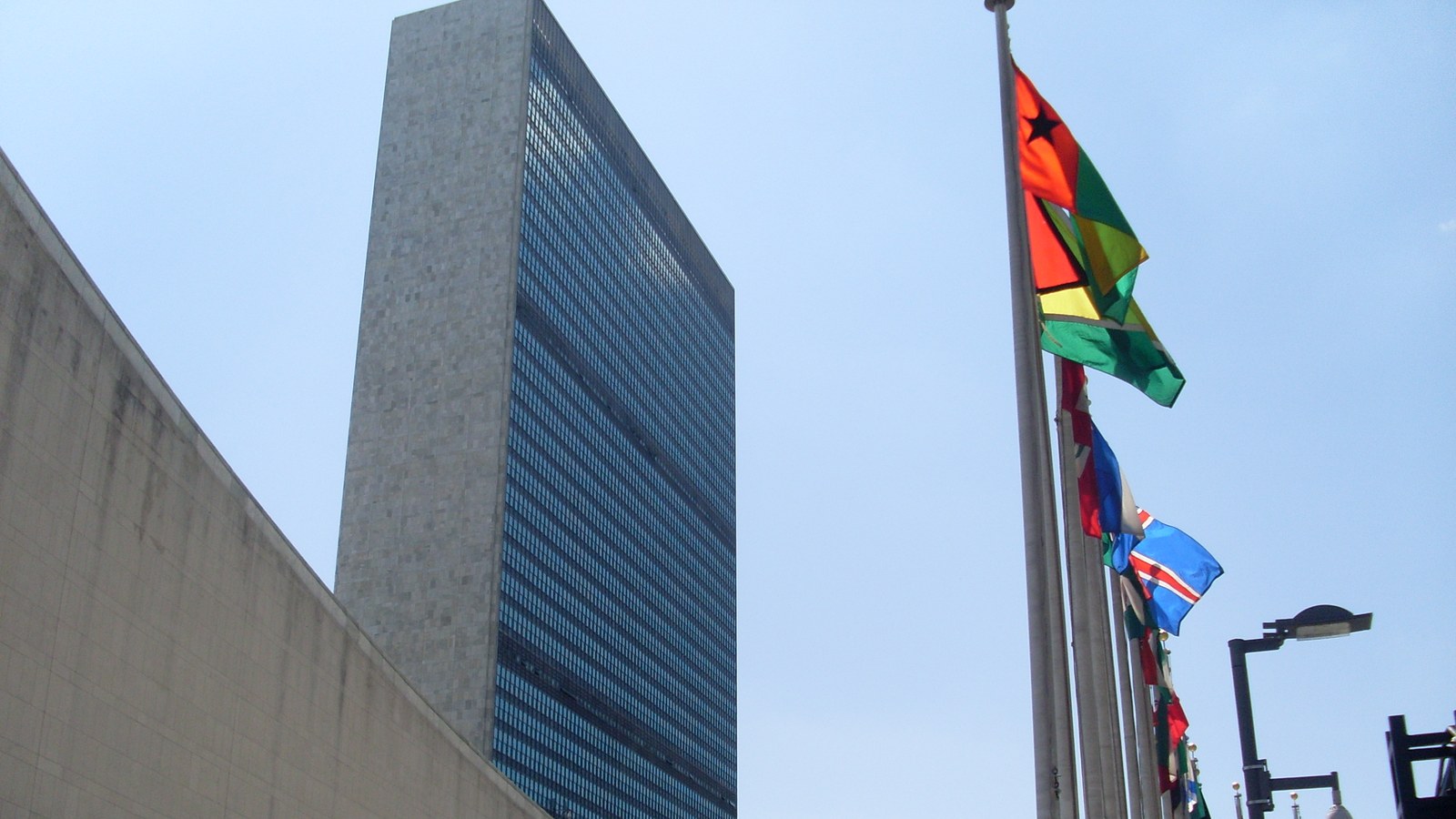
On 15 December 1994, at United Nations Headquarters in New York, the Convention on the Safety of United Nations and Associated Personnel is opened for signature. The General Assembly had adopted it on 9 December 1994, by resolution 49/59. Signature remains open until 31 December 1995. The authentic texts are Arabic, Chinese, English, French, Russian and Spanish. The depositary is the Secretary-General. The first signatories on the opening day are Argentina, Canada, Denmark, Finland, New Zealand, Norway, Panama, Portugal, Sweden and Ukraine. It is not the Optional Protocol of 8 December 2005, which later widens the notion of a United Nations operation.
Article 1 defines United Nations personnel as persons engaged or deployed by the Secretary-General as members of the military, police or civilian components of a United Nations operation, and other officials and experts on mission of the United Nations, its specialized agencies or the International Atomic Energy Agency who are present in an official capacity in the area where an operation is being conducted. Associated personnel includes persons assigned by a Government or an intergovernmental organization with the agreement of the competent organ, persons engaged by the Secretary-General, a specialized agency or the IAEA, and persons deployed by a humanitarian non-governmental organization under an agreement, to carry out activities in support of the mandate. A United Nations operation is one established by the competent organ, conducted under United Nations authority and control, either for the purpose of maintaining or restoring international peace and security, or where the Security Council or the General Assembly has declared, for the purposes of this Convention, that there exists an exceptional risk to the personnel.
Article 2 applies the Convention to such personnel and operations. It does not apply to a United Nations operation authorized by the Security Council as an enforcement action under Chapter VII of the Charter in which any of the personnel are engaged as combatants against organized armed forces and to which the law of international armed conflict applies. Article 3 requires distinctive identification for the military and police components, their vehicles, vessels and aircraft, and appropriate identification documents. Article 6 requires respect for the laws and regulations of the host State and the transit State and refraining from any action incompatible with the impartial and international nature of their duties.
Article 7 provides that United Nations and associated personnel, their equipment and premises shall not be made the object of attack or of any action that prevents them from discharging their mandate. States Parties shall take all appropriate measures to ensure their safety and security, in particular on their territory, against the crimes set out in article 9. Article 8 requires that captured or detained personnel whose identification has been established shall not be subjected to interrogation and shall be promptly released and returned to the United Nations or other appropriate authorities; pending release they shall be treated in accordance with universally recognized standards of human rights and the principles and spirit of the Geneva Conventions of 1949.
Article 9 requires each State Party to make a crime under its national law the intentional commission of a murder, kidnapping or other attack upon the person or liberty of any such personnel; a violent attack upon official premises, private accommodation or means of transportation likely to endanger person or liberty; a threat to commit such an attack in order to compel a physical or juridical person to do or refrain from doing any act; an attempt; and participation as an accomplice, or organizing or ordering others to commit such an attack. Penalties shall take into account the grave nature of the crimes. Article 10 requires jurisdiction, among other cases, when the crime is committed in the territory or on board a ship or aircraft registered in the State, when the alleged offender is a national, and, mandatorily, when that person is present and is not extradited. Article 14 requires that, if the person is not extradited, the case be submitted without exception whatsoever and without undue delay to the competent authorities for prosecution.
Article 21 provides that nothing in the Convention shall be construed so as to derogate from the right to act in self-defence. Article 27 provides that the Convention shall enter into force thirty days after twenty-two instruments of ratification, acceptance, approval or accession have been deposited. Those conditions were later met; the Convention entered into force on 15 January 1999. Article 28 provides for denunciation by written notification; denunciation takes effect one year after receipt by the Secretary-General.
It is not the Charter of the United Nations, and not the Convention on the Privileges and Immunities of the United Nations of 13 February 1946. It is not the Optional Protocol of 8 December 2005, which extends a United Nations operation to delivering humanitarian, political or development assistance in peacebuilding and delivering emergency humanitarian assistance.
Image: United Nations Headquarters, New York; Dendodge, 14 May 2009; public domain, Wikimedia Commons. Cropped to 16:9.
Source consulted: Convention on the Safety of United Nations and Associated Personnel. Treaty text: Convention on the Safety of United Nations and Associated Personnel, New York, 15 December 1994.











0 Comments
No comments on this article yet. Be the first!