


The Croatian offensive Storm in August 1995, the Bosnian army’s offensive and NATO’s Operation Deliberate Force reopened the file. The Contact Group pressed the three sides to the table. Between 10 and 14 August Anthony Lake carried a skeleton of principles to London, Bonn, Paris and Sochi. Richard Holbrooke took over the shuttle; in Geneva and New York, on 8 and 26 September, the basic principles were adopted. The conference at Wright-Patterson, near Dayton, Ohio, ran from 1 to 21 November. Slobodan Milošević came, authorised also for the Bosnian Serbs after the 29 August arrangement, Franjo Tuđman and Alija Izetbegović, with minister Muhamed Šaćirbeg. Warren Christopher chaired; co-chairmen were Carl Bildt and Igor Ivanov.
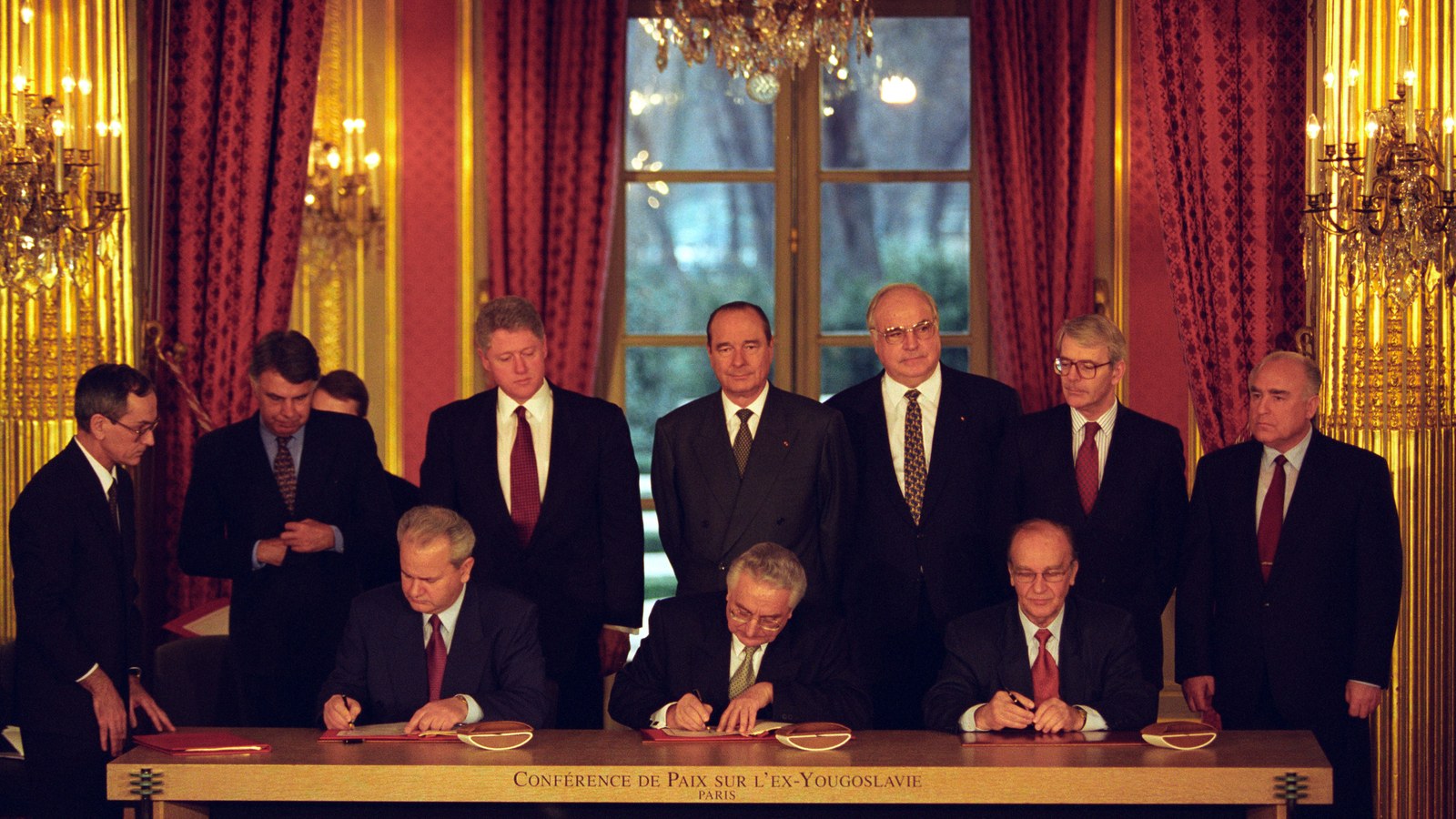
The General Framework Agreement for Peace in Bosnia and Herzegovina was initialled there on 21 November and signed ceremonially on 14 December 1995, in Paris. The Parties are the Republic of Bosnia and Herzegovina, the Republic of Croatia and the Federal Republic of Yugoslavia. Izetbegović, Tuđman and Milošević signed; Felipe González, Jacques Chirac, Helmut Kohl, Viktor Chernomyrdin, John Major and Bill Clinton witnessed. The Bosnian, Croatian, English and Serbian texts are equally authentic. Article 11 says the agreement enters into force upon signature. Article 10 recognises Bosnia and Yugoslavia as sovereign states within their international borders.
Article 1 refers to the UN Charter, the Helsinki Final Act and OSCE documents: sovereign equality, peaceful settlement of disputes, no action against the territorial integrity of Bosnia. Article 2 endorses Annex 1-A, the military aspects, and Annex 1-B, regional stabilisation. Article 3 confirms the Inter-Entity Boundary Line in Annex 2. Article 4 assigns elections to the OSCE, Annex 3. Article 5 makes Annex 4 the Constitution. Articles 6–8 cover arbitration, human rights, refugees, monuments, public corporations, civilian implementation (Annex 10, the High Representative) and the international police task force (Annex 11). Article 9 requires cooperation with war-crimes investigations.
The state remains one, not a confederation: two entities, the Federation of Bosnia and Herzegovina and Republika Srpska, with a rotating presidency, a central bank and a Constitutional Court. Before the peace, Bosnian Serbs held about 46% of the territory, Bosniaks 28%, Bosnian Croats 25%; afterwards Republika Srpska reaches 49% (48% excluding Brčko District). IFOR, led by NATO, took over from UNPROFOR on 20 December. OHR took civilian implementation; the OSCE, the 1996 elections. The Washington Agreement of the previous year remains the Federation’s internal frame.
The White House Photograph Office picture shows the table in Paris. The 1995 Bosnian copy vanished from the presidency archive; France sent a certified copy in 2009, and the stolen original was found in 2017, in Pale.
The agreement stopped the three-and-a-half-year war. It left a constitution-annex which the Constitutional Court, in 1997, refused to judge separately from the rest of the instrument: Annex 4 is the Constitution, not a text to be set against it.
Sources: Dayton Agreement; Office of the High Representative, The General Framework Agreement for Peace in Bosnia and Herzegovina.











0 Comments
No comments on this article yet. Be the first!