


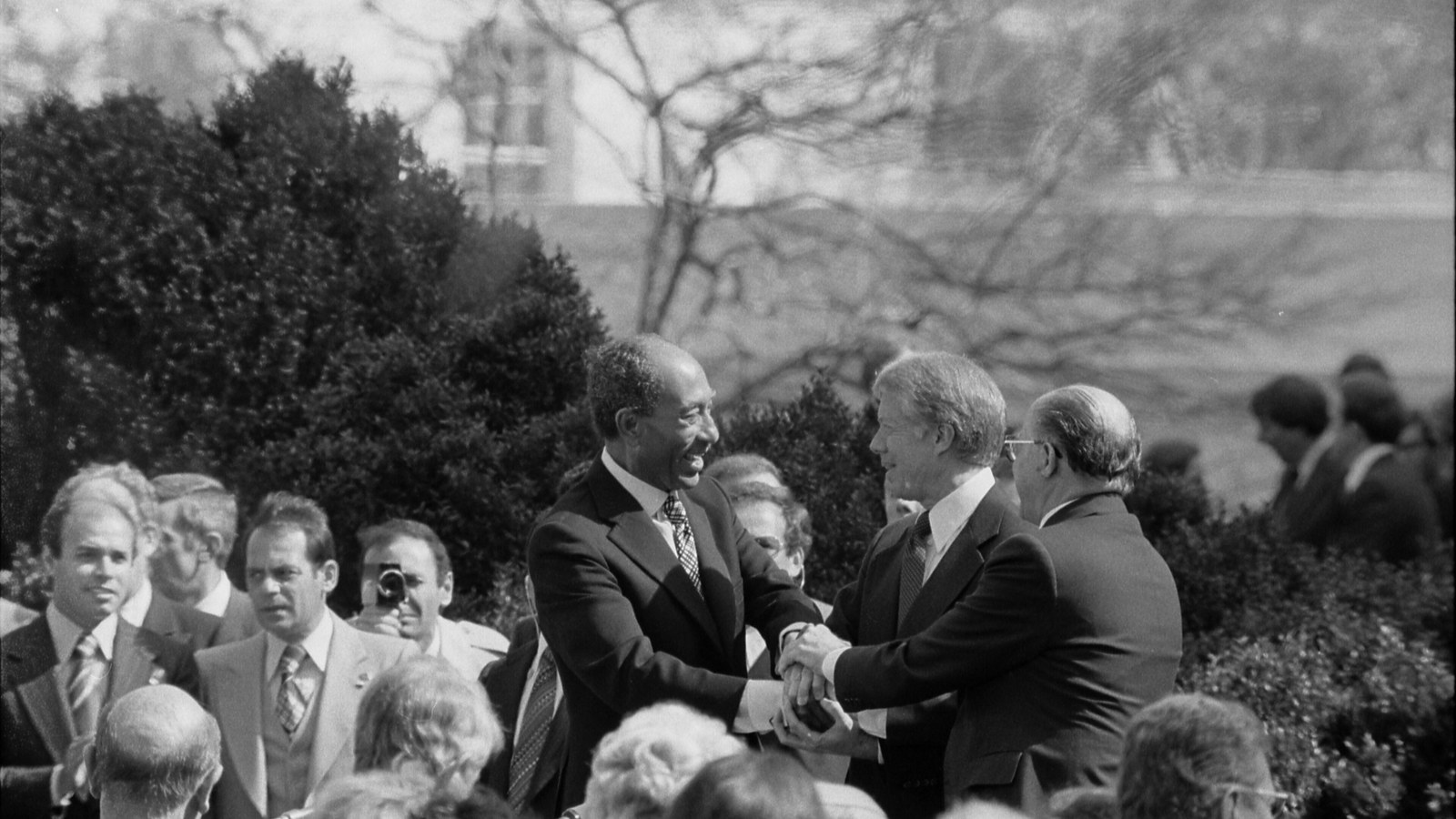
Eleven years after the Six-Day War and sixteen months after Anwar Sadat’s visit to Jerusalem, peace was signed on the North Lawn of the White House. The treaty between the Arab Republic of Egypt and the State of Israel, in Arabic, Hebrew and English, was signed on 26 March 1979, in Washington. Signatories: Sadat, president of Egypt, and Menachem Begin, prime minister of Israel. Witness: Jimmy Carter. The preamble takes up Security Council resolutions 242 and 338 and the Camp David Framework of 17 September 1978. The exchange of ratifications, at Om-Khosheib, in Egypt, on 25 April: that is when the state of war ended.
Article I: Israel withdraws its armed forces and civilians from Sinai, behind the international boundary between Egypt and mandated Palestine; Egypt resumes full sovereignty. Interim withdrawal, within nine months, behind the line from El-Arish to Ras Mohammed; final withdrawal, within three years. After the interim phase, normal relations, under Article III. Article II: the permanent boundary is the recognised line between Egypt and the former mandated territory of Palestine, on the map at Annex II, without prejudice to the status of the Gaza Strip. The boundary is inviolable; territorial waters and airspace likewise.
Article III: the UN Charter, sovereignty, integrity, political independence; no force, no hostility originating from one’s own soil. Full recognition, diplomatic, economic and cultural relations, an end to boycotts, free movement. Article IV: limited-force zones, UN personnel, a joint commission. UN personnel are not withdrawn unless the five permanent members of the Council vote yes, if the parties do not otherwise agree. Article V: Israeli ships and cargoes destined for or coming from Israel have free passage through the Suez Canal, on the basis of the Constantinople Convention of 1888; the Strait of Tiran and the Gulf of Aqaba are international waterways, non-suspendable, for navigation and overflight.
Article VI: the treaty does not affect the UN Charter; the parties fulfil it without waiting on others; they take on no conflicting obligations. Subject to Article 103 of the Charter, in a conflict of obligations this treaty binds. The agreed minutes say there is no assertion of superiority over other treaties. Article VII: negotiations, then conciliation or arbitration. Article VIII: a claims commission. Article IX: the treaty supersedes the September 1975 agreement; protocols, annexes and maps form part of it; depositary, the UN Secretary-General.
Annex I cuts Sinai into zones: A, one Egyptian mechanised division, up to 22,000 men, 230 tanks; B, four border battalions, 4,000; C, only the UN and Egyptian civil police, at the boundary and at Sharm el-Sheikh; D, on the Israeli side, four infantry battalions, 4,000, without tanks or artillery. When the UN could not send a force, because of a Soviet veto threat, the parties signed on 3 August 1981 the Protocol of the Multinational Force and Observers. Ambassadors were exchanged in February 1980; regular flights, in March; Egypt began to sell crude oil.
Egypt was the first Arab state to recognise Israel. The Arab League suspended it from 1979 to 1989. Sadat was killed on 6 October 1981. The 1978 Nobel Peace Prize, shared by Sadat and Begin, belonged to Camp David, not to the lawn signing. The cover is the Sadat–Carter–Begin handshake, photographed by US News & World Report at the White House.
Sources: Egypt–Israel peace treaty; Avalon Project, Peace Treaty Between Israel and Egypt March 26, 1979.











0 Comments
No comments on this article yet. Be the first!