


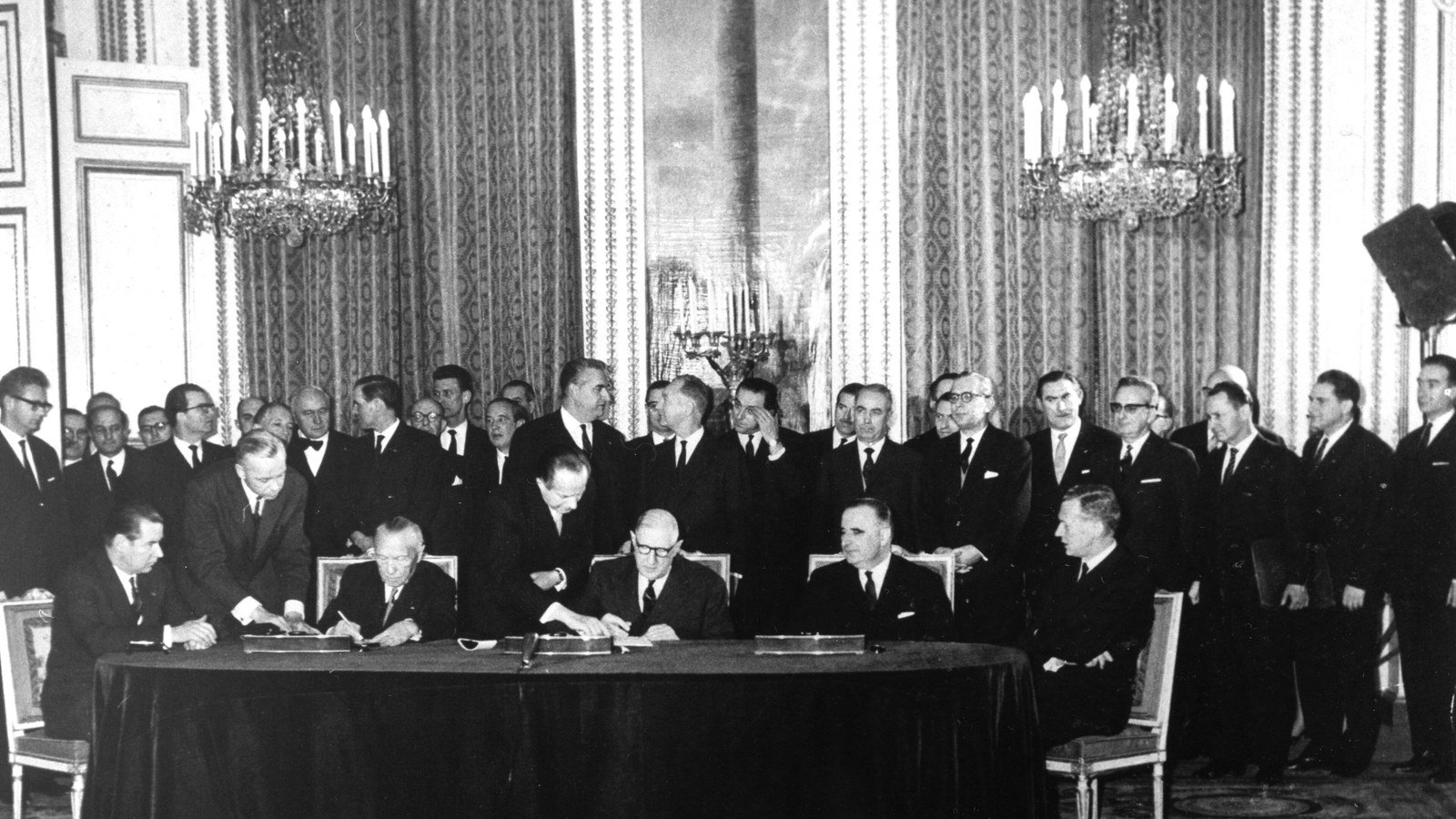
After 1945 France occupied a zone in defeated Germany. Konrad Adenauer made rapprochement with Paris a priority of the Federal Republic. His first meeting with Charles de Gaulle was at Colombey-les-Deux-Églises, in September 1958. The European Economic Community already existed, from 1957; on 14 January de Gaulle had rejected the British application. The conference at the Élysée Palace ran on 21 and 22 January, with Pompidou, Couve de Murville, and the ministers of defence, education, family and youth.
The Treaty between the French Republic and the Federal Republic of Germany on French-German Cooperation was signed on 22 January 1963, in the Salon Murat. Signatures: de Gaulle, Pompidou, Couve de Murville, Adenauer and Gerhard Schröder, the federal foreign minister. The joint declaration says that reconciliation closes a centuries-old rivalry and that youth has a decisive part on the road to a united Europe. The French and German texts are equally authentic.
Heads of state and government were to meet, in principle, at least twice a year. Foreign ministers every three months, and senior officials monthly, alternately in Paris and Bonn. Defence and education ministers likewise every three months; chiefs of staff every two months. Each capital set up an interministerial commission, chaired by a diplomat. Consultation was to come before any foreign-policy decision: the European Communities, East-West affairs, NATO, the Council of Europe, WEU, OECD, the United Nations. Aid to emergent countries and Common Market farm, energy and transport policy were to be compared systematically.
On defence: harmonising doctrines, operational-research institutes, personnel exchanges, joint armaments programmes. On education: the other language, diploma equivalence, concerted research. For youth, a body with an autonomous board and a joint fund — from which the Franco-German Youth Office later came. The treaty also applied to Land Berlin, except the defence clauses. Member states of the Communities were to be kept informed.
The Bundestag ratified, by the law of 15 June, with a preamble tying application to NATO under American leadership, partnership with the United States, British accession to the Communities, GATT and German reunification. Kennedy had complained to the ambassador in Washington. De Gaulle told Alain Peyrefitte that the Germans were “putting themselves completely at the Americans’ service” and betraying the spirit of the treaty; in 1965, that they had been “my greatest hope” and had become “my greatest disappointment”.
The Bundesarchiv photograph, CC BY-SA 3.0 DE, shows de Gaulle and Adenauer at the table on the day of signature. In 1987 the Franco-German military brigade appeared. In January 2003 the Assemblée Nationale and the Bundestag met at Versailles. The Treaty of Aachen, signed also on 22 January, in 2019, updated the frame.
The act closed post-war hostility with a timetable of meetings, not with an alliance in place of NATO. The Bonn preamble kept the Federal Republic on the Atlantic line that de Gaulle wanted to weaken.
Sources: Élysée Treaty; German History in Documents and Images, Franco-German Friendship (1963).











0 Comments
No comments on this article yet. Be the first!