
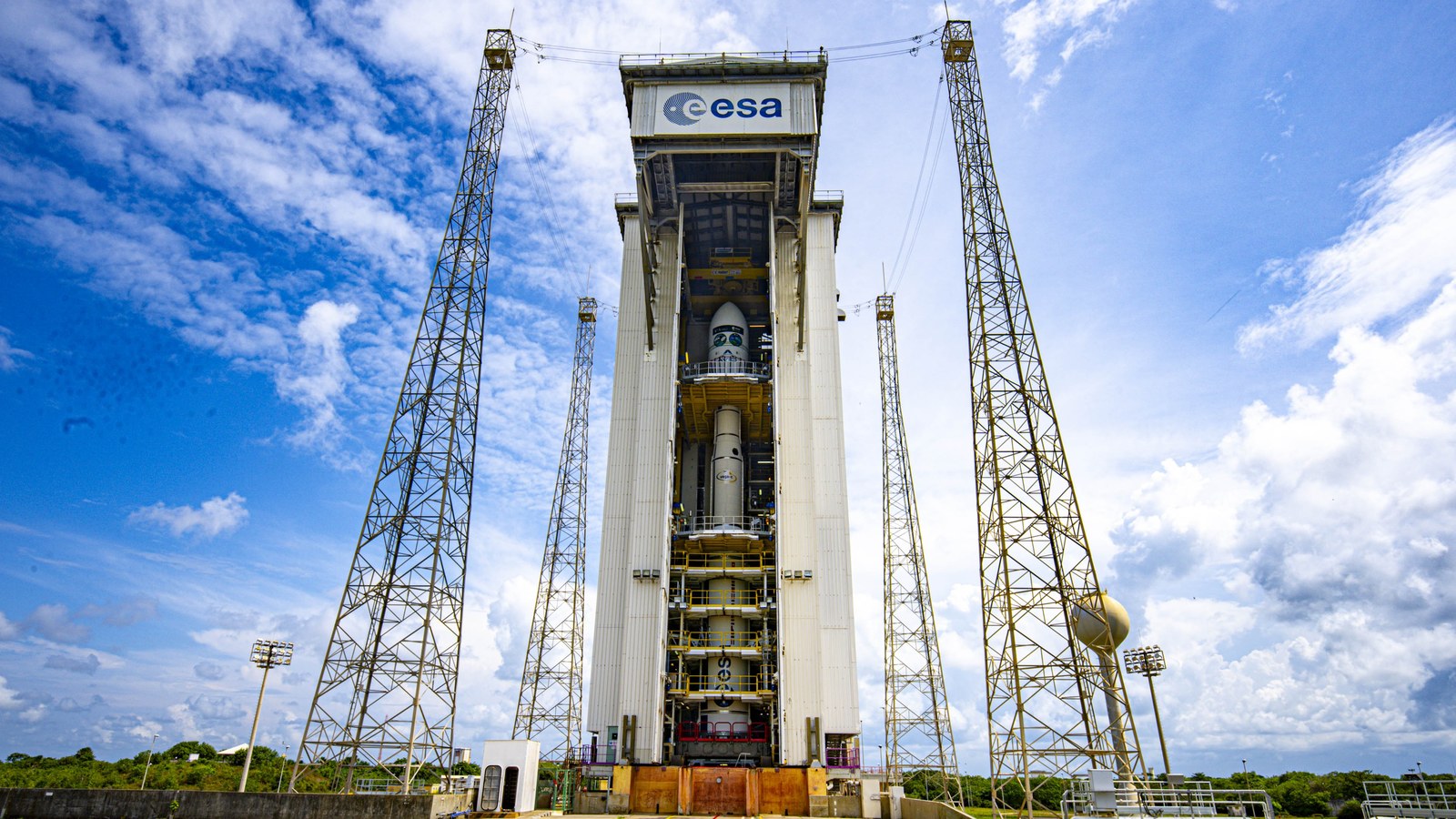
The European Space Agency is preparing to launch the FLEX and Copernicus Sentinel-3C satellites together on 15 September 2026 from Europe’s Spaceport in French Guiana. Vega-C flight VV30 is scheduled to lift off at 03:21 CEST (22:21 local time on 14 September). ESA coverage is due to start at 02:50 CEST. At the time of publication the launch had not taken place; the times below are those ESA listed on 9 September.
FLEX — the Fluorescence Explorer — is ESA’s next Earth Explorer mission. It is designed to measure an extremely faint signal invisible to the human eye: the fluorescence plants emit during photosynthesis. When vegetation absorbs sunlight, a small fraction of that energy is re-emitted as fluorescence, which varies with plant health, environmental stress, water availability and photosynthetic activity. The main instrument is FLORIS (Fluorescence Imaging Spectrometer), an imaging spectrometer built by Leonardo to detect that weak signal from orbit. ESA says FLEX will produce global vegetation fluorescence maps at 300 × 300 metres — a landscape scale, not individual plants — for studying ecosystem productivity, carbon and water cycles, and vegetation stress.
The second satellite is Copernicus Sentinel-3C, the third in the Sentinel-3 series. Like its two predecessors already in orbit, it carries instruments that systematically measure Earth’s oceans, land, ice and atmosphere. Sentinel-3 data support Copernicus services and provide near-real-time information for ocean and weather forecasting. FLEX is not a weather satellite: its primary purpose is the study of photosynthesis and vegetation status. Sentinel-3C has a much broader Earth-observation role.
FLEX is intended to operate in tandem with a Copernicus Sentinel-3 satellite, which can supply information on clouds, aerosols, water vapour, surface temperature, land cover and additional vegetation parameters. ESA notes that FLEX will not initially fly in tandem with Sentinel-3C. Combining FLEX fluorescence measurements with Sentinel-3 observations may give a fuller view of global vegetation function, without the two satellites launched on this flight forming a permanent orbital pair from the outset.
Both satellites ride the same Vega-C. Sentinel-3C sits above; FLEX is encapsulated in the lower part of the Vespa secondary payload adapter so that Sentinel-3C can separate first. ESA’s planned timeline is Sentinel-3C separation at 04:21 CEST and FLEX separation at 05:17 CEST, with broadcast breaks between 03:51–04:12 and 04:32–05:07. Those remain a flight schedule, not confirmed events.
Vega-C is an evolution of Europe’s Vega family. In ESA’s VV30 launch note it can place about 2,300 kg into space, weighs around 210 tonnes on the pad and uses three solid-propellant stages followed by a liquid-propellant fourth stage for precise injection. ESA leads the programme; Avio is prime contractor and design authority and, for this flight, the launch service operator.
Satellite observations complement ground measurements across areas no single field site can cover. If the launch proceeds as planned, FLEX will add a new European observation — direct measurement of vegetation fluorescence — and Sentinel-3C will extend Copernicus monitoring of oceans, land, ice and atmosphere. Any delay or flight result should be read from ESA’s channels, not assumed here.
Photo: ESA–M. Pédoussaut. Vega-C fairing with FLEX and Sentinel-3C rolled out to the launch pad at Europe’s Spaceport in French Guiana, September 2026. ESA Standard Licence for editorial use, with credit. The image was cropped to 16:9.
Sources consulted: Watch: FLEX and Sentinel-3C launch on Vega-C; FLEX | ESA; The instrument | FLEX / FLORIS; Copernicus Sentinel-3; FLEX and Sentinel-3C ready for launch.






0 Comments
No comments on this article yet. Be the first!