


On Tuesday, 20 October 2026, at Boeing’s Everett, Washington plant, U.S. Transportation Secretary Sean Duffy handed certification documents for the 737-10 to Jim Williams, chief engineer of the 737 Development Program, and Chris Payne, vice president and program manager. The Federal Aviation Administration approved the amended type certificate for the largest member of the 737 MAX family. That is a type certificate, not a fleet already carrying passengers.
Duffy said the approval followed “extensive safety reviews,” including thousands of hours of test flights, and called it a major win for American manufacturing. “To think that it took us almost 10 years to get here. We all probably had a little less gray hair 10 years ago,” he said in Everett. In Boeing’s account he added that the FAA team was ready to approve the aircraft for sale.
The papers handed over were the amended type certificate and Production Certificate 700. Boeing writes that the 737-10 is “certified and cleared for commercial service.” NPR notes that each aircraft must still be cleared before it can fly passengers, and that Boeing must continue to show it can build consistently to the approved design. The two phrasings are not the same: the path is open; passengers are not yet flying the type.
Stephanie Pope, president and CEO of Boeing Commercial Airplanes, said the certification “clears the path to deliver an airplane that will set a new standard in commercial aviation.” She credited the 737 MAX development team, which obtained 737-7 certification in August and completed flight tests, safety assessments and design reviews for the 737-10. The company, NPR reported, expects to begin deliveries in 2027. Boeing’s own feature speaks of deliveries as a consequence of certification, without a calendar date. That is not the same as a first delivery already made.
In a typical layout the 737-10 seats 185–210 passengers, with a range of up to 3,100 nautical miles, Boeing says. The 737-9 typically seats 175–195, the 737-8 160–180. Those are typical ranges, not a single maximum configuration. More than 30 customers have ordered 1,555 of the 737-10s, more than 30 percent of the 737 MAX order book; none have been delivered yet. Major customers include United, Delta, American and Ryanair. Alaska Airlines ordered 105 in January, with options for 35 more.
The flight-test programme logged nearly 1,000 flights, more than 2,000 flight hours and 1,000 ground-test hours. It included the enhanced Angle of Attack (eAoA) system, which Boeing says “will become standard” across the 737 MAX family: that is a plan for the other variants, not confirmation that it is already fitted on the existing fleet. Boeing says the 737 MAX is the first aeroplane certified in full compliance with the 2020 Aircraft Certification, Safety, and Accountability Act.
Mike Sinnett, senior vice president of product strategy, said the certification “not only clears a new airplane for deliveries” but offers a roadmap for later work, including the 777-9. The 737 MAX family now has four certified variants. Tuesday’s certificate does not mean passengers are already flying on the 737-10.
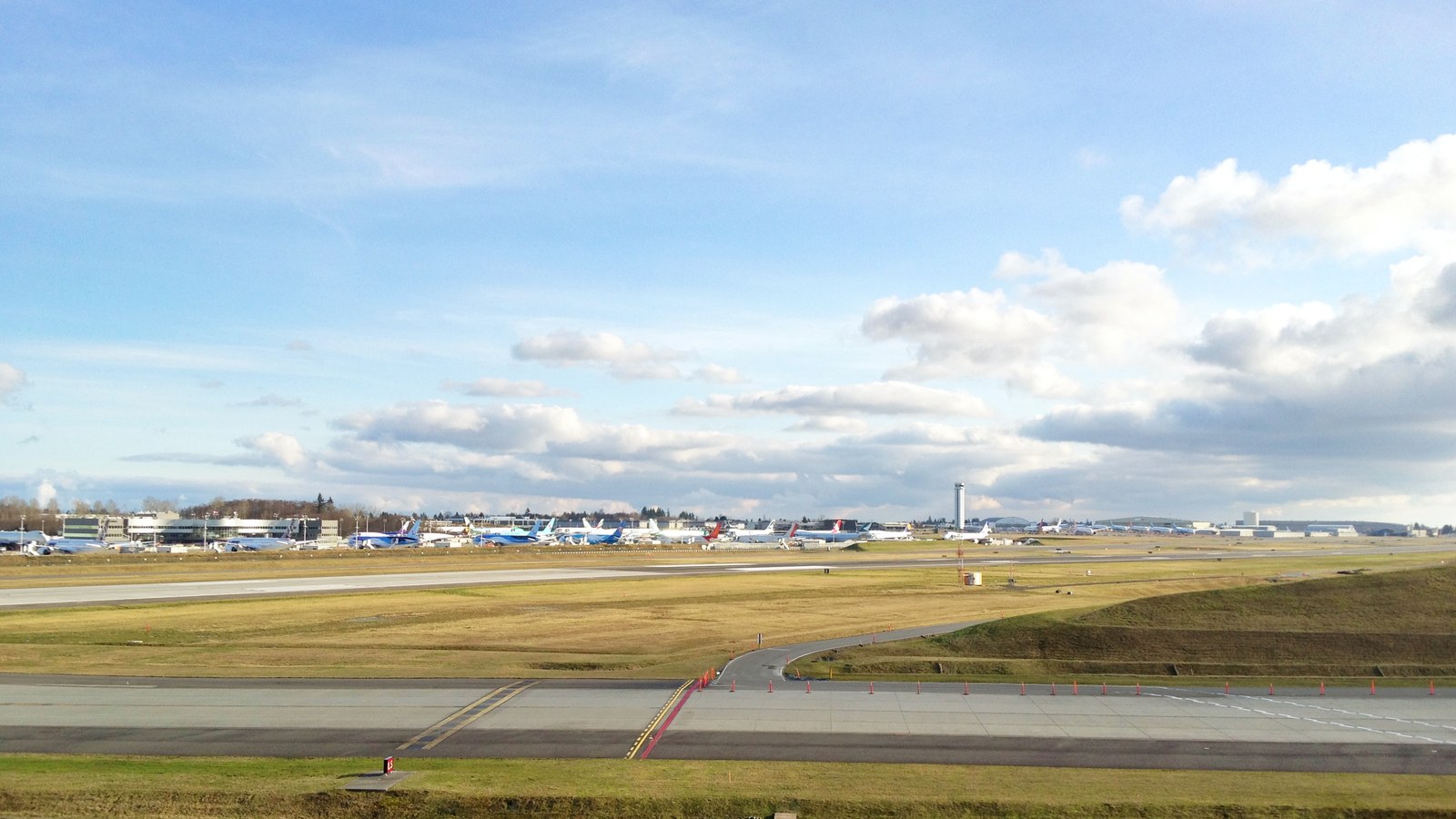
Image: Boeing plant at Paine Field (PAE), near Everett, Washington, 10 February 2013, David Broad, CC BY 3.0, Wikimedia Commons. The plant in 2013, not Tuesday’s ceremony.
Sources consulted: FAA clears the way for airlines to put Boeing's 737 Max 10 into service — NPR; Federal Aviation Administration Issues Certification for Boeing 737 MAX-10 — FAA; FAA certifies Boeing 737-10, largest member of 737 MAX family — Boeing.











0 Comments
No comments on this article yet. Be the first!