


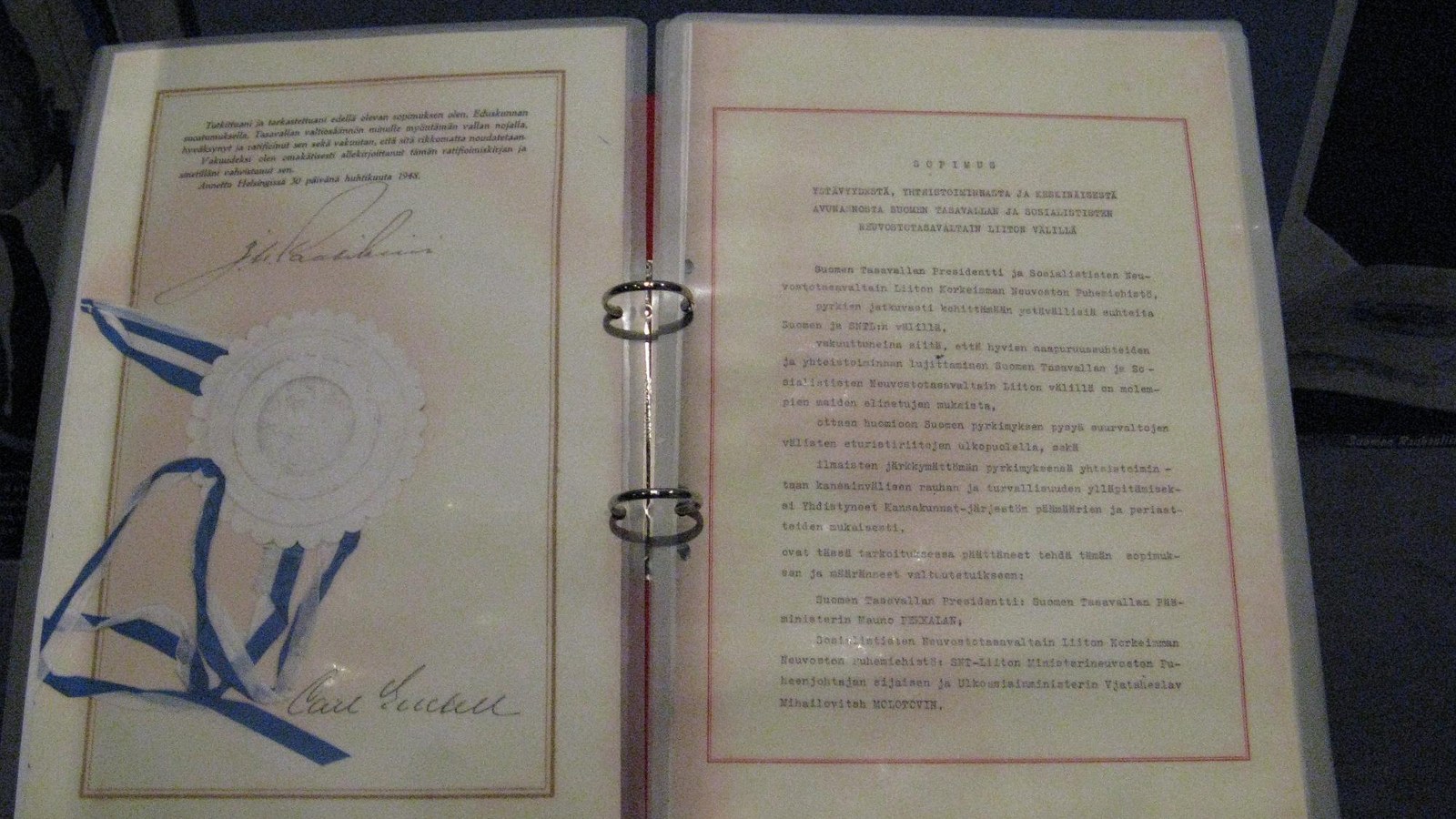
The Treaty of Friendship, Co-operation and Mutual Assistance between the Union of Soviet Socialist Republics and the Republic of Finland was signed at Moscow on 6 April 1948. Plenipotentiaries: Vyacheslav Molotov, Vice-President of the Council of Ministers and Minister of Foreign Affairs, and Mauno Pekkala, Prime Minister, authorised by President J. K. Paasikivi. Two copies, Russian and Finnish, equally authentic. United Nations Treaty Series No. 742, volume 48. Entry into force on 31 May 1948, by the exchange of ratifications at Helsinki, article 8. It is not the Treaty of Peace signed at Paris on 10 February 1947 and not the 1930s non-aggression pact.
The preamble invokes good-neighbourly relations, the vital interests of both countries, Finland’s endeavour not to be involved in clashes between the great Powers, and the Charter of the United Nations. Article 1: should Finland, or the Soviet Union through the territory of Finland, become the object of military aggression on the part of Germany or any Power allied with Germany, Finland will carry out its duty as a sovereign State and fight to repel the aggression, with all forces at its disposal, on land, sea and air, within its boundaries; any necessary Soviet assistance is to be supplied as mutually agreed. That clause is not transcribed as an operations handbook.
Article 2: the Parties will consult together if a threat of the military aggression referred to in article 1 is found. Article 3: participation in action for the maintenance of international peace and security in conformity with the purposes and principles of the United Nations. Article 4 confirms the undertaking in article 3 of the Paris Peace Treaty not to enter into any alliance or take part in any coalition directed against the other Party.
Article 5: further development of economic and cultural ties. Article 6: mutual respect for national sovereignty and independence, and non-interference in internal affairs. Article 7: implementation in conformity with United Nations principles. Article 8: ratification; ten years from coming into force, then further five-year periods unless notice of denunciation is given one year before expiry. The Eduskunta ratified on 28 April, by 156 votes to 11.
Later protocols extended the term in 1955, 1970 and 1983. The 1961 note crisis invoked the consultations in article 2 without opening them. The treaty ended with the Treaty on Good Neighbourliness with the Russian Federation on 20 January 1992, confirmed by an exchange of notes.
Cover: the signing in Moscow; no inner room is claimed beyond the contemporary photograph. Wikimedia Commons, free licence.
Sources consulted: Finno-Soviet Treaty of 1948; Treaty of Friendship, Co-operation and Mutual Assistance (UNTS No. 742).











0 Comments
No comments on this article yet. Be the first!