


The Samogitian uprising, in May 1409, brought Poland and Lithuania against the Teutonic Order. The Knights took Dobrzyń Land, then accepted a truce mediated by Wenceslaus, King of the Romans, in October. When it expired, in June 1410, the allies entered Prussia. At Grunwald, on 15 July, the Order’s leadership fell. Marienburg held, under Heinrich von Plauen. Jogaila beat another host at Koronowo, in October. Three-day talks at Raciąż broke down; the Knights re-entered Dobrzyń.
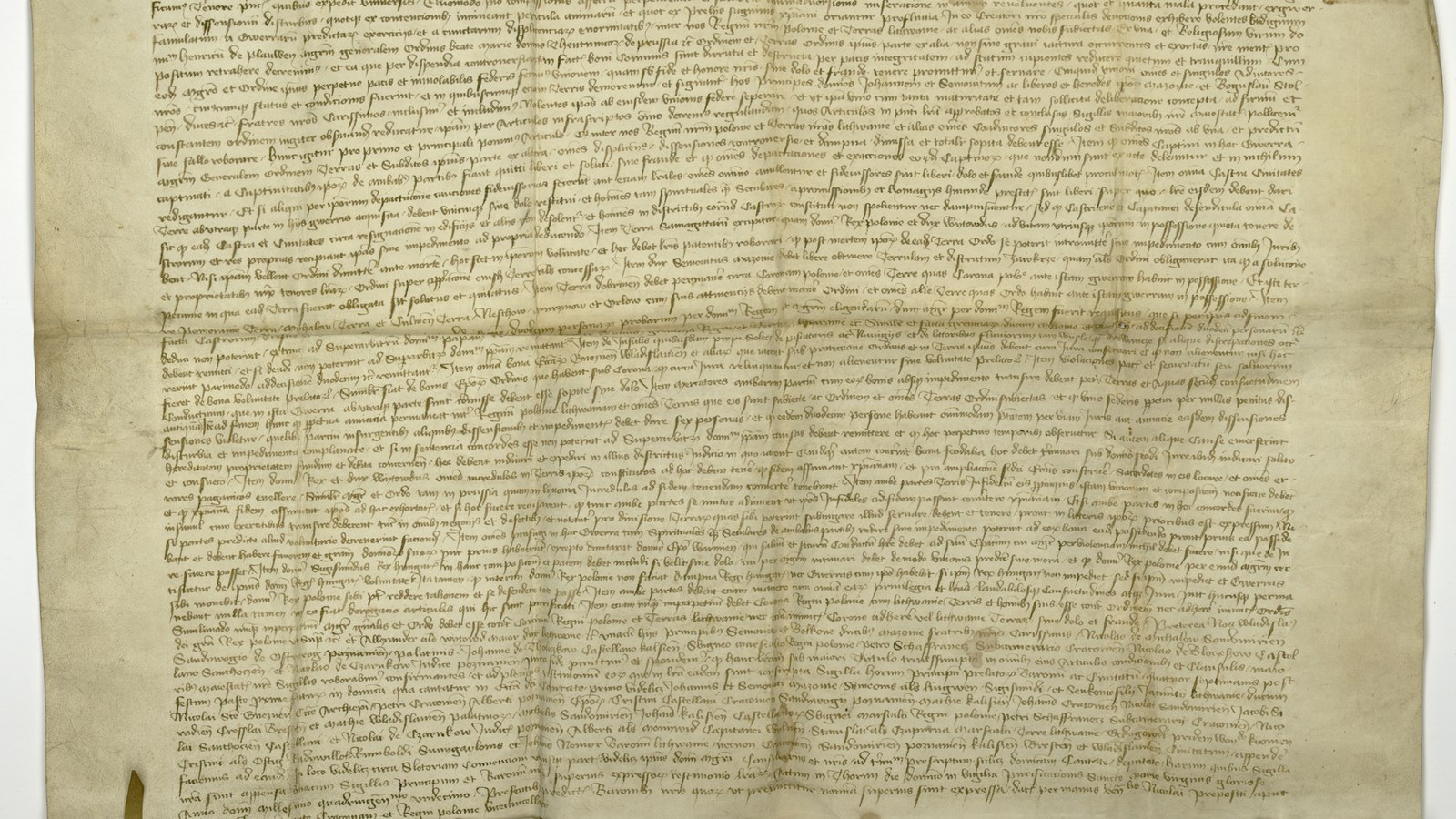
The peace was made on 1 February 1411, a Sunday, on the vigil of the Purification of the Virgin, at Thorn — Toruń, on the Vistula island of Kępa Bazarowa. The Latin letter, given by the hand of vice-chancellor Mikołaj, provost of Saint Florian before Kraków, is of Władysław, king of Poland, and Alexander, otherwise Vytautas, grand duke of Lithuania, with Heinrich von Plauen, grand master of the Teutonic House of Saint Mary in Prussia. The Mazovian dukes Janusz and Siemowit and Bogusław of Słupsk are included. The great seals were to be hung, on Cantate Sunday, near Złotoria on the Drwęca.
Samogitia stayed with Jogaila and Vytautas for their lives; after death the Order would enter again, with the rights in the old charters. Dobrzyń, with Złotoria and Bobrowniki, returned to the Crown. Pomerania, Michałów, Chełmno, Nieszawa, Murzynowo and Orłów stayed with the Order, as before the war. Siemowit of Mazovia took Zawkrze, freed of pledge. Castles taken in the war were restored; wartime homages fell. Merchants passed by water and land after the old custom.
Captives were freed; unpaid ransoms cancelled. Historians put on the Order, separately, a hundred thousand kopas of Prague groschen, in four instalments — nearly twenty tonnes of silver. Santok and Drezdenko, like the borders, went to twelve arbitrators, then to the pope. Pagans in Lithuania and Samogitia were to be brought to the faith, with churches and priests. Sigismund of Hungary could enter the peace if he wished.
Von Plauen raised new taxes; Danzig and Thorn revolted and were put down. The first two instalments were paid on time; the last, in January 1413, after Sigismund held at Buda that the peace was fair. Benedict Makrai awarded, in May 1413, the whole north bank of the Neman, with Memel, to Lithuania. The Order refused. There followed the Hunger War, in 1414, the Gollub War, in 1422, and the Treaty of Melno. By 1419 a fifth of Teutonic land lay abandoned. The Prussian Confederation and the second Peace of Thorn, in 1466, tore Prussia in two.
The public-domain photograph shows the 1411 instrument, not the island. After Grunwald the Order did not lose Prussia; it paid for it in silver and in taxes.
Thorn closed the Great War without moving the Prussian border. Samogitia was a loan on two lives.
Sources: Peace of Thorn (1411); Wikisource, Pax Thorun.











0 Comments
No comments on this article yet. Be the first!