


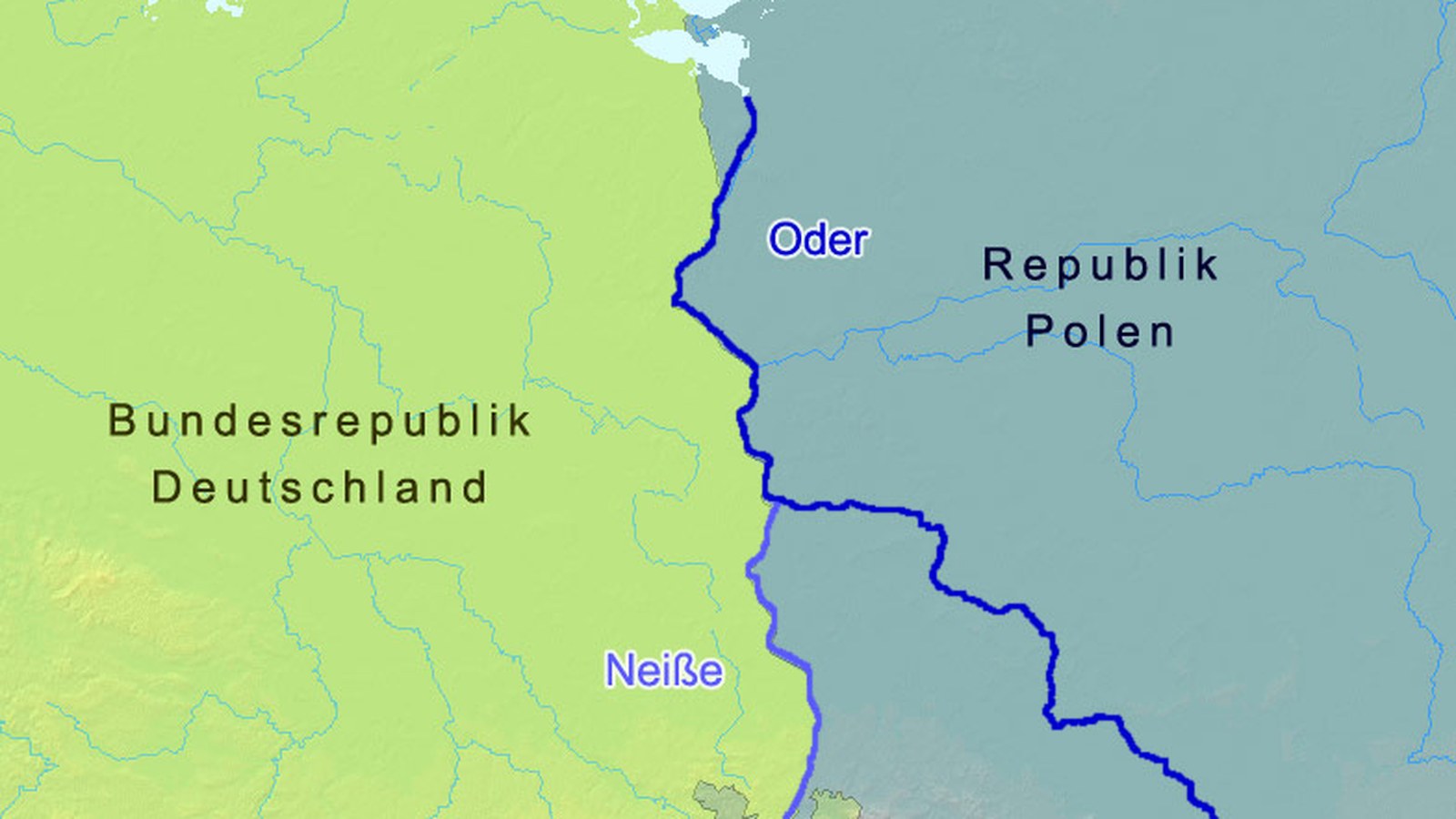
At Potsdam in 1945 the Allies fixed the Oder–Neisse line as the demarcation between the Soviet zone in Germany and Poland, pending a later peace. Germany lost about a quarter of its 1937 territory. The Treaty of Zgorzelec of 6 July 1950 between the GDR and Poland confirmed the border; a demarcation instrument followed on 27 January 1951, and an agreement on the Oder Bay on 22 May 1989. Bonn, which saw itself as the sole legal successor to the Reich, held that only a reunited Germany could close the file. The Treaty of Warsaw of 7 December 1970 accepted the line in practice, but kept the legal caveat of a future peace treaty.
The Treaty between the Federal Republic of Germany and the Republic of Poland on the confirmation of the frontier between them was signed on 14 November 1990 in Warsaw by foreign ministers Hans-Dietrich Genscher and Krzysztof Skubiszewski, in German and Polish, both texts equally authentic. Full sovereignty for reunited Germany, under the Two Plus Four Treaty of 12 September 1990, was made conditional, in article 1.2, on final recognition of the Oder–Neisse line. The same pledge stood in the Unification Treaty between the FRG and the GDR, in force on 3 October 1990.
Article 1 reaffirms the frontier defined at Zgorzelec, in the 1951 instrument, in the 1989 Oder Bay agreement and in the 1970 Treaty of Warsaw. Article 2 declares the frontier inviolable now and in future and pledges the parties to respect unconditionally their sovereignty and territorial integrity. Article 3 declares that they have no territorial claims against each other and shall not raise such claims. Article 4 requires ratification; the exchange of instruments, at Bonn, brings the treaty into force.
The preamble invokes the UN Charter, the Helsinki Final Act and a “European peace order in which frontiers will no longer divide”. It mentions the suffering of the war, including the loss of native land by many Germans and Poles through expulsion or resettlement, as a warning. The unification of Germany as a State with definite frontiers is treated as a contribution to that order.
The Sejm ratified on 26 November 1991, the Bundestag on 16 December 1991 — 13 votes against from the CDU/CSU faction, among them Erika Steinbach and Peter Ramsauer. The exchange at Bonn took place on 16 January 1992. The supplement was the Treaty of Good Neighbourship and Friendly Cooperation, signed on 17 June 1991.
In 2006 the Polish foreign minister Anna Fotyga, answering compensation claims by the “Prussian Trust”, said the treaty was insufficient and might have to be renegotiated. The 1990 text remains, even so, the international-law basis of the post-1945 frontier: three short articles, without the West German reservations of earlier decades.
Sources: German–Polish Border Treaty; United Nations DOALOS, Treaty on the confirmation of the frontier, 14 November 1990.











0 Comments
No comments on this article yet. Be the first!