


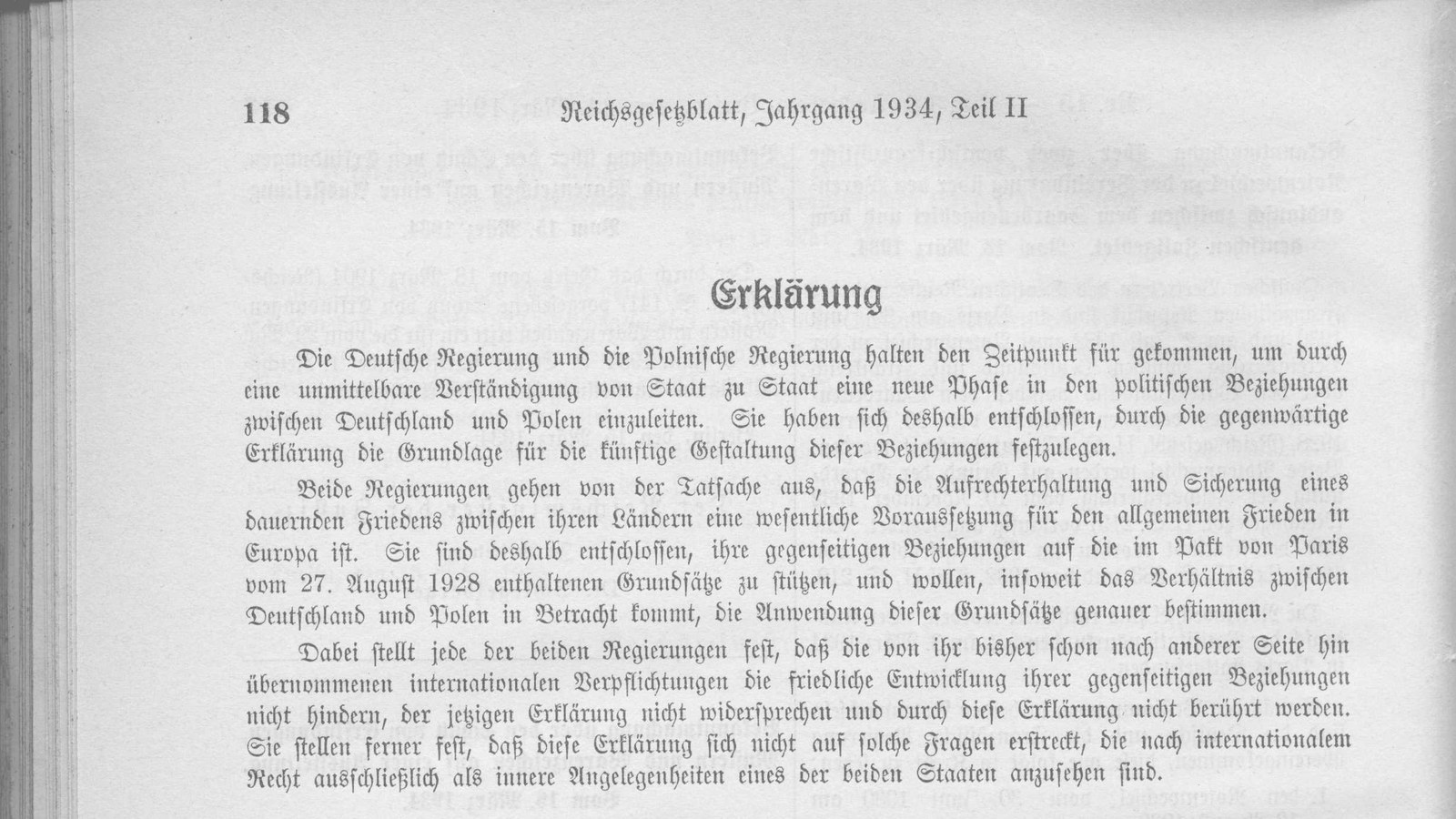
At Berlin, the German Government and the Polish Government conclude on 26 January 1934 a declaration by which they propose to introduce a new phase in the political relations between Germany and Poland through a direct understanding between State and State. For the German Government, Freiherr von Neurath signs; for the Polish Government, Jozef Lipski. The instrument is made in duplicate in the German and Polish languages.
The two Governments base their action on the fact that the maintenance and guarantee of a lasting peace between their countries is an essential precondition for the general peace of Europe. They therefore decide to base their mutual relations on the principles laid down in the Pact of Paris and to define more exactly the application of those principles so far as the relations between Germany and Poland are concerned.
Each of the two Governments lays it down that the international obligations undertaken by it towards a third party do not hinder the peaceful development of their mutual relations, do not conflict with the present declaration, and are not affected by this declaration. The declaration does not extend to those questions which under international law are to be regarded exclusively as the internal concern of one of the two States.
Both Governments announce their intention to settle directly all questions of whatever sort which concern their mutual relations. Should any disputes arise between them and agreement thereon not be reached by direct negotiation, they will in each particular case, on the basis of mutual agreement, seek a solution by other peaceful means, without prejudice to the possibility of applying, if necessary, those methods of procedure provided for such cases in other agreements in force between them. In no circumstances, however, will they proceed to the application of force for the purpose of reaching a decision in such disputes.
The guarantee of peace created by these principles will facilitate the great task of both Governments of finding a solution for problems of political, economic and social kinds, based on a just and fair adjustment of the interests of both parties. Both Governments are convinced that the relations between their countries will in this manner develop fruitfully and will lead to the establishment of a neighbourly relationship which will contribute to the well-being not only of both their countries, but of the other peoples of Europe as well.
The present declaration shall be ratified, and the instruments of ratification shall be exchanged in Warsaw as soon as possible. The declaration is valid for a period of ten years, reckoned from the day of the exchange of the instruments of ratification. If the declaration is not denounced by one of the two Governments six months before the expiration of this period, it will continue in force, but can then be denounced by either Government at any time on notice of six months being given.
The text is not a military alliance treaty and is not the Pact of Paris itself. The German signature is that of the foreign minister; the Polish signature, that of the ambassador in Berlin.
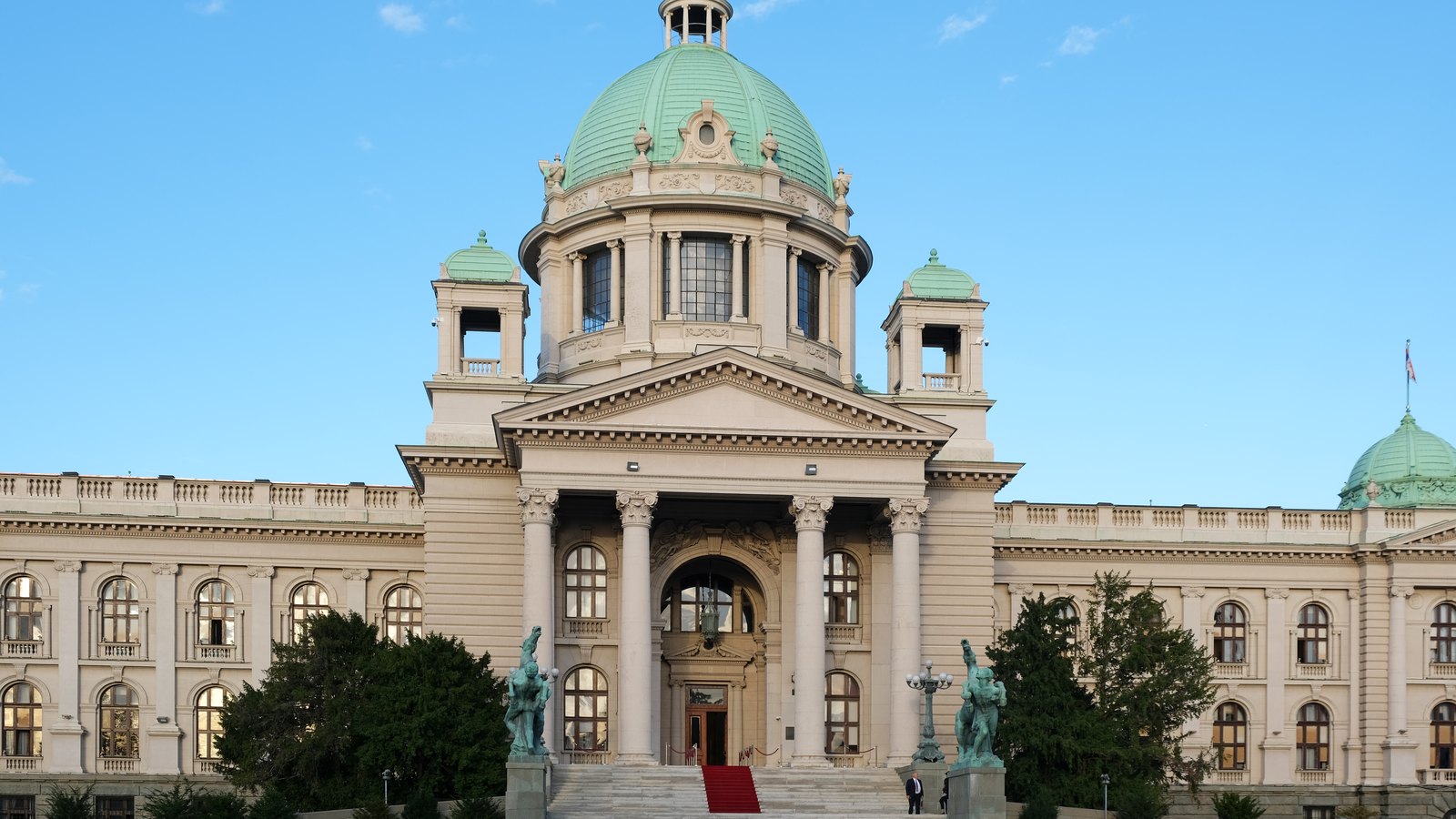
Image: Reichsgesetzblatt 1934, Part II, p. 118, text of the Erklarung; public domain, Wikimedia Commons. Cropped to 16:9.
Source consulted: German-Polish declaration of non-aggression. Treaty text: Text of German-Polish Agreement of January 26, 1934, Avalon Project (British War Bluebook).






0 Comments
No comments on this article yet. Be the first!