


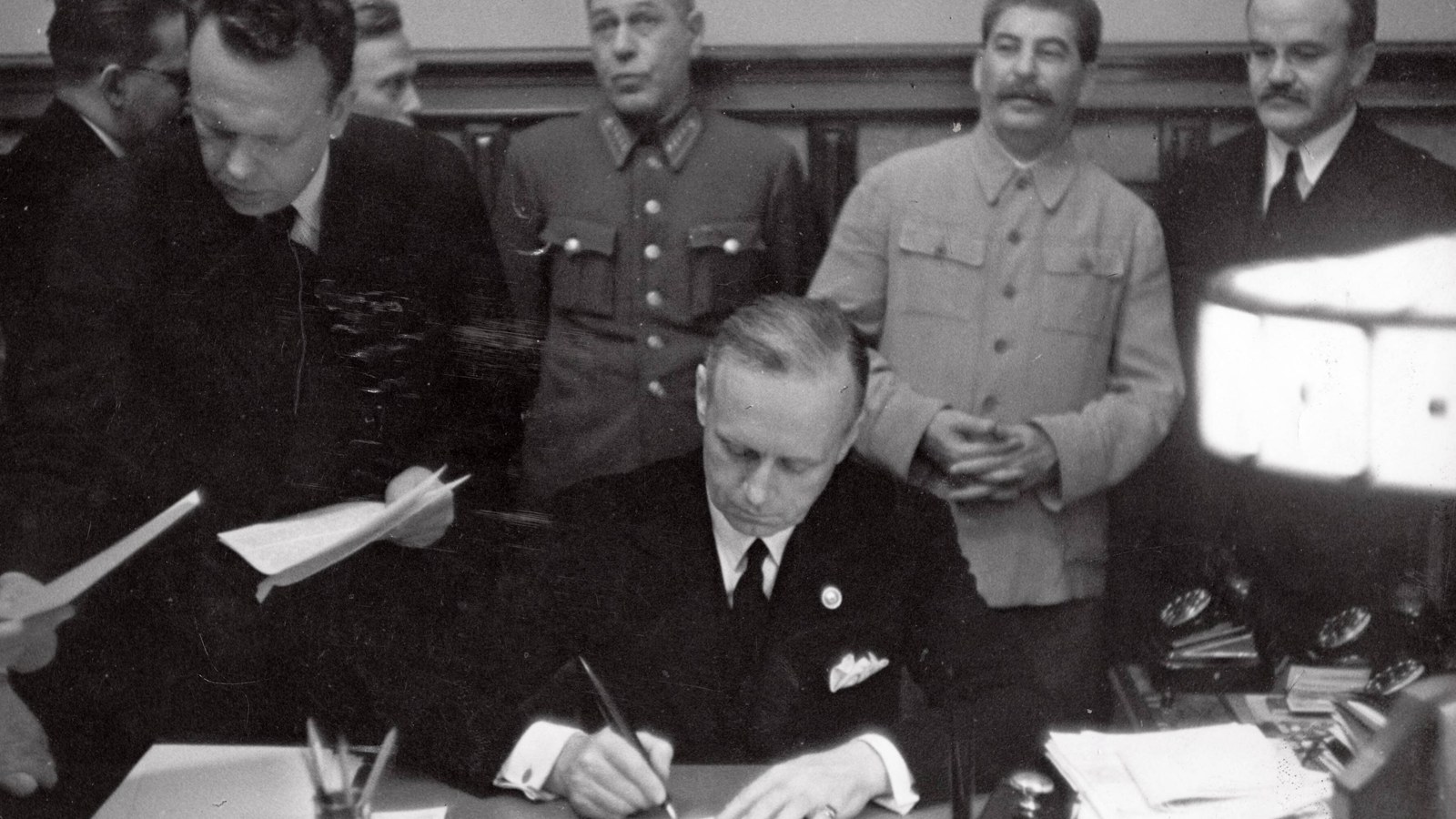
On 28 September 1939, in Moscow, Joachim von Ribbentrop and Vyacheslav Molotov signed the German–Soviet Boundary and Friendship Treaty. It takes effect on signature; ratifications are to be exchanged in Berlin. It is not the Non-Aggression Pact of 23 August and not the secret protocol of 10 January 1941 on the Lithuanian strip west of the Šešupė.
The preamble declares that, after the “collapse of the former Polish state,” the two governments regard it as exclusively their task to re-establish peace and order in those territories. Article I fixes the boundary of their respective national interests on the line of the attached map, to be described in more detail in a supplementary protocol. Article II recognises that boundary as definitive and rejects any interference of third powers. Article III leaves the reorganisation of public administration west of the line to the German Reich and east of it to the U.S.S.R. Article IV calls the settlement a firm foundation for friendly relations. The text is in German and Russian, in duplicate.
The secret protocol amending the 23 August instrument assigns the territory of the Lithuanian State to the Soviet sphere of influence; the province of Lublin and parts of the province of Warsaw fall to the German sphere, as on the map attached to the treaty signed that day. As soon as the U.S.S.R. takes special measures on Lithuanian territory, the then German–Lithuanian border is to be rectified so that the land southwest of the line on the map falls to Germany. Economic agreements then in force between Germany and Lithuania remain unaffected.
The second secret protocol states that neither party will tolerate on its territory Polish agitation affecting the territories of the other; they will suppress all beginnings of such agitation and inform each other of suitable measures. The confidential protocol places no obstacle in the way of Reich nationals and persons of German descent in the Soviet zone who wish to migrate, with Reich agents and protection of property rights; a corresponding obligation covers persons of Ukrainian or White Russian descent in the German zone.
The public declaration of the same day claims that the treaty has created a sure foundation for lasting peace in Eastern Europe and calls for an end to the war between Germany on one side and England and France on the other. If the effort proves fruitless, the declaration would hold London and Paris responsible for the continuation of the war, and the two governments would consult on necessary measures. The Molotov–Ribbentrop letters announce an economic programme: Soviet raw materials against German manufactured goods over an extended period, aiming at the highest volume of exchange previously attained.
Behind Molotov at the signing stand adjutant Richard Schulze-Kossens, Chief of Staff Boris Shaposhnikov, Ribbentrop, Joseph Stalin and translator Vladimir Pavlov; ambassador Alexey Shkvarzev stands next to the commissar. It is not the mutual assistance treaty with Estonia, signed the same day, and not the German invasion of 22 June 1941.
Molotov signs the boundary treaty in Moscow; Ribbentrop and Stalin stand behind him. Image: Wikimedia Commons, CC0.
For context: German–Soviet Boundary and Friendship Treaty. The text: German-Soviet Boundary and Friendship Treaty.











0 Comments
No comments on this article yet. Be the first!