


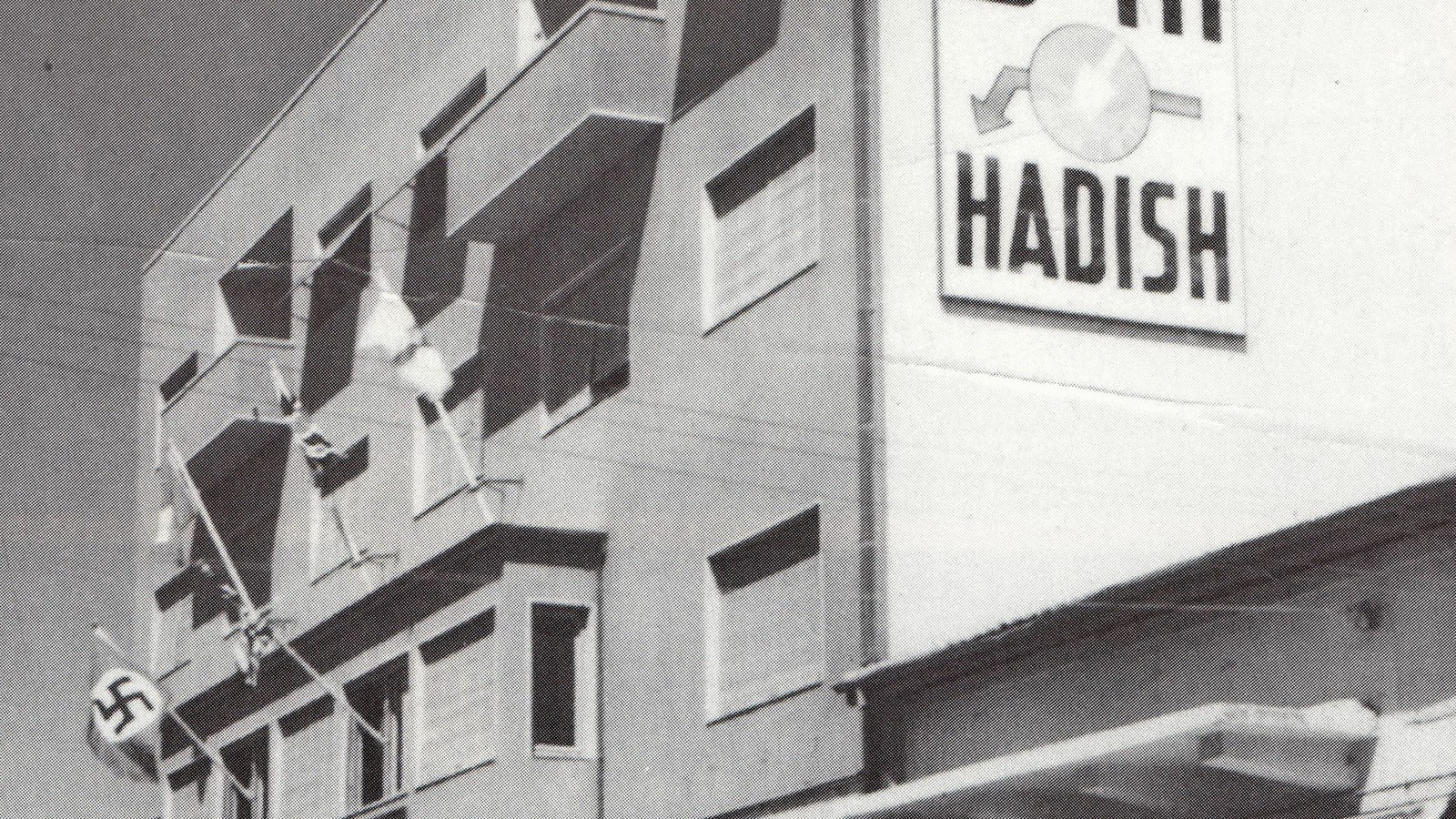
The Reich Ministry of Economics confirms to Eliezer Hoofien, director of the Anglo-Palestine Bank in Tel Aviv, the transfer arrangement to Mandatory Palestine. The instrument is dated 25 August 1933. Three days later Circular 54/33 sends it to the foreign-exchange offices. It is not the Nuremberg Laws of 1935, and it is not the Madagascar Plan.
The setting is the first months after Hitler is named chancellor on 30 January. On 1 April the Nazis organise a boycott of Jewish shops; on 7 April the civil-service law removes Jews from the administration. Outside Germany, Jewish organisations answer with a boycott of German goods. In March Sam Cohen, of the Netanya citrus company Hanotea, begins direct talks with the same ministry; in May Hanotea asks leave to transfer capital.
On 25 August Hoofien represents the Tel Aviv bank; Arthur Ruppin, the Executive of the Jewish Agency; Cohen and his partner, Hanotea; for the Zionist Federation of Germany, its chairman Siegfried Moses and Georg Landauer. The ministry wants emigration without emptying the Reichsbank’s foreign-exchange reserve and, at the same time, German exports to Palestine.
The circular requires, for “capitalist” immigrants, a minimum of 1,000 Palestine pounds, then about 15,000 Reichsmarks. Sums above that threshold are paid into Special Account I of the Bank of the Temple Society, held at the Reichshauptbank in favour of a Jewish trust company still to be set up in Palestine — until then, the Anglo-Palestine Bank. German goods shipped to Palestine are paid from the account; the Palestinian trust pays out, in pounds, the counterpart, in the order and proportion of the deposits.
Special Account II, also at the Templer bank, takes, up to 50,000 marks a person, deposits from German citizens of Jewish origin who are not yet leaving but want a home in Palestine. For both accounts the first ceiling is three million marks. Palästina-Treuhandstelle zur Beratung deutscher Juden (Paltreu), at Friedrichstraße 218 in Berlin, advises the emigrants. Its partners are M. M. Warburg of Hamburg, A. E. Wassermann of Berlin and the Tel Aviv bank.
In the last quarter of the year the Trust and Transfer Office Haavara Ltd. is formed in Tel Aviv. Haavara, “transfer” in Hebrew, gives the operation its name. Between November 1933 and the end of 1937 German exports to Jewish businesses in Palestine by this route reach 77.8 million marks; by wind-up, about 105 million, some 35 million dollars of that time. About 60,000 German Jews reach Palestine between 1933 and 1939 with the scheme’s help. The disagio borne by emigrants rises from 6 per cent in 1934 to 50 per cent in 1938.
The arrangement breaks the boycott in the Yishuv and draws opposition: Stephen Wise and the American Jewish Congress, Ze'ev Jabotinsky and the Revisionists. The Zionist Congress at Lucerne, in 1935, keeps it by a majority and places Haavara under the Jewish Agency. Haim Arlosoroff, an Agency negotiator, is assassinated in Tel Aviv on 16 June 1933, during the Hanotea talks, not after the August confirmation.
The programme closes in September 1939, with the war. It is not the Évian conference, and it does not organise the later destruction; it is an emigration and export agreement, confirmed in Berlin to Hoofien.
Image: Bank of the Temple Society, Jaffa, 1936; Carl Lutz; public domain, PikiWiki / Wikimedia Commons. Cropped to 16:9.
Source consulted: Haavara Agreement. Treaty text: Regulations of the German Ministry of Economics, August 1933, concerning Haavara (Yad Vashem).











0 Comments
No comments on this article yet. Be the first!