


On 6 November 1925, at The Hague, the plenipotentiaries signed the Agreement Concerning the International Deposit of Industrial Designs, pursuant to Article 15 of the Paris Union Convention of 20 March 1883, as revised at Brussels (1900) and Washington (1911). One copy. Ratifications are to be deposited at The Hague by 1 May 1928 at the latest; the Arrangement enters into force, among the countries that have ratified it, one month after that date, with the same force and duration as the general Convention. It is not the Hague Act revising the Paris Convention, signed at the same conference. It is not the London Act of 1934, not the Hague Act of 1960 and not the Geneva Act of 1999.
Article 1: nationals of each contracting country, and persons who have satisfied on the territory of the restricted Union the conditions of Article 3 of the general Convention, may secure protection of their industrial designs in all the other contracting countries by an international deposit at the International Bureau of Industrial Property in Berne. Article 2: the deposit comprises the industrial product itself, a drawing, a photograph or any other sufficient graphic representation; the application, in duplicate, in French, as specified by the Regulations.
Article 3: the Bureau records the application in a special register, notifies the Administration indicated by each contracting country and publishes it in a periodical sheet distributed free to the Administrations; deposits are kept in the Bureau’s archives. Article 4: the depositor is presumed owner until proof to the contrary; the deposit is purely declaratory and has, in each contracting country, the same effects as a national deposit on the international date; the publicity of Article 3 is fully sufficient; the priority of Article 4 of the general Convention is guaranteed without the formalities of that article. Article 5: no compulsory marking on the object; no forfeiture for non-working or for introduction of conforming articles.
Articles 6–9: a single design or several, the number stated in the application; open or sealed packet, including the Soleau system; the first period admits both, the second only open deposit. Article 7: international protection lasts 15 years from the Berne deposit — five plus ten. Articles 10–12: unofficial notice in the first six months of the fifth year; request for prolongation at least three months before expiry; unprolonged objects returned on request at the owner’s expense, otherwise destroyed after two years. Article 14: if a court so orders, the Bureau opens the secret packet, extracts the object and reseals it after return.
Article 15, fees payable before recording: one design, first period — 5 francs; second period — 10 francs; multiple deposit, first period — 10 francs; second — 50 francs. Article 16: the annual net product of the fees is shared among the contracting countries after common expenses. Article 21: a minimum of protection only; it leaves intact the revised Berne Convention of 1908 on artistic works and works of applied art. Article 22: accession in the form of Articles 16 and 16 bis of the general Convention. WIPO records entry into force on 1 June 1928 in four countries: Germany, the Netherlands, Spain and Switzerland. The present membership of the Hague Union is not listed here.
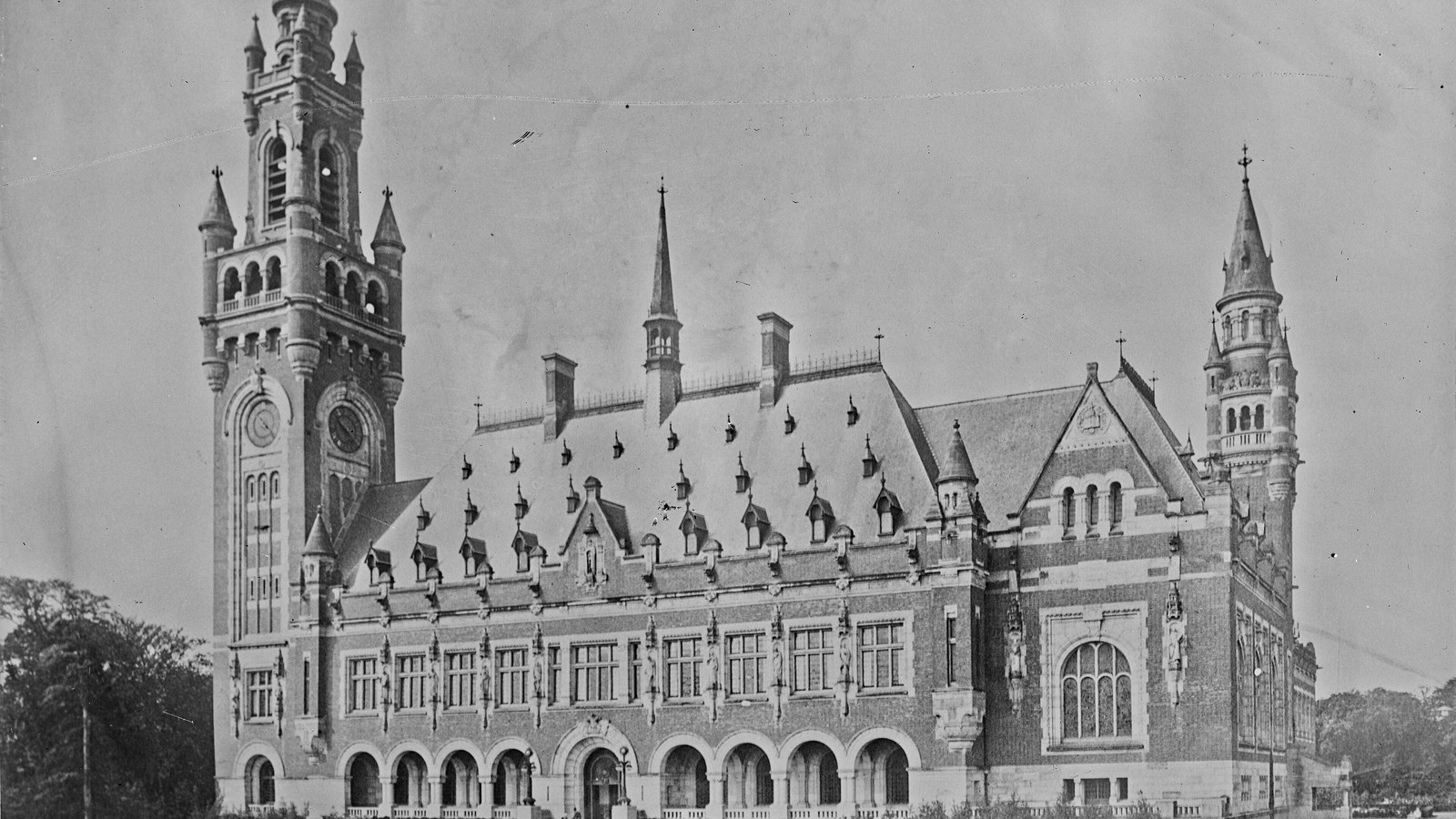
Peace Palace, The Hague, 1922. A conference landmark of the city, not the confirmed hall of the diplomatic conference. Wikimedia Commons, public domain.
For context: Hague Agreement Concerning the International Deposit of Industrial Designs. The text: Arrangement de La Haye (1925).











0 Comments
No comments on this article yet. Be the first!