


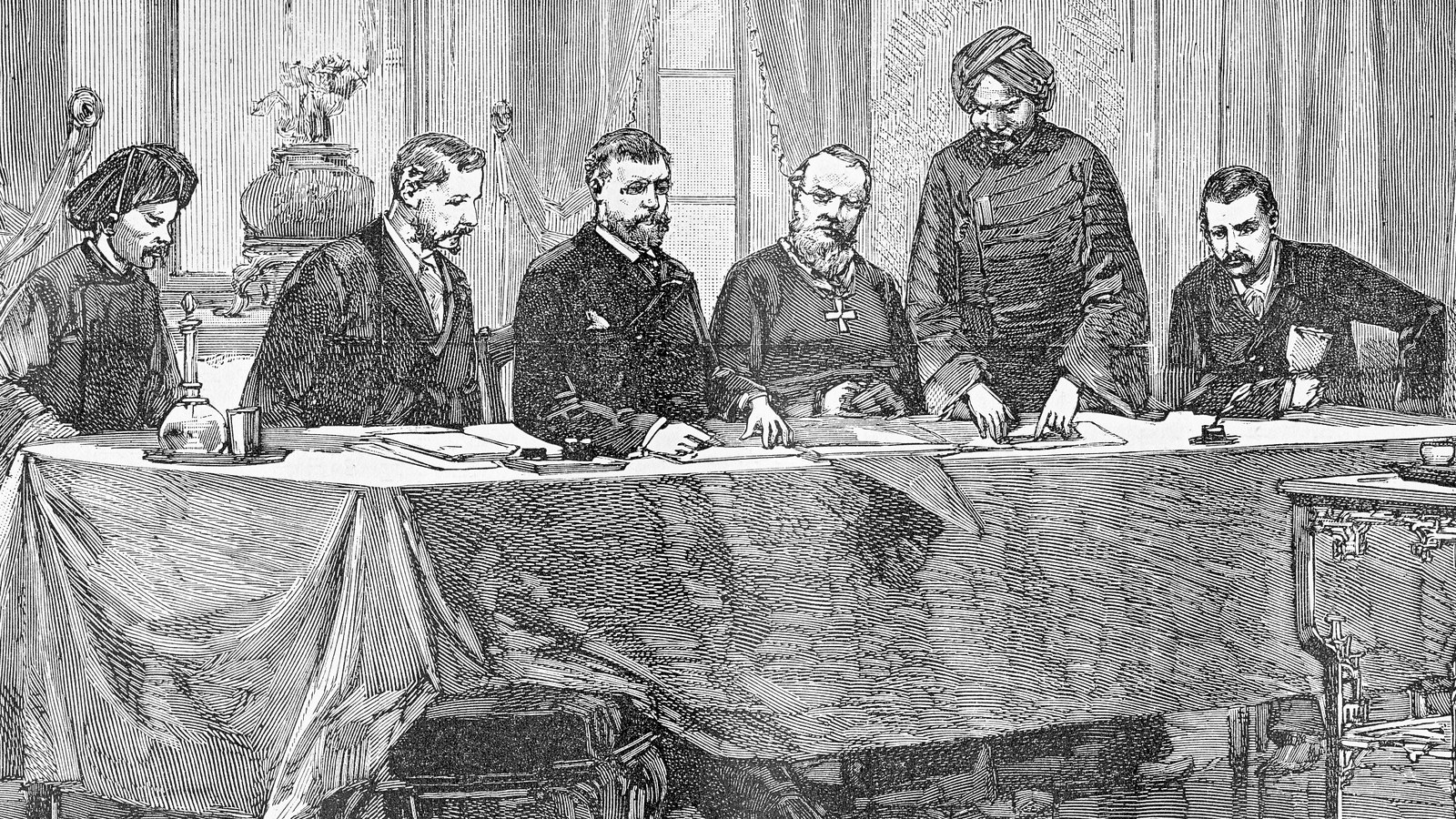
On 25 August 1883, at the French legation in Huế, France and Annam signed the Peace Preliminaries, twenty-seven articles, known as the Harmand Treaty or Hòa ước Quý Mùi. For the Republic: J. T. Harmand, commissioner-general plenipotentiary, with Palasne de Champeaux, Ory, de la Bastide, Masse and Haitee. For the Nguyễn court, under Emperor Hiệp Hòa: Trần Đình Túc, grand censor, first plenipotentiary; Nguyễn Trọng Hiệp, minister of the interior and foreign affairs; Huỳnh Hữu Thưởng of the privy council. The Annamese date: the 23rd day of the seventh month. Four days earlier Admiral Courbet had taken the Thuận An forts. The convention was to go to the President of the Republic and to the king; ratifications as soon as possible. France did not ratify. On 6 June 1884 the Patenôtre treaty replaced it.
Article 1: Annam recognises and accepts the protectorate of France, with the consequences of European diplomatic law; France shall preside over relations with all foreign powers, including China; Annam may communicate diplomatically only through France. Article 2: the province of Bình Thuận is annexed to the French possessions in Lower Cochinchina. Article 3: a French military force shall occupy permanently the Đèo Ngang chain, ending at Cape Vĩnh Ký, and the Thuận An forts and those at the mouth of the Huế river, rebuilt at the pleasure of the French authorities: Hà Dương, Trần Hải, Thái Dương, Tràng Làng, Hạp Châu, Lô Thâu, Luỹ Mới. Articles 4–5: immediate recall of Annamese troops from Tonkin, garrisons on a peace footing; mandarins to resume their posts, French nominations confirmed after agreement.
Article 6: from the northern frontier of Bình Thuận to Đèo Ngang, provincial officers administer as before, without French control except for customs, public works and whatever needs European technicians. Article 7: open to the commerce of all nations, besides Qui Nhơn, Tourane (Đà Nẵng) and Xuân Đài; French agents under the resident at Huế. Articles 8–10: a lighthouse at Cape Varella, Padaran or Poulo Cécir; the Hanoi–Saigon road, at joint expense, for carriages, with French engineers for bridges and tunnels; a telegraph worked by French staff, part of the charges to Annam. Article 11: at Huế, a resident of very high rank, representative of the protectorate, under the commissioner-general; a private audience with the king, who may not refuse him without a valid reason.
Articles 12–18: residents at Hanoi, Haiphong, in each large Tonkin province; a garrison; mandarins remain, but may be changed at French request; justice between Europeans and natives, appeal to Saigon; urban police; taxes with the Quan Bố. Article 19: customs, maritime and frontier only, in French hands. Article 20: full liberty of person and property throughout Tonkin and in the open ports of Annam. Articles 22–25: posts along the Red River; France guarantees the integrity of the king’s states, drives out the Black Flags, treats all Annamese as its protégés. Article 26: Annam’s debts to France are held discharged by the cession of Bình Thuận. Article 27: Annam’s share of customs and monopolies not less than two million francs a year; the Mexican dollar and Cochinchina silver legal tender.
This is not the Saigon treaty of 15 March 1874 (Philastre). It is not Patenôtre, 6 June 1884, the basis of the protectorate until the Élysée Accords of 1949. It is not Tientsin 1885 with China. It is not Saigon 1862. The cover is the signing at Huế.
Sources: Treaty of Huế (1883); Treaty of Hué, peace preliminaries (FRUS 1883).











0 Comments
No comments on this article yet. Be the first!