


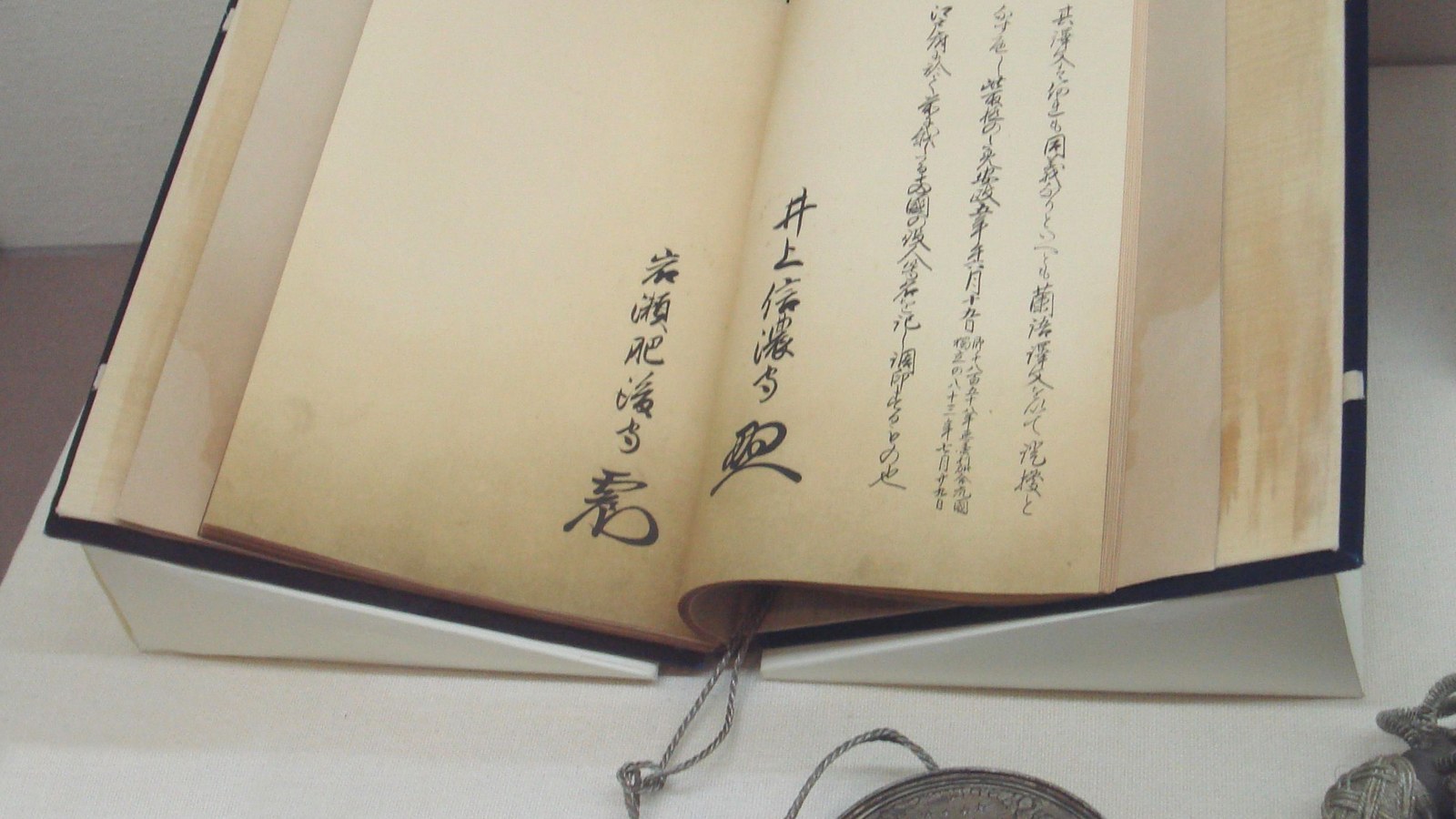
On 29 July 1858, on USS Powhatan in Edo Bay, Townsend Harris signed with Inoue, shinano-no-kami, and Iwase, higo-no-kami, the Treaty of Amity and Commerce between the United States and the Empire of Japan.
Harris was consul-general of the United States. For the shogun (tycoon) the two bakufu officials signed. The instrument was executed in quadruplicate, in Japanese, English and Dutch; the Dutch version is the original.
Article I proclaims perpetual peace and allows an American diplomatic agent at Yedo, plus consuls in the ports opened to commerce. Japan may in turn appoint an agent at Washington. Article II provides for American mediation, at Japan’s request, in differences with a European power.
Article III adds, besides Shimoda and Hakodate, Kanagawa and Nagasaki from 4 July 1859, Niigata from 1 January 1860 and Hyōgo from 1 January 1863. Shimoda closes as a place of residence and trade six months after Kanagawa opens. Americans may lease ground, purchase buildings and erect dwellings and warehouses, but no fortifications. Yedo opens for trade from 1 January 1862, Osaka from 1 January 1863. The import of opium above three catties is prohibited.
Article IV ties duties to the appended tariff and reserves most-favoured-nation treatment. Article VI gives American consular courts jurisdiction over offences committed by Americans against Japanese. Article VIII recognises American worship, with the right to erect places of worship, and requires that Japanese temples not be insulted. The government of Japan has already abolished the trampling of religious emblems.
Article XII revokes those provisions of the Kanagawa convention of 31 March 1854 that conflict with this text, and also the convention signed at Shimoda on 17 June 1857. Article XIV brings the treaty into force on 4 July 1859, even if the exchange of ratifications, provided for at Washington, should be delayed. The ratifications were in fact exchanged on 22 May 1860.
Article XIII opens revision after 4 July 1872, on one year’s notice. This is distinct from Perry’s Kanagawa convention, which opened only coaling and protection for shipwrecked sailors, and from the Ansei treaties signed in the following weeks with the Netherlands, Russia, Britain and France, beginning with the British act of 26 August. It is not the tariff treaty of 22 November 1894.
Image: Treaty of Amity and Commerce between Japan and the United States, 29 July 1858; photograph by World Imaging, 2009, at the Japan Foreign Ministry Archives; CC BY-SA 3.0, Wikimedia Commons. Cropped to 16:9.
Source consulted: Treaty of Amity and Commerce (United States–Japan). Treaty text: Treaty of Amity and Commerce, Yedo, 29 July 1858.











0 Comments
No comments on this article yet. Be the first!