


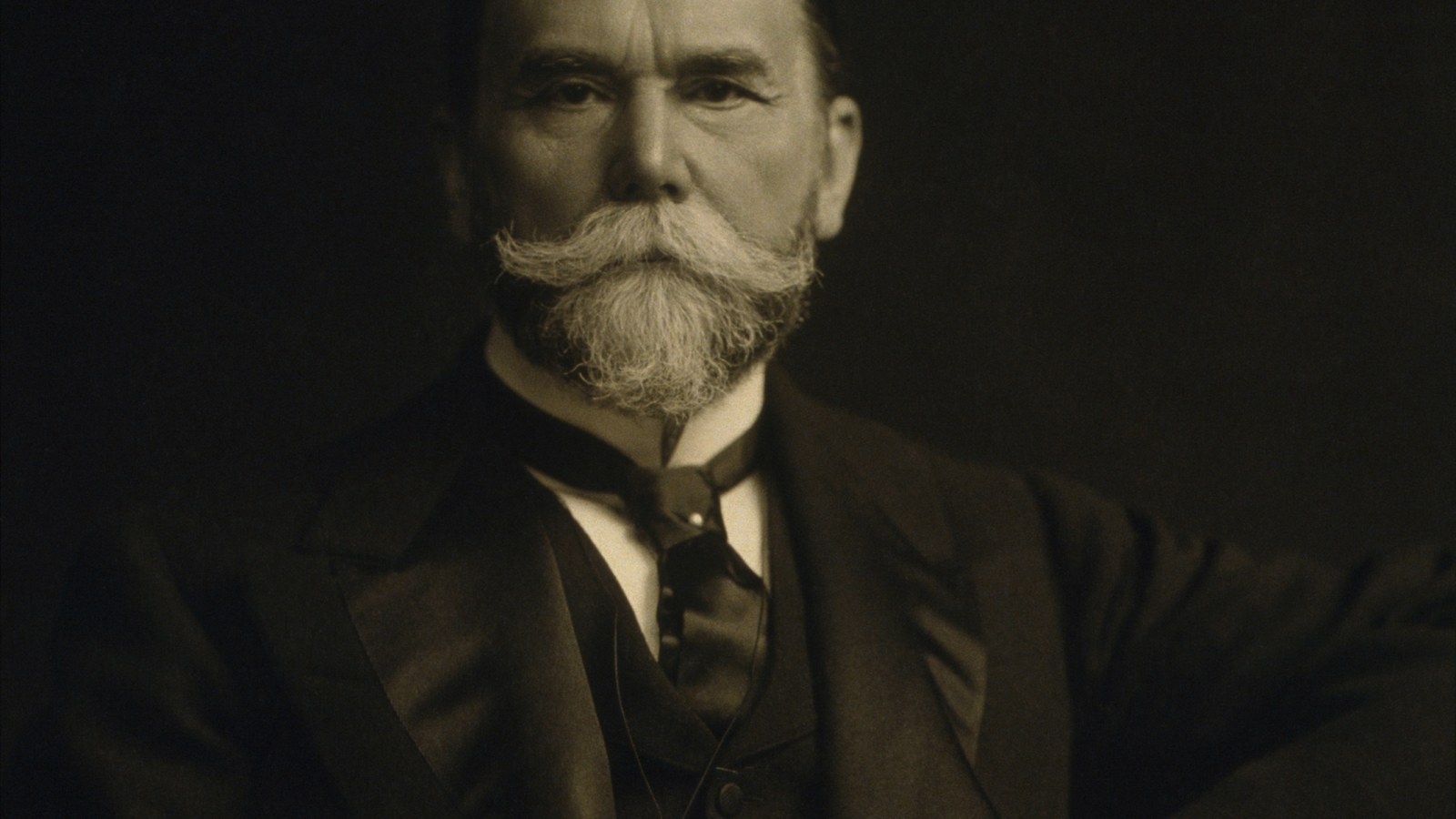
At Washington, the Republic of Colombia and the United States of America conclude on 22 January 1903 the convention for the construction of a ship canal between the Atlantic Ocean and the Pacific Ocean. For the President of Colombia, Tomás Herrán, specially authorized, signs; for the President of the United States, John Hay, Secretary of State. The plenipotentiaries communicate their full powers, found in good and due form. The instrument is done in the city of Washington.
Article I authorizes the New Panama Canal Company to sell and transfer to the United States its rights, privileges, properties and concessions, as well as the Panama Railroad, with a reservation of vacant lands outside the zone, which revert to Colombia, and of Colombia’s rights as a shareholder. Article II grants the United States the exclusive right, for one hundred years, renewable at their absolute option for like periods, to excavate, construct, maintain, operate, control and protect the maritime canal, with or without locks, across Colombian territory, together with the railroad and auxiliary works. Article III grants the use and control of a zone five kilometres wide on each side of the centre line, plus auxiliary works, a depth of ten fathoms in Limon Bay and at least three nautical miles from each terminus; the islands of Perico, Naos, Culebra and Flamenco in Panama Bay may be used, without being included in the zone. The cities of Panama and Colon are excepted, save company property; a mixed commission is created for sanitary and police regulations.
Article IV leaves the sovereignty of Colombia over the territory unaffected; the United States fully recognizes that sovereignty and rejects any pretension to impair it or to increase its territory at the expense of Colombia or of the sister republics of Central or South America. Article V permits the construction and maintenance, at United States expense, of a port at each mouth of the canal, with lighthouses, and provides for drainage, hospitals and waterworks at Panama and Colon, with water charges for fifty years, thereafter free except for operating costs. Article VI binds Colombia not to cede or lease to any foreign government islands or ports in Panama Bay or on the Atlantic coast between the Atrato and the western limit of the Department of Panama, for fortifications, naval stations or coaling stations that might hinder the canal; the United States will, if need be, lend its strong hand to prevent occupation.
Article VII includes the right to use the waters of the River Chagres and other streams, to raise or lower the water level, to flood lands, and to take free of charge water, stone, clay and minerals from public lands; damages to private owners are assessed by a mixed commission and paid solely by the United States. Article VIII declares free at all times the ports at either end, including Panama and Colon, without Colombian charges on vessels using the canal; the ports remain open to universal commerce, with Colombian customs on goods destined for the rest of the Republic. Article IX exempts the canal, railroads, auxiliary works and personnel from taxes. Articles X to XII permit the use of telegraph and telephone lines on equitable arrangements, free immigration of workmen exempt from military service, and duty-free import into the zone of materials and supplies.
Article XIII gives the United States authority to protect the canal and keep order; Colombia may establish courts for controversies between Colombians or between Colombians and aliens who are not citizens of the United States; the United States, subject to Colombia’s general sovereignty, for controversies between Americans or between Americans and other aliens, and for those arising from construction and operation of the works; a mixed court has civil, criminal and admiralty jurisdiction for mixed controversies and for offences committed in the zone. Article XIV declares the works of public utility; expropriations follow Colombian law, with compensation finally determined by the mixed commission, paid by the United States, on the value before the works began. Article XV grants the use of Colombian ports open to commerce as places of refuge, without tonnage or anchorage dues. Article XVI leaves the canal and its mouths perpetually neutral and open, in accordance with the treaty between the United States and Great Britain.
Article XVII exempts from dues the transport of Colombia’s vessels, troops and munitions of war, and of persons in the public service on the auxiliary railroad. Article XVIII leaves to the United States the regulations for use and the tariffs. Article XIX leaves Colombia’s sovereignty over real property acquired by the United States outside the zone unaffected. Article XX requires Colombia to remove, within four months, incompatibilities in earlier treaties with third powers. Article XXI leaves claims from earlier concessions to Colombia. Article XXII cedes to the United States Colombia’s share in future canal revenues and the rights reserved under the Wyse concession and the railroad grants. Article XXIII binds Colombia to use armed force for the security of the canal; if it cannot, the United States, with the consent or at the request of Colombia, of its minister at Washington or of the local authority, employs the force necessary and withdraws it when the need ceases; in unforeseen or imminent danger it may act without prior consent, giving immediate notice.
Article XXIV requires actual work to begin within two years from the exchange of ratifications and the canal to be open to commerce twelve years after those two years, with extensions if unforeseen obstacles arise or if a sea-level canal is chosen. Article XXV fixes the price for the use of the zone: ten million dollars in American gold on the exchange of ratifications, and, after nine years, an annual payment of two hundred and fifty thousand dollars in gold during the life of the Convention. Article XXVI leaves the rights of the United States unaffected by changes in the government, laws or treaties of Colombia without their consent. Article XXVII constitutes the mixed commission of two persons named by each President, with a third in case of a tie. Article XXVIII requires ratification according to the laws of the respective countries and exchange at Washington within eight months from its date, or sooner. The text is not the later convention concluded with Panama.
Image: John Hay, Secretary of State; C. M. Gilbert, circa 1904, restored by Adam Cuerden, public domain, Wikimedia Commons. Cropped to 16:9.
Source consulted: Hay-Herran Treaty. Treaty text: Herran-Hay Treaty between the Republic of Colombia and the United States of America, Washington.











0 Comments
No comments on this article yet. Be the first!