
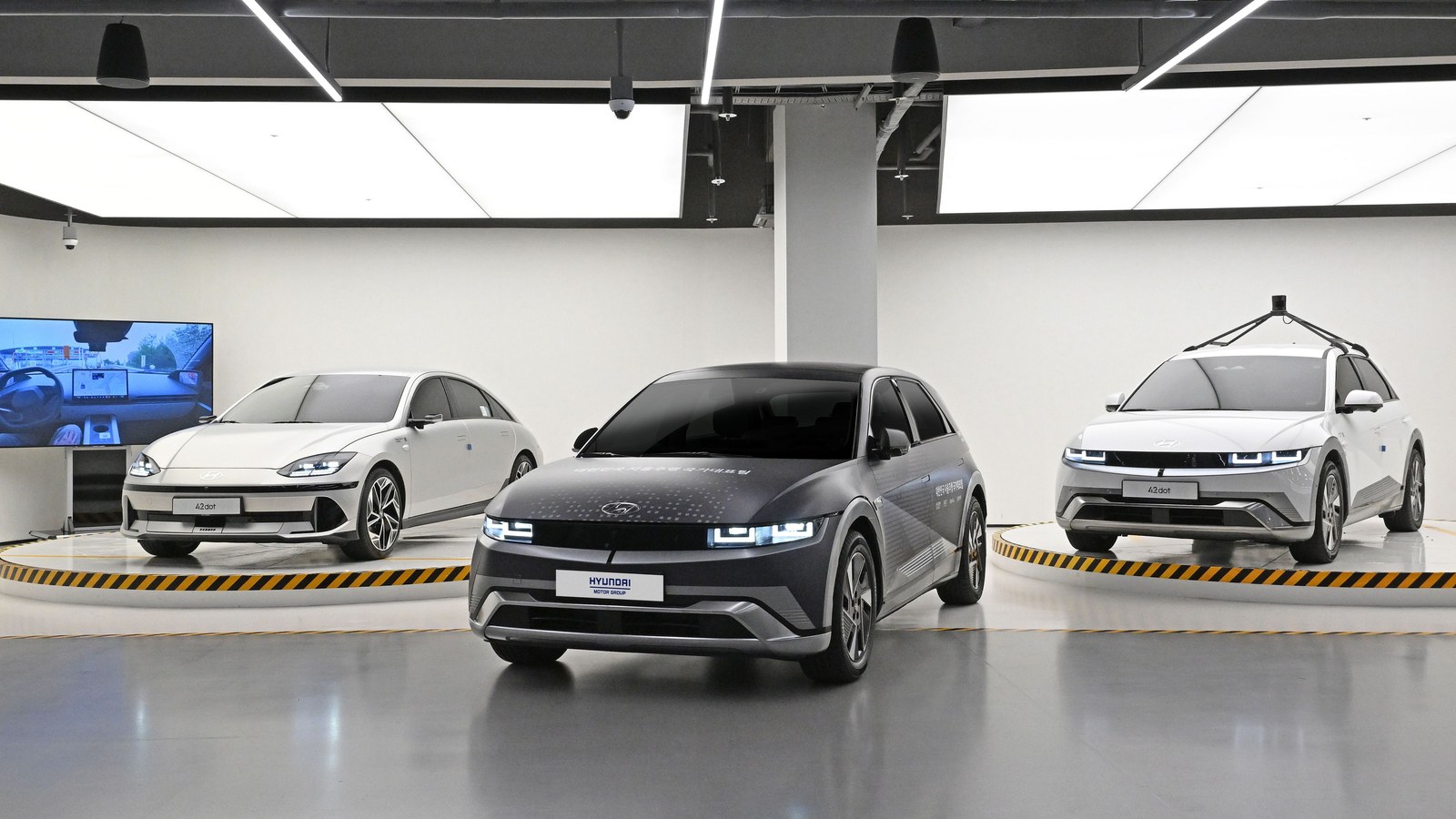
Hyundai Motor Group said on 13 September 2026 that it has put its Data Flywheel into full operation: a cycle of collecting vehicle data, training artificial-intelligence models, validating them and deploying improved versions. The announcement came at “HMG Autonomous Driving Media Day” at 42dot’s headquarters in Gyeonggi Province, South Korea. The group ties the strategy explicitly to its software-defined vehicle (SDV) architecture and to the data it can draw from a global sales network: Hyundai Motor and Kia sell more than 7 million vehicles a year across about 190 countries and regions, according to the release.
The Data Flywheel is described as a virtuous cycle: road data trains and validates AI models, and updated models go back onto vehicles and generate new data. The group currently runs about 40 dedicated collection vehicles around the clock, including for rare situations — roadworks, severe weather, abrupt lane changes, parked cars on narrow streets, dense urban traffic. This year it has folded in hard-example mining, a continuous-training pipeline, virtual validation in reconstructed 3D environments (including 3D Gaussian Splatting), a follow-the-sun development model between South Korea and the United States, a Special Event Recorder, and a Data Union of common sensor and data standards across Hyundai Motor, Kia, 42dot and Motional.
The group presents a dual-track strategy, announced in March with its NVIDIA collaboration. The first track integrates NVIDIA’s vehicle AI computing platform and autonomous-driving software into the SDV architecture. Production targets in the release: NVIDIA-based Level 2+ vehicles in the first half of 2028, and a Level 2++ production vehicle in the second half of 2028. Hyundai says it will progressively standardise sensors used by Hyundai Motor, Kia, 42dot and Motional around NVIDIA DRIVE Hyperion 10. The second track is Atria AI, a proprietary end-to-end system developed jointly by the AVP division and 42dot, with Atria-powered Level 2++ vehicles targeted for the second half of 2029. The statement does not name the production models that will carry these systems.
Level 2++ is not a separate official rung in SAE J3016, which defines driving automation from 0 to 5. In industry use the label usually means a more capable Level 2-class assistance system in which the driver remains responsible and must be able to intervene. Hyundai released footage of an Atria AI-equipped SDV Testbed presented as operating at Level 2++ capability in complex urban traffic, including sequences in Seoul, Gangnam, Jamsil and Pangyo. That is a test and demonstration vehicle, not an unsupervised production car. Level 2 can control steering and speed in some conditions; Level 3 allows the system to take the driving task in limited domains, with the driver taking over when requested; Levels 4 and 5 are higher automation. The release does not announce a fully autonomous production car.
Alongside mass-production work, the group is preparing real-world Level 4 validation. With South Korea’s Ministry of Land, Infrastructure and Transport, it plans to deploy an Atria AI-equipped SDV Pace Car in Jeonnam-Gwangju by year-end. That is a pilot on complex Korean roads, not a commercial Level 4 launch. 42dot is also developing Vision-Language-Action models, now in simulation validation, with on-vehicle testing planned from late 2026 into early 2027.
Minwoo Park, president of the Advanced Vehicle Platform division and CEO of 42dot, said the contest is no longer about isolated features but about how quickly a company can learn from data and put the result into products. Junghyun Kwon, head of the autonomous-driving development centre, said the advantage is not raw data volume but the link from data to learning, validation and performance. The group repeats that only thoroughly validated technology will go into production vehicles. Higher automation still raises questions of liability, cybersecurity and data; the announcement does not settle them, and AI is not a guarantee of safety.
Photo: Hyundai Motor Group. Demonstrator vehicles at HMG Autonomous Driving Media Day, 42dot headquarters, Gyeonggi Province, September 2026. Official newsroom press-kit photograph. The image was cropped to 16:9.
Sources consulted: Hyundai Motor Group Accelerates Autonomous Driving Innovation with AI-Powered Data Flywheel; Hyundai Motor, Kia and NVIDIA Expand Strategic Partnership for Next-Generation Autonomous Driving Technology; SAE J3016 Taxonomy and Definitions for Terms Related to Driving Automation Systems; Hyundai Motor Group Accelerates Autonomous Driving Innovation with AI-Powered Data Flywheel | PR Newswire.








0 Comments
No comments on this article yet. Be the first!