


The Agreement between the Government of the United States of America and the Government of the Union of Soviet Socialist Republics on the Prevention of Incidents On and Over the High Seas was signed in Moscow on 25 May 1972 by Secretary of the Navy John W. Warner and Commander-in-Chief of the Soviet Navy Sergey Gorshkov, in duplicate, the English and Russian texts being equally authentic. It is not the ABM Treaty and not the SALT Interim Agreement, signed at the same summit the following day. Talks had opened in Moscow in October 1971 and continued in Washington in May.
The preamble seeks the safety of navigation of the parties' armed-forces ships on the high seas and of the flight of their military aircraft over the high seas, guided by the principles and rules of international law. Article I defines, at framework level, a warship, a naval auxiliary, military aircraft and a formation. Article II: the parties instruct commanding officers to observe strictly the letter and spirit of the International Regulations for Preventing Collisions at Sea; freedom to conduct operations on the high seas rests on recognized international law, including the 1958 Geneva Convention on the High Seas.
Articles III–V require, as a matter of principle, that ships operating in proximity remain well clear, that formations not be hindered, that manoeuvres not be conducted through traffic-separation schemes, that surveillance ships keep a safe distance, that recognized signals be used, that simulated attacks and illumination of navigation bridges be prohibited, that submarine exercises be signalled, and that aircraft commanders use caution. A manoeuvre, signalling or collision-avoidance handbook is not set out here.
Article VI: notification, as a rule three to five days in advance, of high-seas actions that represent a danger to navigation or to aircraft in flight, through the established system of warnings to mariners, and increased use of informative signals; additional signals may be tried and submitted to IMCO. Article VII: exchange of information on collisions and incidents, through the naval attachés in Washington and Moscow. Article X establishes a committee to consider specific measures, including the practical workability of concrete fixed distances, and to submit recommendations to the consultations in Article IX.
Article VIII: the agreement enters into force on the date of signature, for three years, thereafter renewed without further action for successive three-year periods; either party may terminate it upon six months' written notice. Article IX: a meeting to review implementation within one year, then annual consultations or more frequent ones as the parties decide. A 1973 protocol extended some rules to non-military ships; it is not this agreement. Combat, pursuit and tactical-signalling procedures are not transcribed.
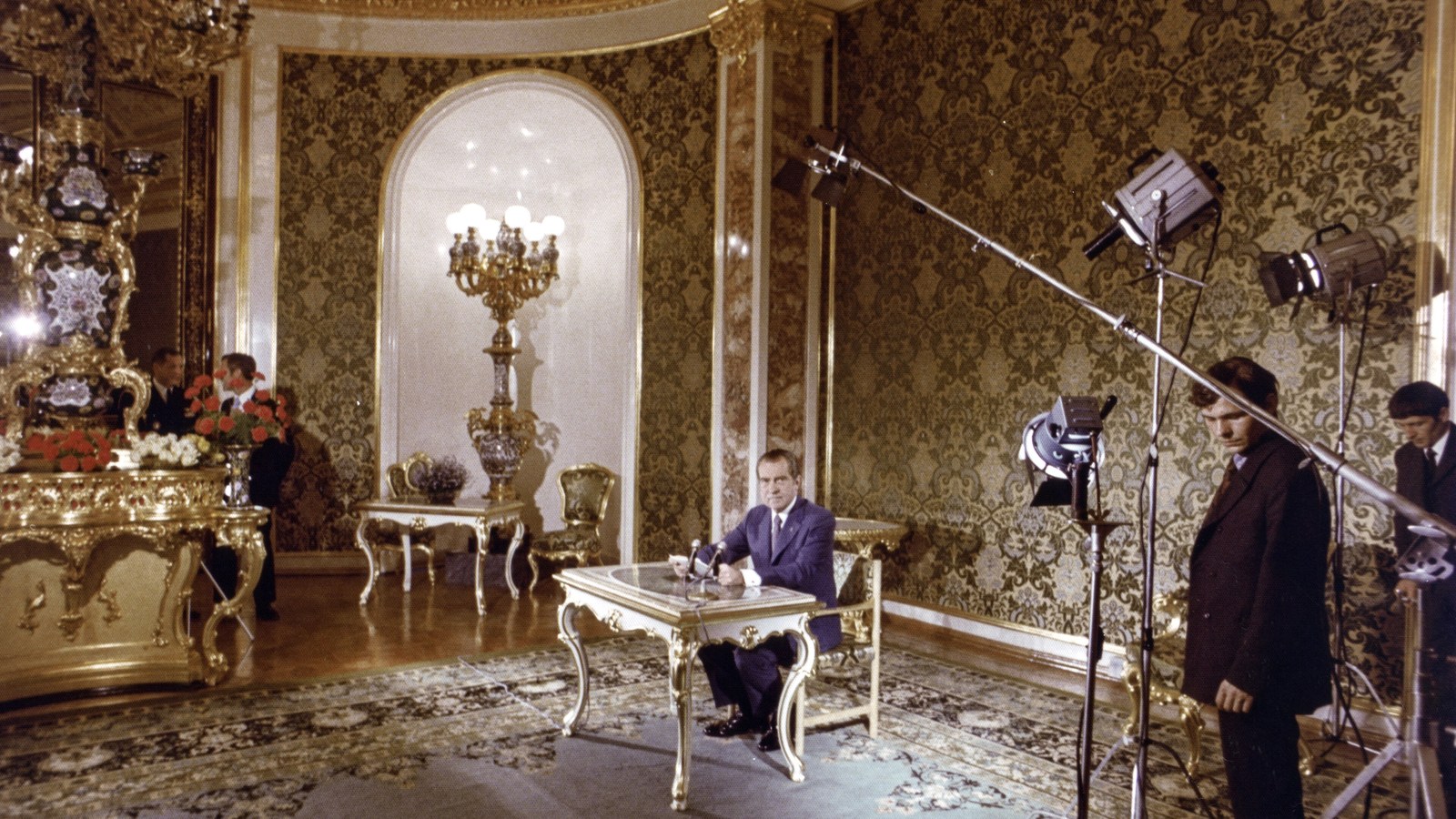
Cover: the Grand Kremlin Palace, venue of the Moscow summit; we do not claim the signing table of this agreement. Wikimedia Commons, free licence.
Sources consulted: U.S.–Soviet Incidents at Sea agreement; Agreement on the prevention of incidents on and over the high seas (UNTS 12214).











0 Comments
No comments on this article yet. Be the first!