


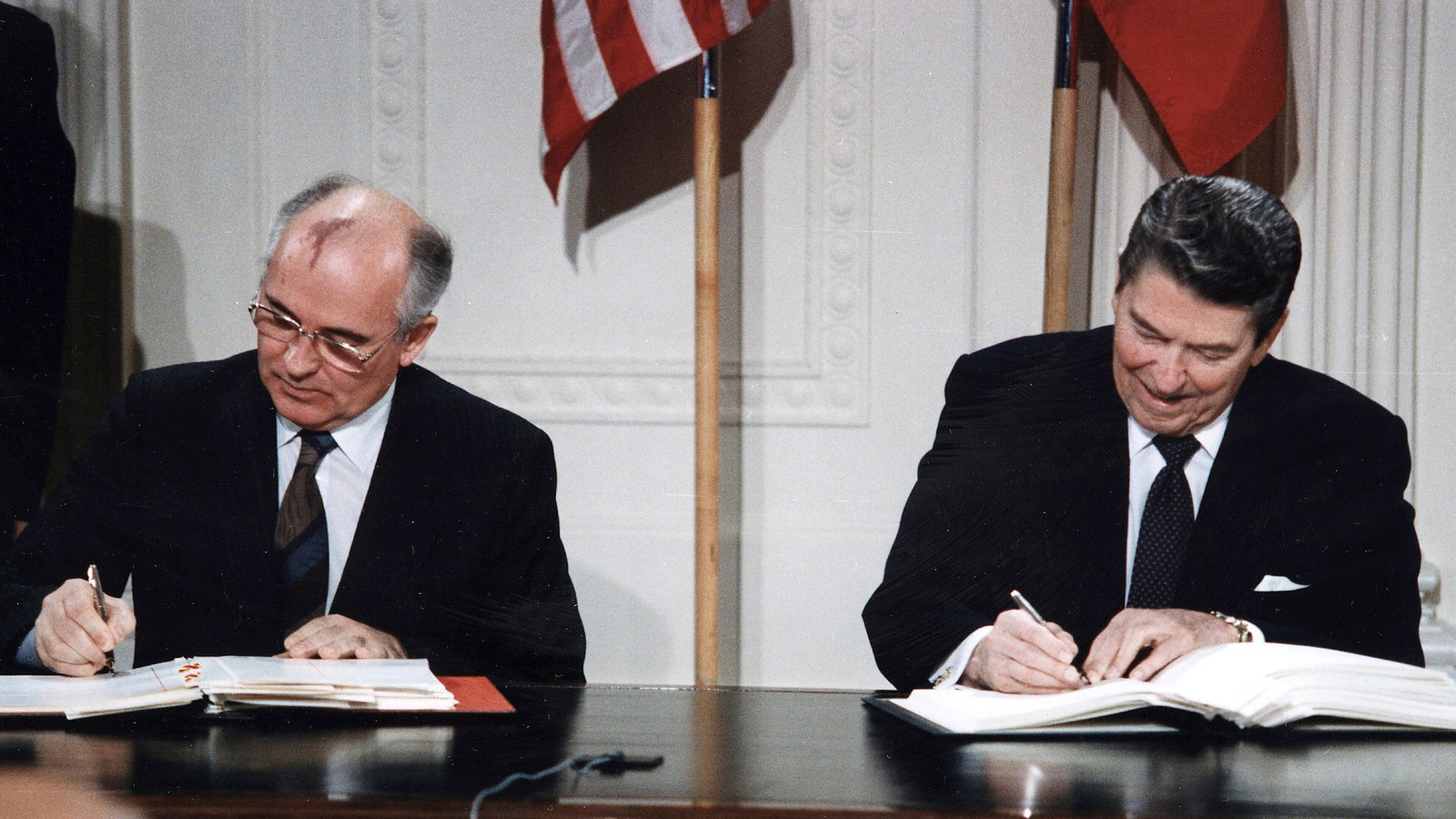
On 8 December 1987, in the East Room of the White House, Ronald Reagan and Mikhail Gorbachev sign the Treaty between the United States of America and the Union of Soviet Socialist Republics on the Elimination of Their Intermediate-Range and Shorter-Range Missiles. Two copies, English and Russian, both authentic. Reagan signs as President. Gorbachev, as General Secretary of the CPSU Central Committee.
Article I: each Party shall eliminate its intermediate-range and shorter-range missiles, not have such systems thereafter, and carry out the other obligations. The Memorandum of Understanding and the Protocols form an integral part. Article II: ground-launched ballistic missile, ground-launched cruise missile. Intermediate-range: in excess of 1,000 kilometres, not in excess of 5,500. Shorter-range: equal to or in excess of 500, not in excess of 1,000. Air and sea stay out.
Article III, existing types. For the United States, intermediate-range: Pershing II and BGM-109G. For the USSR: RSD-10, R-12, R-14, known in the West as SS-20, SS-4, SS-5. Shorter-range: Pershing IA; Soviet, OTR-22 and OTR-23, SS-12 and SS-23. Article IV: elimination of intermediate-range missiles no later than three years after entry into force, in two phases, the first at 29 months.
Article XI: on-site inspections, including of elimination. Article XV: unlimited duration. Each Party may withdraw, with six months’ notice, if extraordinary events related to the subject matter have jeopardized its supreme interests. Article XVII: ratification under constitutional procedures; entry into force on the exchange of instruments. The U.S. Senate advises on 27 May 1988, 93–5. The exchange is in Moscow, on 1 June 1988. Reagan proclaims on 27 December.
By 1 June 1991, the three-year deadline, 2,692 missiles are gone: 846 American, 1,846 Soviet. The SS-20, mobile, with three warheads, had been deployed from 1976. NATO had answered, on 12 December 1979, with the Double-Track Decision: talks and, if they failed, Pershing II in West Germany and 464 GLCMs in Belgium, Italy, the Netherlands and the United Kingdom. Reagan had put the Zero Option on 18 November 1981. At Reykjavík, in October 1986, the two had agreed in principle to zero in Europe and a global cap.
After 1991, Belarus, Kazakhstan, Russia and Ukraine continue the obligations. Inspections run until 31 May 2001. Washington accuses Moscow over the 9M729 (SSC-8) missile. The United States withdraws on 2 August 2019. Russia announces, on 4 August 2025, that it will no longer abide by the treaty.
Image: White House Photographic Office, signing of the INF Treaty, East Room, 8 December 1987, public domain, NARA / Wikimedia Commons. Cropped to 16:9.
Source consulted: Intermediate-Range Nuclear Forces Treaty. Treaty text: Treaty between the United States of America and the Union of Soviet Socialist Republics on the Elimination of Their Intermediate-Range and Shorter-Range Missiles.











0 Comments
No comments on this article yet. Be the first!