


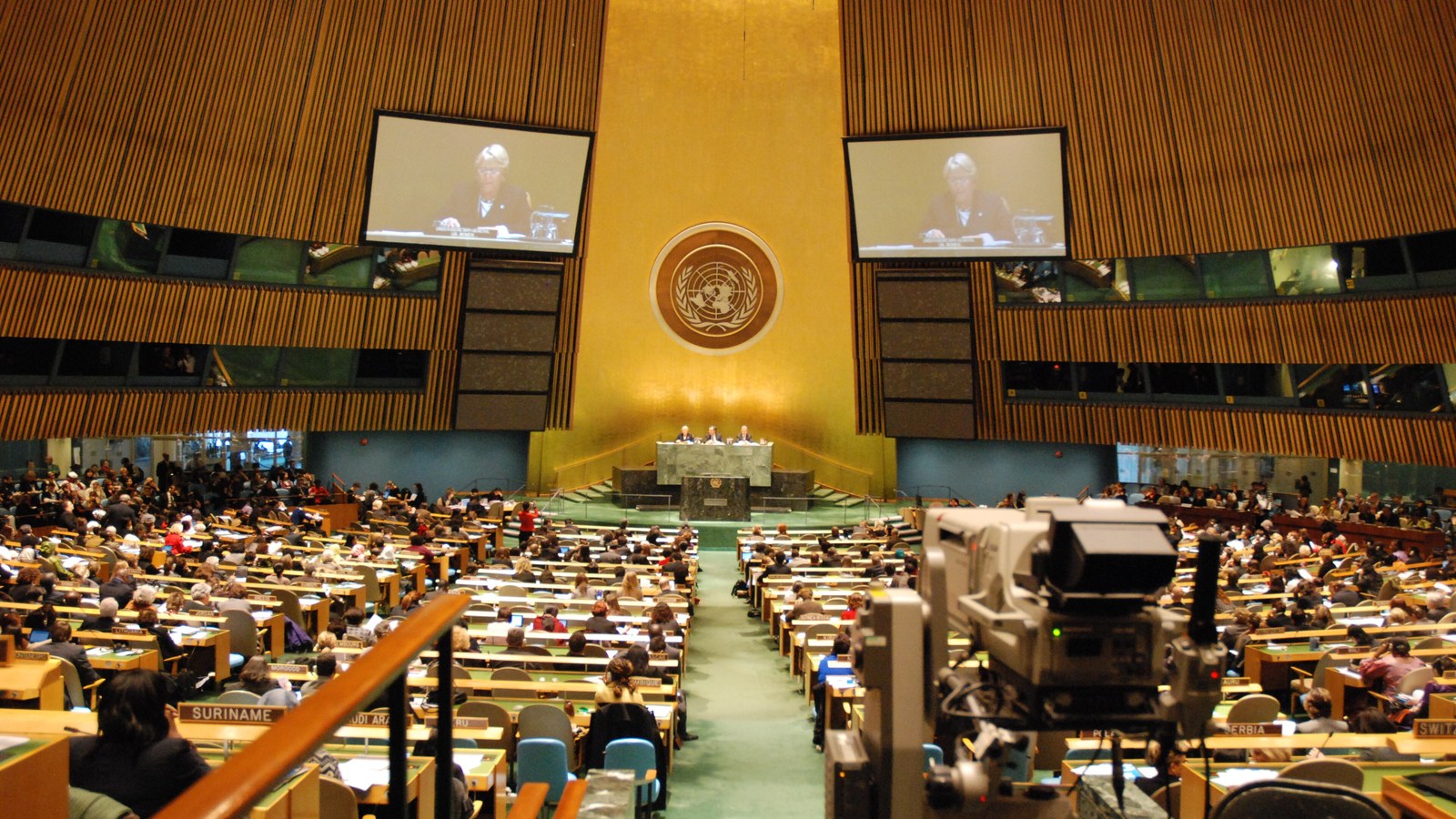
On 16 December 1966 the United Nations General Assembly, meeting in New York, adopted by resolution 2200 A (XXI) the International Covenant on Economic, Social and Cultural Rights. The same act also contains the International Covenant on Civil and Political Rights and the Optional Protocol thereto. The Covenant was opened for signature in New York on 19 December 1966. The authentic texts are Chinese, English, French, Russian and Spanish. The depositary is the Secretary-General.
Article 1 recognizes the right of peoples to self-determination, including freely to determine their political status and freely to pursue their economic, social and cultural development, and freely to dispose of their natural wealth and resources, without depriving a people of its own means of subsistence. States responsible for Non-Self-Governing and Trust Territories shall promote the realization of this right.
Article 2 requires each State Party to take steps, individually and through international assistance and co-operation, especially economic and technical, to the maximum of its available resources, with a view to achieving progressively the full realization of the recognized rights by all appropriate means, including particularly the adoption of legislative measures. The rights shall be exercised without discrimination of any kind as to race, colour, sex, language, religion, political or other opinion, national or social origin, property, birth or other status. Developing countries may determine to what extent they would guarantee the economic rights recognized to non-nationals, with due regard to human rights and their national economy. Article 3 ensures the equal right of men and women. Article 4 permits limitations only by law, compatible with the nature of these rights, and solely for the purpose of promoting the general welfare in a democratic society.
Article 6 recognizes the right to work, which includes the opportunity to gain a living by work which is freely chosen or accepted, with technical and vocational guidance and training and employment policies. Article 7 requires just and favourable conditions of work: fair wages and equal remuneration for work of equal value, a decent living for workers and their families, safe and healthy working conditions, equal opportunity for promotion subject to seniority and competence, rest, limitation of working hours and paid holidays. Article 8 recognizes the right to form and join trade unions, the right of trade unions to function freely, and the right to strike, provided it is exercised in conformity with the laws of the particular country; lawful restrictions may be imposed on members of the armed forces, the police or the administration of the State. Article 9 recognizes the right to social security, including social insurance.
Article 10 requires the widest possible protection and assistance to the family, free consent to marriage, paid leave or adequate social security benefits for mothers before and after childbirth, and special measures for children and young persons, including a minimum age of employment. Article 11 recognizes the right to an adequate standard of living, including adequate food, clothing and housing, and to the continuous improvement of living conditions, as well as the right to be free from hunger. Article 12 recognizes the right to the enjoyment of the highest attainable standard of physical and mental health, with steps for infant mortality, environmental and industrial hygiene, epidemic disease, and medical service. Article 13 recognizes the right to education, directed to the full development of the human personality; primary education shall be compulsory and available free to all, secondary education generally available and accessible with the progressive introduction of free education, and higher education equally accessible on the basis of capacity, also with progressive free education. Article 14 requires, within two years, a plan for compulsory free primary education where it does not already exist. Article 15 recognizes the right to take part in cultural life, to enjoy the benefits of scientific progress, and to benefit from the protection of the moral and material interests resulting from scientific, literary or artistic production.
Articles 16 to 25 provide for reports to the Secretary-General, transmitted to the Economic and Social Council, on the measures adopted and the progress made. Article 26 opens the Covenant for signature by Members of the United Nations, of the specialized agencies, parties to the Statute of the International Court of Justice, and States invited by the General Assembly. Article 27 provides that the Covenant shall enter into force three months after the deposit of the thirty-fifth instrument of ratification or accession. Those conditions were later met; the Covenant entered into force on 3 January 1976. Article 28 extends to all parts of federal States without any limitations or exceptions. Article 29 governs amendments. Article 31 deposits the texts in the archives of the United Nations.
It is not the International Covenant on Civil and Political Rights, adopted in the same resolution. It is not the Optional Protocol to the International Covenant on Economic, Social and Cultural Rights of 10 December 2008, which opens individual communications.
Image: United Nations General Assembly Hall, Commission on the Status of Women session; Silje Bergum Kinsten, 22 February 2011; CC BY 2.5 dk, Wikimedia Commons. Cropped to 16:9.
Source consulted: International Covenant on Economic, Social and Cultural Rights. Treaty text: International Covenant on Economic, Social and Cultural Rights, New York, 16 December 1966.











0 Comments
No comments on this article yet. Be the first!