


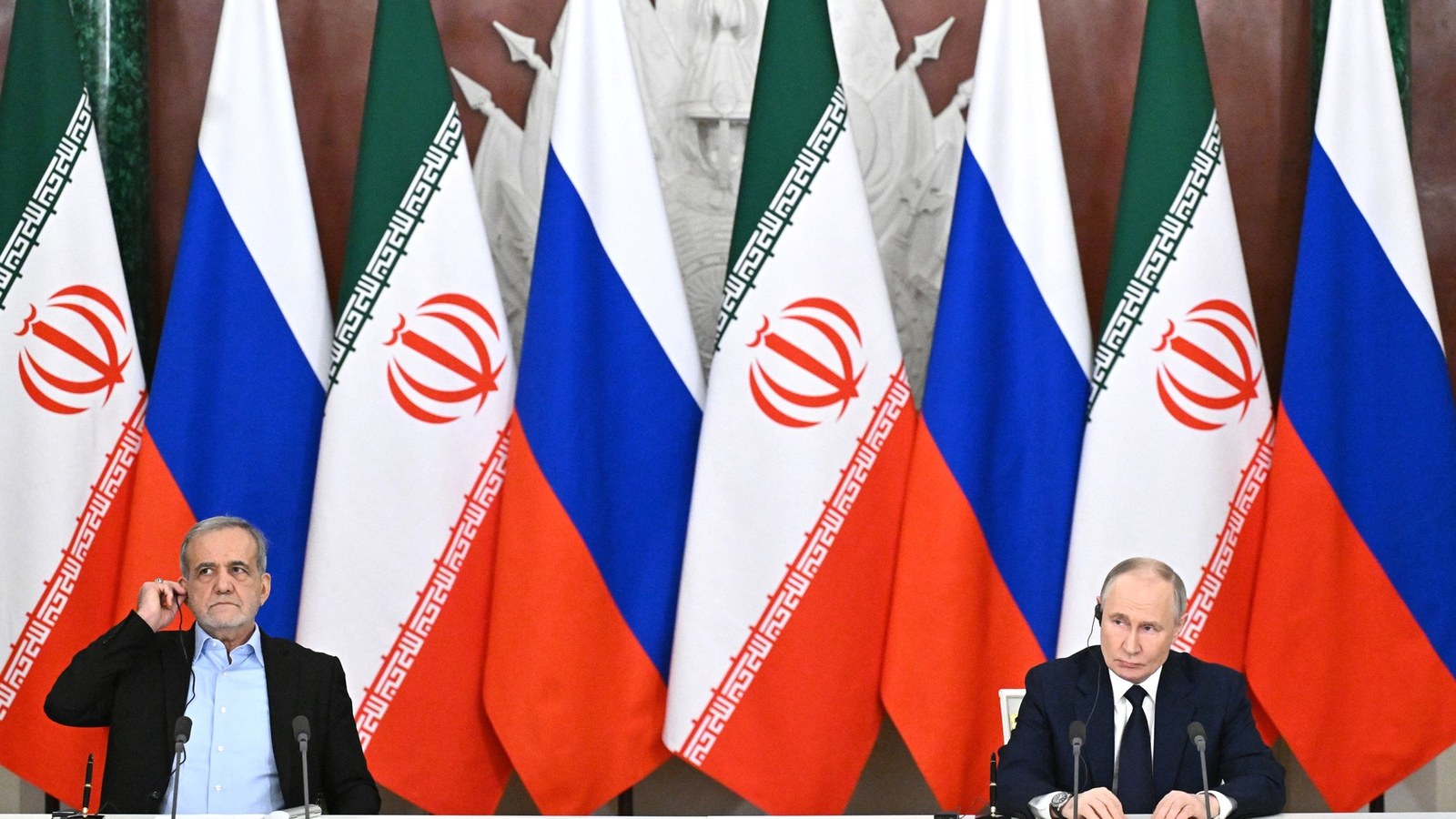
At Moscow, the Russian Federation and the Islamic Republic of Iran conclude on 17 January 2025 the Treaty on Comprehensive Strategic Partnership. It is signed by President Vladimir Putin of Russia and President Masoud Pezeshkian of Iran. The instrument consists of a preamble and 47 articles, in two originals in the Russian, Persian and English languages, all texts being equally authentic; in case of any disagreement in interpretation or implementation, the English text shall be used. The parties seek to bring friendly interstate relations to a comprehensive, long-term and strategic character, based on sovereign equality, good-faith cooperation and the United Nations Charter, including renunciation of the threat or use of force, non-interference in internal affairs, and respect for the territorial integrity of both States.
Article 1 provides that the Contracting Parties shall seek to deepen and expand relations in all fields of mutual interest, strengthen cooperation in security and defence, and closely coordinate activities at the regional and global levels. Article 2 requires a state policy based on mutual respect for national and security interests, multilateralism, peaceful settlement of disputes and rejection of unipolarity and hegemony in world affairs, as well as countering interference by third parties. Article 3 founds the relationship on sovereign equality, territorial integrity, independence, non-interference, cooperation and mutual trust. If either Party is subject to aggression, the other shall not provide any military or other assistance to the aggressor which would contribute to the continued aggression, and shall help to ensure that the differences are settled on the basis of the United Nations Charter; the Parties shall not permit the use of their territories in support of separatist movements or hostile actions against each other.
Article 4 provides that the intelligence and security agencies shall exchange information and experience and increase cooperation under separate agreements. Article 5 develops military cooperation: exchange of delegations, port calls by military ships, training of personnel, joint exercises in the territory of both Parties and beyond by mutual consent, maritime relief and rescue, and combating piracy and armed robbery at sea. Article 6 confirms military-technical cooperation on the basis of respective agreements as an important component of regional and global security, with annual sessions of the relevant working bodies. Article 7 covers international terrorism, transnational organized crime, human trafficking, illegal migration, illicit financial flows, money laundering, terrorist financing and proliferation of weapons of mass destruction, as well as coordination within INTERPOL. Article 8 protects the rights and legitimate interests of each Party's citizens in the territory of the other, including legal assistance, extradition and transfer of sentenced persons.
Article 9 provides for consultations within international organizations, including the United Nations, and reciprocal support for membership. Article 10 addresses arms control, disarmament, non-proliferation and international security. Article 11 develops international information security, a legally binding regime under the aegis of the United Nations, sovereignty over national segments of the Internet, and the involvement of the International Telecommunication Union. Article 12 requires the Parties to facilitate peace and security in the Caspian region, Central Asia, Transcaucasia and the Middle East and to cooperate to prevent interference and destabilizing presence of third states. Article 13 preserves the Caspian Sea as a zone of peace, with no armed forces not belonging to the coastal States, confirms the exclusive competence of the littoral states, and provides for economic use with environmental protection. Article 14 deepens work in the Shanghai Cooperation Organization and trade and economic ties between the Eurasian Economic Union and Iran. Article 15 promotes cooperation between legislative bodies, including the Commission for Cooperation between the State Duma and the Islamic Consultative Assembly.
Article 17 coordinates trade and economic cooperation within the Permanent Russian-Iranian Commission on Trade and Economic Cooperation. Article 18 facilitates joint investment, infrastructure financing, easing of trade and business mechanisms, and banking cooperation. Article 19 counters the application of unilateral coercive measures, including those of an extraterritorial nature, considers their imposition an internationally wrongful and unfriendly act, guarantees non-application of such measures against each other, requires the Parties to refrain from joining such measures of any third party, and provides for practical efforts to reduce risks if a third party introduces them. Article 20 aims to augment mutual trade by developing a payment infrastructure independent of third states, transitioning to bilateral settlements in national currencies, direct interbank cooperation, special and free economic zones, and readiness to cooperate in gold-mining, diamond and jewellery industries.
Article 21 develops transport partnership, including the North-South International Transport Corridor, all modes of transport and digital transportation systems. Article 22 expands oil and gas cooperation on equality and mutual benefit: scientific and technical assistance, energy supplies and swap operations, investment in field development, non-discriminatory access to international energy markets, coordinated policy in the Gas Exporting Countries Forum and OPEC-plus, and renewable energy. Article 23 promotes long-term projects in the peaceful use of nuclear energy, including construction of nuclear energy facilities. Articles 24 to 27 cover agriculture and food safety, a simplified customs corridor and mutual recognition of authorized economic operator programmes, anti-monopoly policy, and mutual recognition of standards, test reports and certificates of conformity.
Articles 28 to 30 cover health care, sanitary and epidemiological well-being, higher education, science and the study of each Party's official language. Article 31 concerns exploration and exploitation of outer space for peaceful purposes. Articles 32 and 33 strengthen mass-media ties and require joint opposition to disinformation and negative propaganda directed against either Party. Article 34 encourages culture and art and creates favourable conditions for the Iranian Cultural Center in Moscow and the Russian Cultural Center in Tehran. Articles 35 to 40 address cultural heritage and tourism, youth exchanges, physical culture and sports, disaster prevention and response, environmental protection and water resources management.
Article 41 allows separate agreements to define specific areas and parameters of cooperation. Article 42 provides for an exchange of views on implementation, including at regular summits and high-level meetings. Article 43 provides that the Treaty shall not affect rights and obligations deriving from other international treaties. Article 44 leaves disputes on interpretation or implementation to consultations and negotiations through diplomatic channels. Article 45 makes the Treaty subject to ratification; it enters into force upon the expiration of 30 days from the date of the last written notification of completion of domestic procedures, remains valid for 20 years with automatic renewal for subsequent five-year periods, and may be terminated if one Party notifies the other in writing no later than one year prior to expiration. Article 46 provides that termination shall not affect current projects unless the Parties agree otherwise in writing. Article 47 allows amendment by mutual written agreement, entering into force in accordance with Article 45. The Treaty is concluded in the city of Moscow. This text is not the earlier treaty on the basis for mutual relations and principles of cooperation.
Image: joint press conference following the Russian-Iranian talks, Moscow, 17 January 2025; Kremlin.ru, CC BY 4.0, Wikimedia Commons. Cropped to 16:9.
Source consulted: Iranian-Russian Treaty on Comprehensive Strategic Partnership. Treaty text: Full text of Iran-Russia Comprehensive Strategic Partnership Treaty, 17 January 2025.











0 Comments
No comments on this article yet. Be the first!