


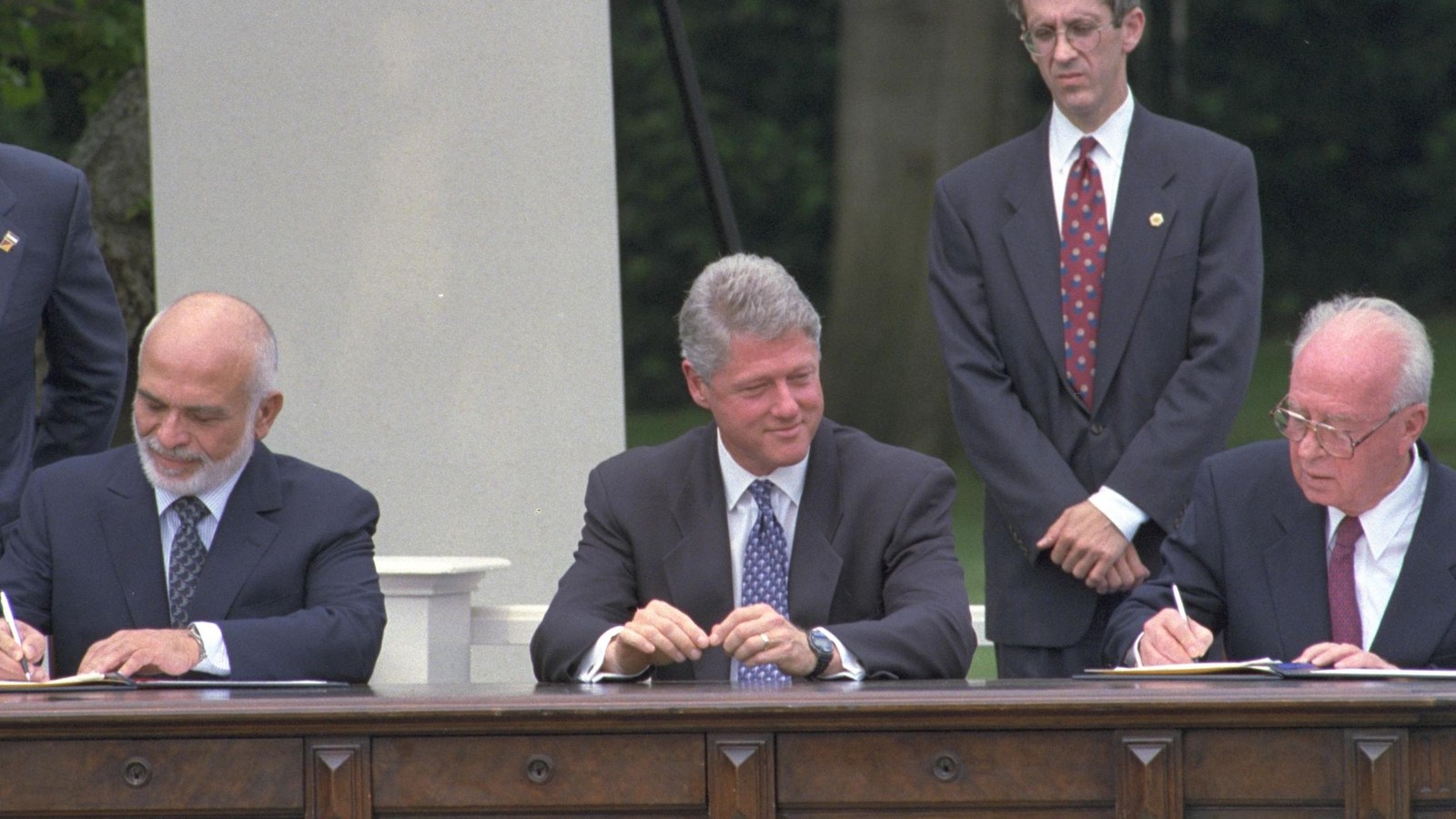
The 1948 war left Israel and Jordan in a state of belligerency. In 1987 Shimon Peres and King Hussein sketched, in London, a framework for a peace conference; Yitzhak Shamir blocked the formula. In 1988 Amman dropped its claims to the West Bank in favour of a settlement with the PLO. After Oslo, Rabin and Peres told Hussein that Jordan risked being left out of the game. Hosni Mubarak encouraged him; Hafez al-Assad told him only to talk, not to sign. Bill Clinton pushed the talks and promised relief of Jordanian debt. On 25 July 1994 the Washington Declaration ended the official state of enmity.
The Treaty of Peace Between the State of Israel and the Hashemite Kingdom of Jordan was signed on 26 October 1994 at the Arava/Araba crossing, north of Eilat, on the Israeli side of Wadi Araba. Prime Minister Yitzhak Rabin signed for Israel, Prime Minister Abdelsalam al-Majali for Jordan. President Ezer Weizman shook hands with King Hussein. Clinton looked on, accompanied by Secretary of State Warren Christopher. The United States and the Russian Federation stood as witnesses. The text was deposited with the UN Secretary-General (UNTS 35325). Jordan became the second Arab state, after Egypt, to conclude peace with Israel.
Article 1 establishes peace from the exchange of instruments of ratification. Article 3 delimits the international boundary by the Mandate line, “without prejudice to the status of any territories that came under Israeli military government control in 1967”. Where the line follows a river, it follows the new natural course. Maritime delimitation in the Gulf of Aqaba was to be finished within nine months. Annex I (b) and (c) set special regimes for Naharayim/Baqura (Jordanian sovereignty, Israeli private ownership) and Zofar/Al-Ghamr.
Article 6 recognises allocations on the Jordan, the Yarmouk and Araba groundwater, set out in Annex II: a Joint Water Committee, a diversion dam at Adassiya and storage of floods. Article 4 binds both states against the use of territory as a staging ground by a third party and sketches a Conference on Security and Co-operation in the Middle East, on the model of the Helsinki process. Article 9 recognises Jordan’s special role at the Muslim holy shrines in Jerusalem and gives it high priority in permanent-status talks.
The 30 articles, five annexes and agreed minutes cover diplomacy (resident ambassadors within a month of ratification), a ban on hostile propaganda, crime and drugs, transport, free navigation through Tiran and the Gulf of Aqaba, civil aviation, tourism, energy and the joint development of Aqaba and Eilat. Egypt welcomed the accord; Syria ignored it. Twenty minutes before the ceremony, Hezbollah fired mortars and rockets at towns in northern Galilee.
The Knesset ratified by 92 votes to 3. The borders opened; Israeli tourists began to go to Petra. After Rabin’s assassination on 4 November 1995, Hussein spoke at the funeral in Jerusalem — his first visit to the city since the 1967 war. In October 2018 Amman notified Israel that it would not renew the 25-year leases on Naharayim/Baqura and Tzofar/Al-Ghamr, a right set out in Annex I.
Sources: Israel–Jordan peace treaty; UNISPAL, Israel-Jordan peace treaty.











0 Comments
No comments on this article yet. Be the first!