


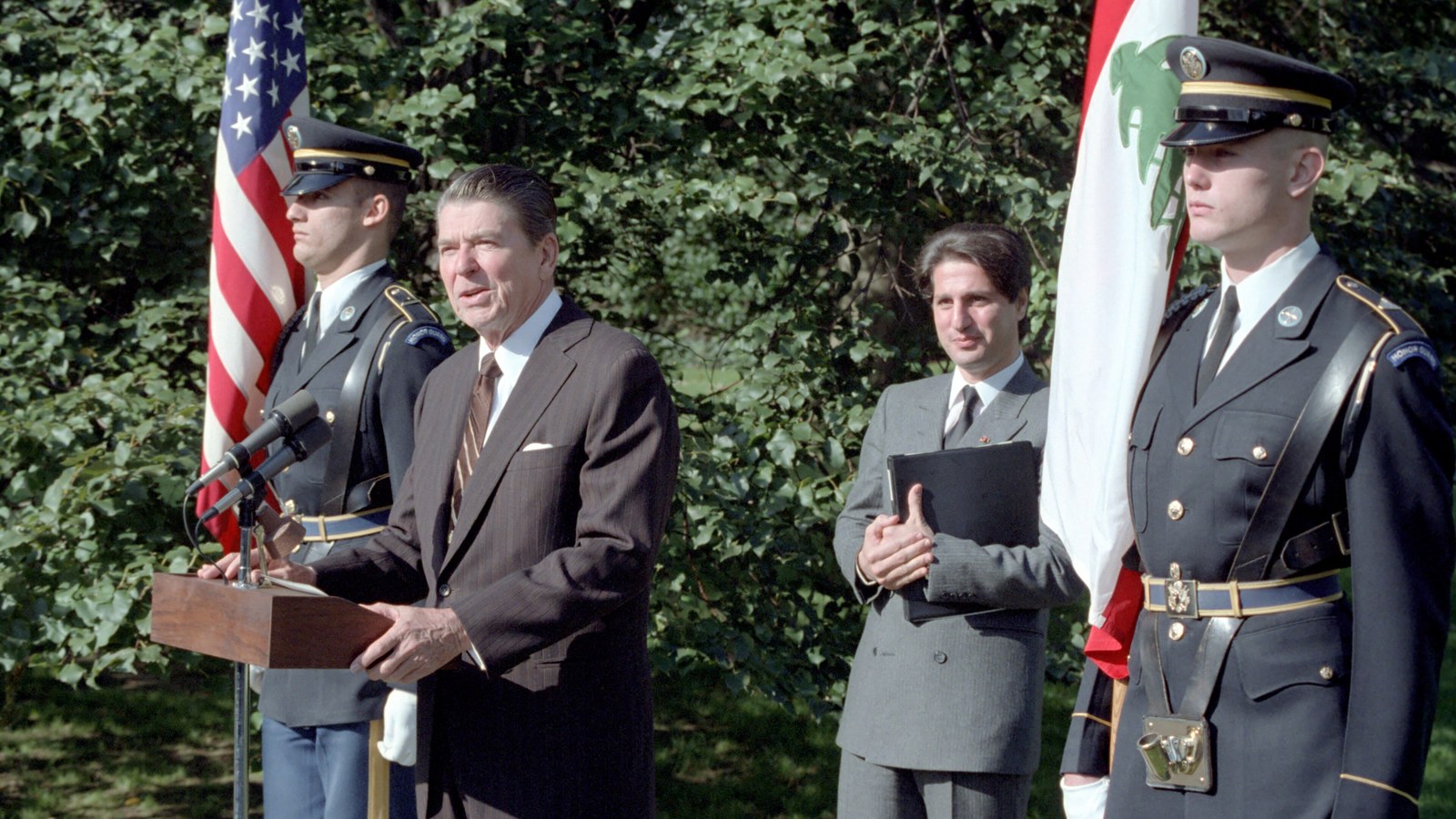
Israel invaded Lebanon in June 1982, to push the PLO off the northern border, and besieged Beirut. President-elect Bachir Gemayel was assassinated; his brother Amin took the palace. Talks, with American mediation, lasted nearly five months. George Shultz came to the region at the end of April. The instrument — not a formal peace treaty — was signed on 17 May 1983, in two ceremonies: the Arabic and French texts at Khalde, near Beirut; the Hebrew and English at Kiryat Shmona. For Lebanon: Antoine Fattal. For Israel: David Kimche, director-general of the Foreign Ministry. Witness: Morris Draper, for the United States. English and French are equally authentic if the versions diverge.
Article 1: the parties respect each other's sovereignty, political independence and territorial integrity; the existing international boundary is inviolable; the state of war, open since 1948, is declared terminated; Israel undertakes to withdraw its forces, according to the annex. Article 4: neither territory shall be a base for hostile or terrorist acts against the other; arrangements that enabled hostile elements to operate are null. Article 5: no hostile propaganda.
The annex created a "Security Region" in southern Lebanon, up to Line A on the map. Only the Lebanese Army, police, internal security forces and ANSAR, plus two brigades, with the weapons in the appendix. Local units were to be folded into the army. Israeli withdrawal: within 8 to 12 weeks of entry into force, "consistent with the objective of Lebanon that all external forces withdraw from Lebanon". Article 8: a Joint Liaison Committee, with the United States a participant; liaison offices; within six months after withdrawal, talks on goods and persons.
Entry into force required the exchange of ratifications. Syria refused to move its troops; without a Syrian withdrawal the annex could not be applied. Lebanese Muslim opposition and the Arab world called the text an imposed surrender. On 6 February 1984 the confessional government collapsed under civil war in Beirut. The cabinet cancelled the agreement on 5 March 1984. Parliament, 49 deputies present, revoked it unanimously on 21 May 1987, under Hussein el-Husseini, together with the 1969 Cairo Agreement.
This is not the 1949 General Armistice and not Camp David. Israel remained in the south until 2000. The cover is Amin Gemayel beside Reagan at the White House; Fattal on Commons is too small, and no scan of the instrument clears 1600 pixels.
Sources: May 17 Agreement; Agreement between the Government of the State of Israel and the Government of the Republic of Lebanon.











0 Comments
No comments on this article yet. Be the first!