


On 23 October 2020, Donald J. Trump, Abdel Fattah al-Burhan, chairman of Sudan’s Sovereignty Council, Prime Minister Abdalla Hamdok and Benjamin Netanyahu spoke together and issued a joint statement of the United States, the Republic of Sudan and the State of Israel. It is not the White House ceremony of 15 September, with the Emirates and Bahrain. Nor is it the signing of the Abraham Accords Declaration in Khartoum on 6 January 2021, with Steven Mnuchin. That day there was no bilateral treaty on a table, but a call and a communiqué: the leaders agreed to the normalisation of relations between Sudan and Israel and to end the state of belligerence between their nations.
The text ties the step to Sudan’s removal from the American list of state sponsors of terrorism, announced by Trump after the deposit of $335 million for victims of the 1998 embassy bombings in Kenya and Tanzania and of the USS Cole in 2000. The United States, the statement says, will take steps to restore Sudan’s sovereign immunity and to reduce its debt burdens, including discussions on debt forgiveness consistent with the Heavily Indebted Poor Countries Initiative. The United States and Israel also committed to supporting Sudanese democracy, food security, counter-terrorism and economic potential.
Beyond ending belligerence, the leaders agreed to begin economic and trade relations, with an initial focus on agriculture. Delegations were to meet in the coming weeks to negotiate cooperation in those fields, as well as agriculture technology, aviation, migration and other areas. The communiqué does not open embassies, set an accreditation calendar or repeal Sudan’s 1958 law boycotting Israel — the Khartoum cabinet voted that repeal only on 6 April 2021, with the Sovereignty Council’s confirmation on 20 April.
Sudan had sent troops in the Arab–Israeli wars. In Khartoum, in 1967, the Arab League held the “three noes”: no peace, no recognition, no negotiations. In February, Netanyahu and Burhan had met in Uganda and talked of normalisation; Israeli aircraft were then allowed to overfly Sudan. On 22 October an Israeli delegation saw Burhan in Khartoum. Sudan’s acting foreign minister said, on the same day as the statement, that the understanding depends on a legislative council not yet formed. The transitional government treated it as a preliminary agreement.
On 6 January 2021 Sudan signed in Khartoum the declarative section of the Abraham Accords, not the corresponding bilateral document with Israel, unlike the UAE and Bahrain. Talks toward full diplomatic relations remained open. It is not the Egyptian–Israeli peace treaty of 1979, nor the one with Jordan of 1994.
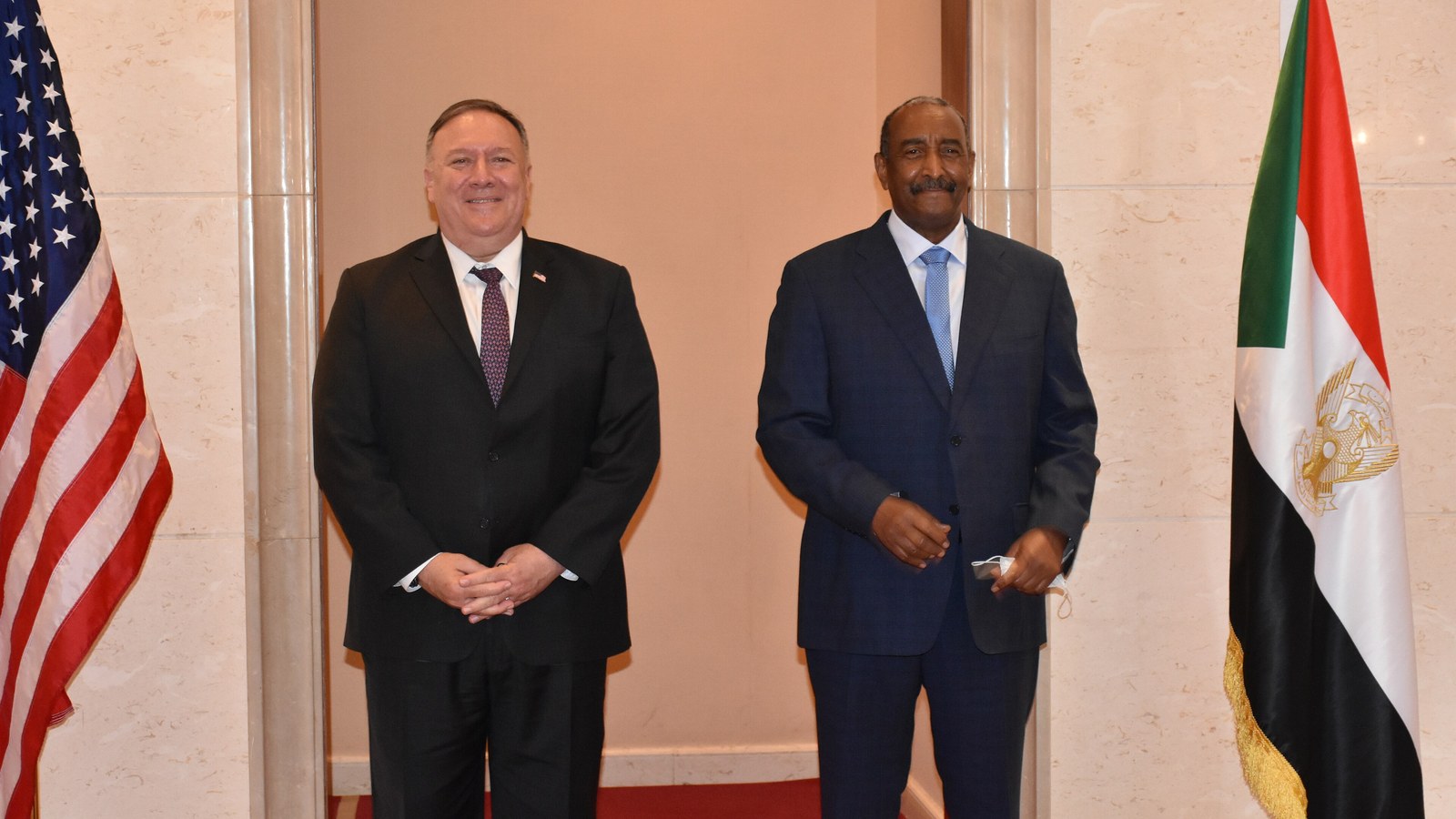
Abdel Fattah al-Burhan with Secretary of State Mike Pompeo, Khartoum, 25 August 2020, not the October call. State Department, public domain.
For context: Israel–Sudan normalization agreement. The text: Joint Statement of the United States, the Republic of Sudan, and the State of Israel.











0 Comments
No comments on this article yet. Be the first!