


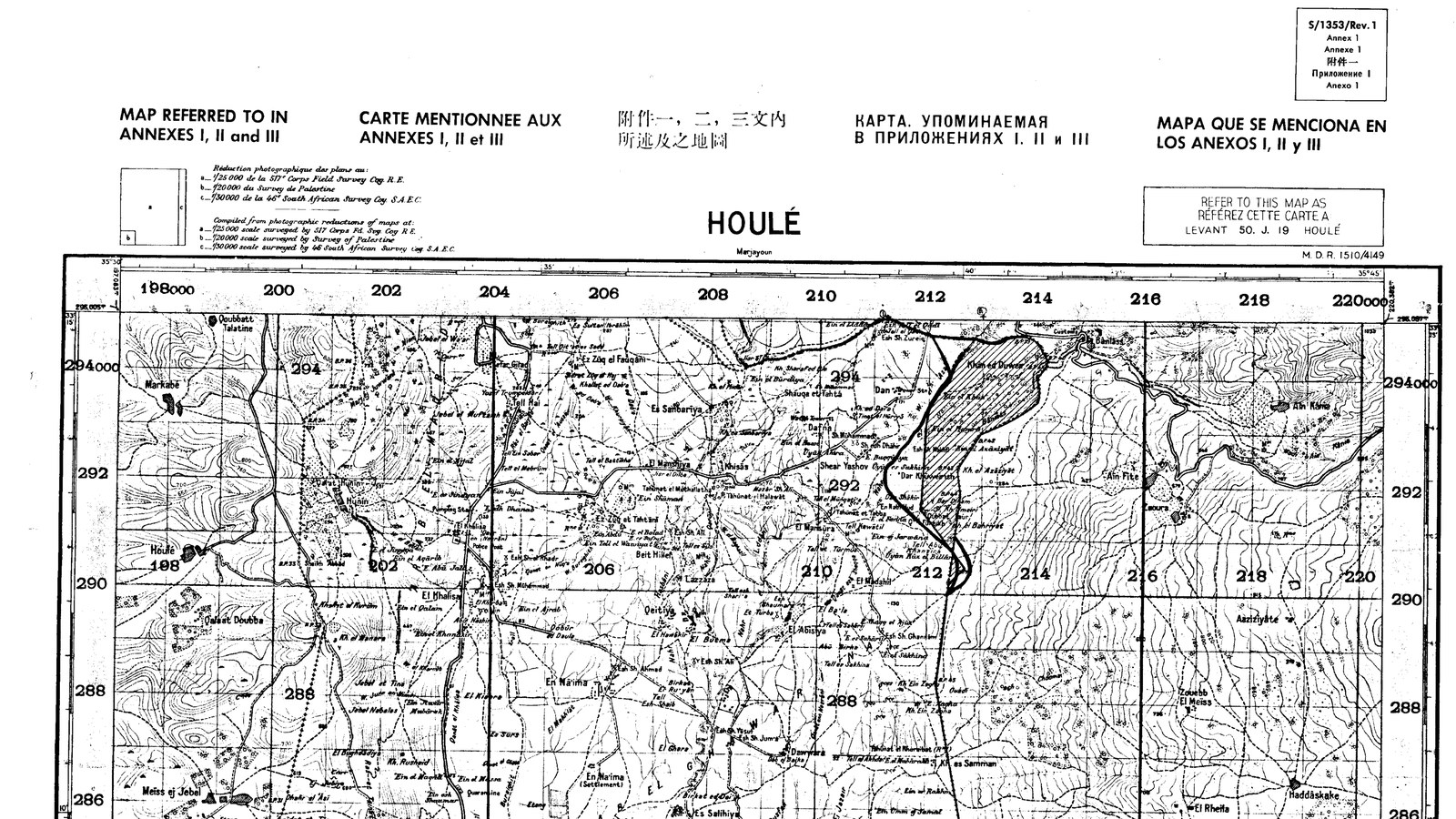
At Hill 232, near Mahanayim, on 20 July 1949, the Israeli and Syrian delegations signed the General Armistice Agreement. For Israel: Lieutenant-Colonel Mordechai Makleff, Yehoshua Pelman, Shabtai Rosenne. For Syria: Colonel Fozi Selo, Lieutenant-Colonel Mohamed Nasser, Captain Afif Sizri. Present were the Personal Deputy of the United Nations Acting Mediator and the UNTSO Chief of Staff, Brigadier-General William E. Riley. Article VIII: not subject to ratification; it comes into force on signature. Authentic texts: English and French, in quintuplicate.
The act is not the February armistice with Egypt at Rhodes, nor the March one with Lebanon, nor the April one with Jordan. It is not the 1967 line and not the 1974 Disengagement Agreement. The preamble invokes the Security Council resolution of 16 November 1948, a provisional measure under Article 40 of the Charter.
Article I: the injunction against military force, no aggressive action by land, sea or air. Article II: no provision shall prejudice the rights, claims and positions of either Party in the ultimate peaceful settlement; the clauses are military, not political. Article III: a general armistice; forces shall not advance beyond the Armistice Demarcation Line in Article V, nor enter the other Party’s air space or waters within three miles of the coastline.
Article V: the Armistice Demarcation Line and the Demilitarized Zone “are not to be interpreted as having any relation whatsoever to ultimate territorial arrangements”. The line follows a line midway between the truce lines certified by UNTSO; where those run along the international boundary between Syria and Palestine, it follows that boundary. Where they do not, the strip to the boundary, including the Ein Gev and Dardara sectors, is a Demilitarized Zone, with no forces. The Chairman of the Mixed Commission authorizes the return of civilians and limited locally recruited civilian police.
Article VI: exchange of prisoners of war, under UN supervision, within twenty-four hours, at the conference site, including those facing prosecution; remaining matters under the 1929 Geneva Convention. Article VII: a Mixed Armistice Commission of five members, two from each Party, chaired by the UNTSO Chief of Staff or a designated officer; headquarters at the Customs House near Jisr Banat Ya'qub and at Mahanayim; first meeting within one week. Expenses other than UN observers are shared equally.
The July act is not the Mixed Commission itself, nor the post-1967 map of the Golan Heights, nor final sovereignty over the Demilitarized Zone.
Image: map of the Israeli-Syrian General Armistice Agreement; United Nations, public domain, Wikimedia Commons. Cropped to 16:9. Annex I traces the Armistice Demarcation Line.
Source consulted: Israel–Syria Mixed Armistice Commission. Treaty text: S/1353: Israeli-Syrian General Armistice Agreement, Hill 232 near Mahanayim, 20 July 1949.











0 Comments
No comments on this article yet. Be the first!