
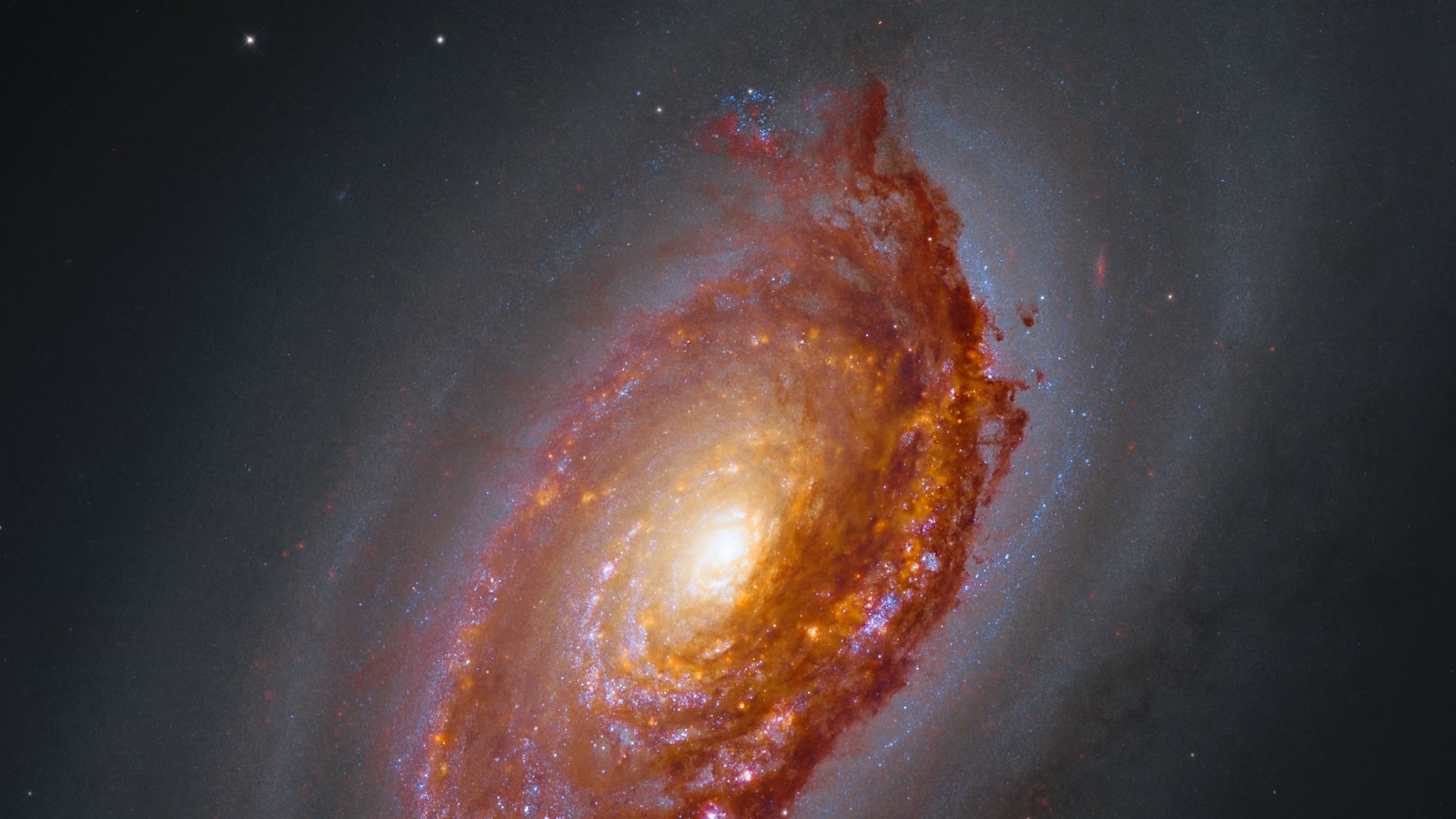
NASA has published a new composite view of the Messier 64 galaxy on 16 September 2026, combining data from the James Webb Space Telescope and the Hubble Space Telescope. M64 is popularly known as the Black Eye Galaxy because of the dark band of dust crossing its bright central region.
The new perspective demonstrates one of the fundamental advantages of infrared observations: where Hubble sees a region heavily obscured by dust, Webb can detect radiation associated with heated dust and structures hidden within it.
Webb’s Mid-Infrared Instrument, or MIRI, observes dust that absorbs light from young stars and re-emits that energy at infrared wavelengths.
In NASA’s image, this dust is represented in red, while star-forming regions appear differently in the Hubble data and in the combined Webb-Hubble view.
Messier 64 is a relatively nearby spiral galaxy on cosmic scales and is scientifically interesting not only for its appearance but also for the unusual dynamics of its gas.
NASA explains that M64’s inner and outer gas regions rotate in opposite directions.
Where the two gas “currents” meet, material can be compressed, contributing to regions of increased star formation.
A likely explanation for this counter-rotation is a past merger between M64 and a smaller galaxy.
That interpretation is important to the history of galaxy astronomy. Spiral galaxies were once regarded as systems with comparatively peaceful histories. M64 provided evidence that spiral galaxies can also undergo mergers.
This is relevant even to understanding the Milky Way because interactions and mergers are normal processes in galactic evolution.
Webb does not simply “see through dust” in the way an ordinary camera might. Its instruments observe infrared wavelengths, and different components of dust and stars emit or transmit radiation differently at those wavelengths.
MIRI is optimised for the mid-infrared, making it particularly useful for studying cosmic dust.
Hubble, by contrast, provides observations at other wavelengths, including visible and ultraviolet light, so combining the two observatories can reveal different components of the same galaxy.
NASA’s Astronomy Picture of the Day presentation is precisely a comparison between the Hubble view and a Hubble-plus-Webb composite.
The scientific purpose is not merely to create a spectacular image. NASA says Webb’s observations will help astronomers study the structure, motion and composition of M64’s dust.
The data will also provide context for the galaxy’s merger history and evolution.
The James Webb Space Telescope is an international observatory led by NASA in partnership with ESA and the Canadian Space Agency.
For the M64 image, NASA credits NASA, CSA, ESA and researchers from several institutions, with image processing credited to G. Kober.
It is important to present the image as a composition of astronomical data rather than as a natural-colour photograph representing exactly what the human eye would see.
Colours in astronomical images are used to represent information captured at different wavelengths and to make observed structures easier to analyse visually.
M64 demonstrates exactly why astronomers use multiple telescopes to study the same target. One observatory provides part of the story; combining data can reveal structures and processes that would otherwise be difficult to identify.
The image published on 16 September shows a spectacular galaxy, but the story behind its colours is one of cosmic violence: a likely ancient merger left the outer gas rotating in the opposite direction from the inner gas.
The interaction between those gas flows may be helping to create new stars today.
The galaxy’s “black eye” is therefore more than a visual feature. The dust that gives M64 its nickname is precisely the material Webb can now study in new detail, helping astronomers understand how the galaxy came to look and behave as it does today.
Image: NASA, CSA, ESA, F. Belfiore (ESO), J. Lee (STScI), A. Leroy (OSU), D. Thilker (JHU); processing: G. Kober (NASA/Catholic University). Astronomical composite, not natural colour. Cropped to 16:9.
Source consulted: Webb’s View of M64 | NASA Astronomy Picture of the Day.








0 Comments
No comments on this article yet. Be the first!