


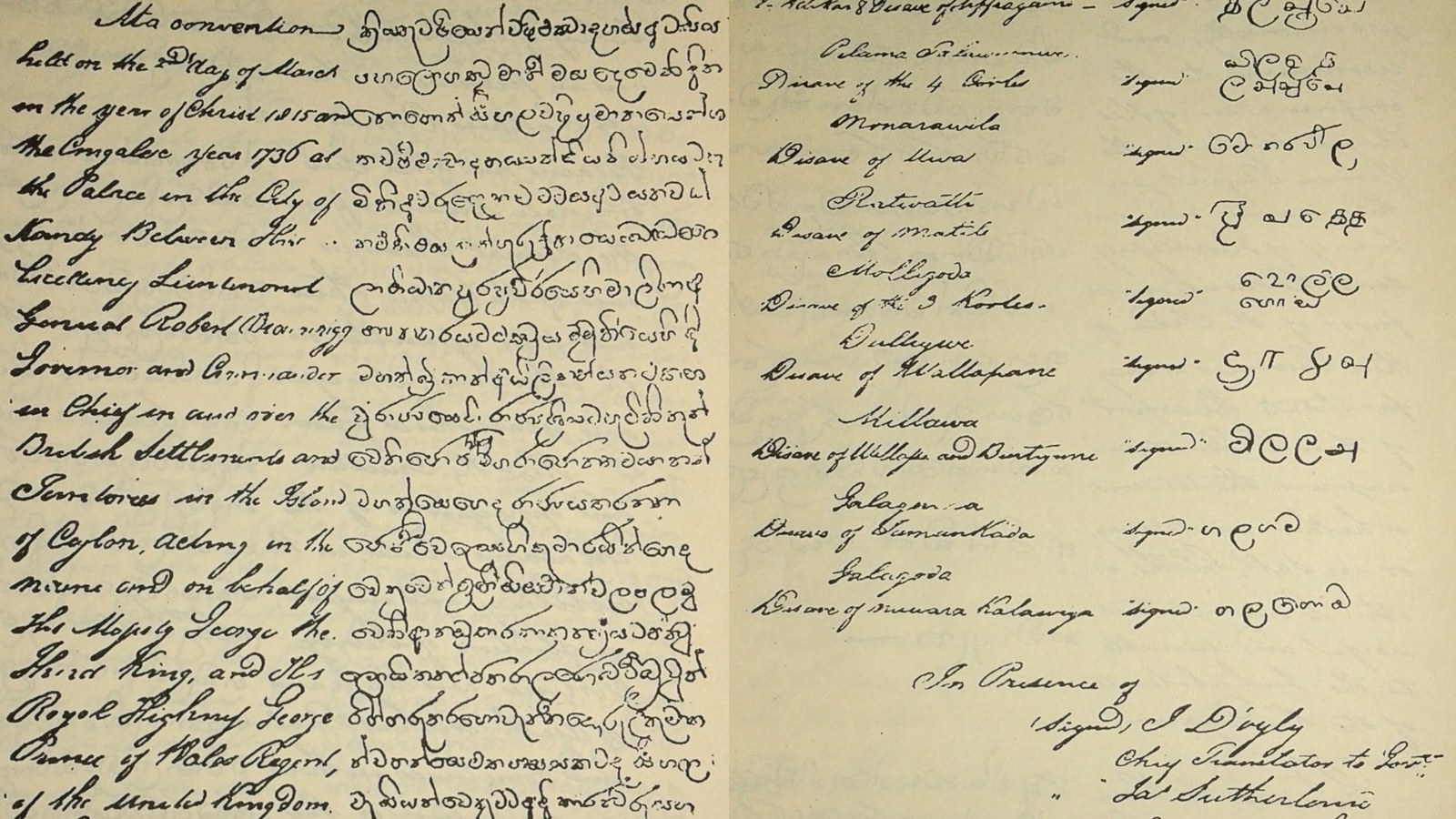
On 2 March 1815, the Cingalese year 1736, at the Palace in the city of Kandy, a Convention is held between Lieutenant-General Robert Brownrigg, Governor and Commander-in-Chief in and over the British settlements and territories in the Island of Ceylon, acting in the name and on behalf of His Majesty George the Third and His Royal Highness George, Prince of Wales, Regent, of the one part, and the Adigars, Dessaves and other principal chiefs of the Kandyan provinces on behalf of the inhabitants, in presence of the Mohottales, Coraals, Vidaans and other subordinate headmen, and of the people then assembled. Texts: English and Sinhala. Place: Magul Maduwa, the Royal Audience Hall of the palace.
Article 1: the cruelties and oppressions of the Malabar ruler, in the arbitrary infliction of bodily tortures and the pains of death without trial, and sometimes without an accusation, and in the general contempt of all civil rights, have become flagrant, enormous and intolerable. Article 2: the Rajah Sri Wikreme Rajah Sinha, by habitual violation of the chief duties of a Sovereign, has forfeited all claims to that title and the powers annexed; he is declared fallen and deposed; his family and relatives, whether in the ascending, descending or collateral line, and whether by affinity or blood, are for ever excluded from the throne; all claim of the Malabar race to the dominion of the Kandyan provinces is abolished and extinguished.
Article 3: all male persons being or pretending to be relations of the late Rajah are declared enemies to the government of the Kandyan provinces, and prohibited from entering those provinces without a written permission of the British Government, under the pains of martial law, hereby declared in force for that purpose. All male persons of the Malabar caste now expelled are, under the same penalties, prohibited from returning, except with that permission. Article 4: the dominion of the Kandyan provinces is vested in the Sovereign of the British Empire, to be exercised through the Governors or Lieutenant-Governors of Ceylon and their accredited Agents, saving to the Adigars, Dessaves, Mohottales, Coraals, Vidaans and other native headmen, lawfully appointed by authority of the British Government, the rights, privileges and powers of their respective offices, and to all classes of the people the safety of their persons and property, according to the laws, institutions and customs in force amongst them.
Article 5: the religion of Boodho, professed by the chiefs and inhabitants of these provinces, is declared inviolable, and its rites, ministers and places of worship are to be maintained and protected. Article 6: every species of bodily torture, and all mutilation of limb, member or organ, are prohibited and abolished. Article 7: no sentence of death can be carried into execution against any inhabitant except by the written warrant of the British Governor or Lieutenant-Governor, founded on a report of the case made to him through the accredited Agent or Agents resident in the interior; all trials for capital offences are to take place in their presence.
Article 8: civil and criminal justice over Kandyans is administered according to the established norms and customs of the country, the government reserving to itself the right of interposition when and where necessary. Article 9: over all other persons, civil or military, residing in or resorting to these provinces, not being Kandyans, justice, until the pleasure of His Majesty’s Government in England be otherwise declared: persons not being commissioned or non-commissioned military officers, soldiers or followers of the army, are subject to the magistracy of the accredited Agents, except charges of murder, which shall be tried by special commissions; a British subject charged with murder is tried by the laws of the United Kingdom for offences committed by British subjects in foreign parts; military defendants are liable to the laws, regulations and customs of war. The Governor reserves an unlimited right of review.
Article 10: the operation of the preceding clauses shall not be contravened by any temporary or partial proclamations published during the advance of the army; provisions incompatible with the preceding articles are hereby repealed. Article 11: the royal dues and revenues of the Kandyan provinces are managed and collected for His Majesty’s use and the support of the provincial establishment, according to lawful custom, under the direction of the accredited Agent or Agents of the British Government. Article 12: the Governor will adopt, and recommend to the confirmation of the Prince Regent, such dispositions in favour of the trade of these provinces as may facilitate the export of their products and improve the returns, whether in money or in salt, cloths or other commodities useful to the inhabitants of the Kandyan country.
Signed by Brownrigg; on the Kandyan side, among others, Molligoda the elder, 1st Adigar and Dissawa of the Sath Korles, and Pilima Talawuwe the elder, 2nd Adigar and Dissawa of Sabaragamuwa. Witnesses: John D’Oyly, Chief Translator, and J. A. S. Sutherland, Deputy Secretary. The Convention is not signed by the king. The king is imprisoned at Vellore.
Image: Government Archives of Sri Lanka, first and last pages of the Kandyan Convention, photographed by MediaJet, public domain, Wikimedia Commons. Cropped to 16:9. The document, not the signing in Magul Maduwa.
Source consulted: Kandyan Convention. Treaty text: Kandyan Convention, 2 March 1815 (Legislative Enactments of Ceylon / LawNet).











0 Comments
No comments on this article yet. Be the first!