


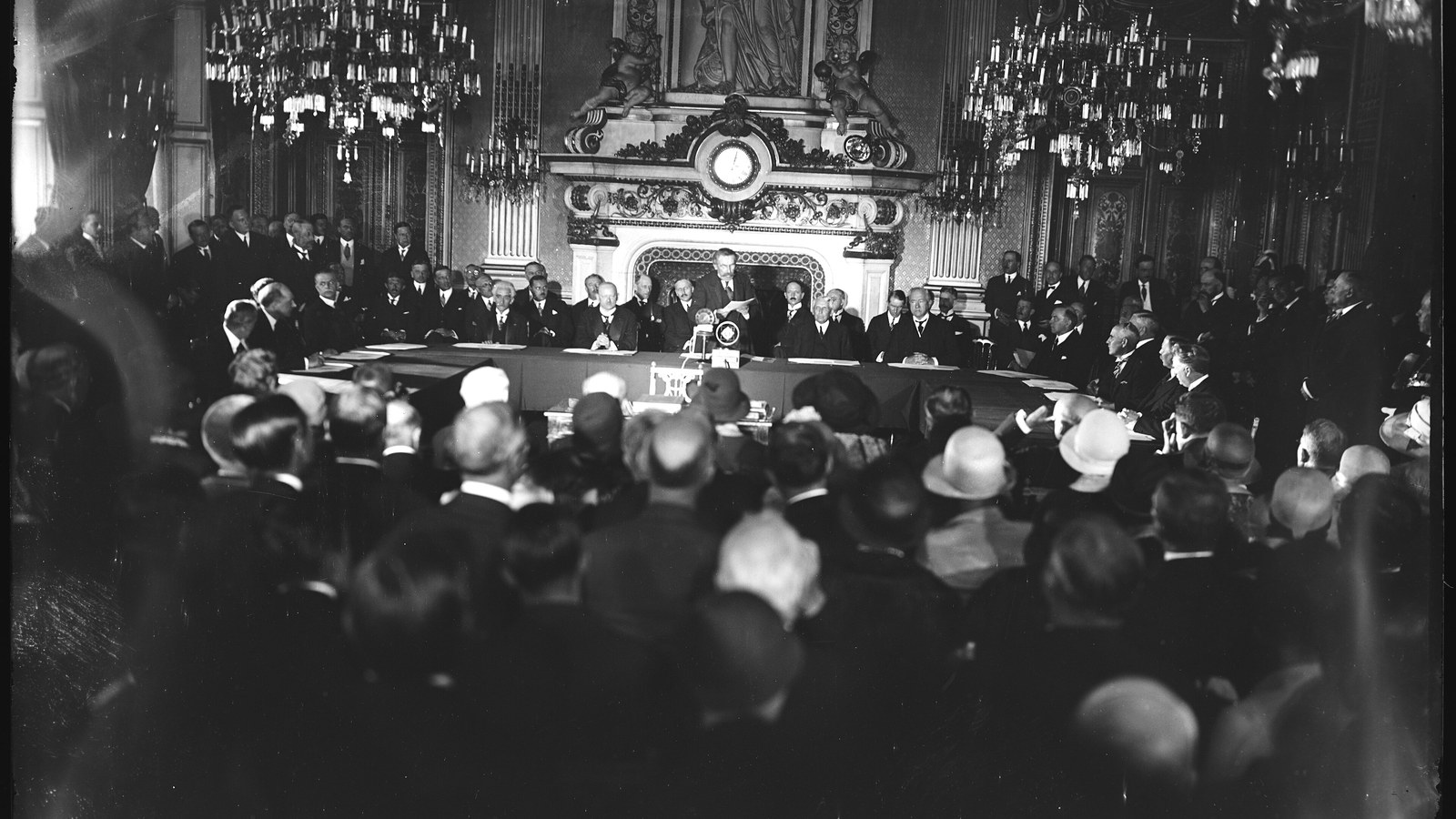
Aristide Briand, France’s foreign minister, first proposed a bilateral treaty with the United States that would outlaw war between the two countries. Frank B. Kellogg, the American secretary of state, wanted no implied alliance on the Continent and asked for a pact open to all. William Richards Castle Jr. widened the formula; Senator William E. Borah backed it. The treaty was concluded outside the League of Nations.
The official text, kept by the Avalon Project, is titled Treaty between the United States and other Powers providing for the renunciation of war as an instrument of national policy. Article I condemns recourse to war for the solution of international controversies and renounces it as an instrument of national policy. Article II requires that the settlement of all disputes or conflicts “of whatever nature or of whatever origin” be sought only by pacific means. A signatory that thereafter resorts to war “should be denied the benefits furnished by this Treaty”. There is no other enforcement mechanism.
On 27 August 1928, at the Quai d’Orsay, the representatives of Germany, the United States, Belgium, France, Great Britain, Canada, Australia, New Zealand, South Africa, the Irish Free State, India, Italy, Japan, Poland and Czechoslovakia signed. The plenipotentiaries named in the Avalon preamble are Gustav Stresemann, Frank B. Kellogg, Paul Hymans, Aristide Briand, Lord Cushendun, William Lyon Mackenzie King, A. J. McLachlan, C. J. Parr, J. S. Smit, W. T. Cosgrave, Gaetano Manzoni, Count Uchida, August Zaleski and Edvard Beneš. The French and English texts have equal force.
Article III requires the deposit of ratifications in Washington. Japan, the last of the preamble powers, deposited on 24 July 1929; Herbert Hoover proclaimed the treaty the same day. By then Romania, the Soviet Union, Turkey, China and the Kingdom of Serbs, Croats and Slovenes had, among others, adhered. The U.S. Senate voted 85 to 1, with the understanding that the pact did not impair the right of self-defence and did not oblige Washington to punish those who violated it.
On 9 February 1929 the Litvinov Protocol in Moscow put the pact into force between the Soviet Union and its western neighbours, including Romania, without waiting for the remaining ratifications. In the years that followed, Japan invaded Manchuria, Italy Abyssinia, and Germany and the Soviet Union Poland, without classical declarations of war. The pact remains in force and supplied the legal basis for the crime against peace, for which the Nuremberg and Tokyo tribunals tried the leaders who started the Second World War.
The ban on aggression was restated in Article 2, paragraph 4, of the United Nations Charter: members shall refrain from the threat or use of force against the territorial integrity or political independence of any state. States that nevertheless use force typically invoke self-defence or collective defence. Annexation by force became, in principle, unlawful.
Critics called it “a worthless piece of paper”; Ian Kershaw judged it “a dead letter from the moment it was signed”. Others, among them Oona Hathaway and Scott Shapiro, see in it the start of an era in which military conquest ceased to be the norm. The Pact of Paris remains in effect.
Sources: Kellogg–Briand Pact; Avalon Project, Kellogg-Briand Pact 1928.











0 Comments
No comments on this article yet. Be the first!