


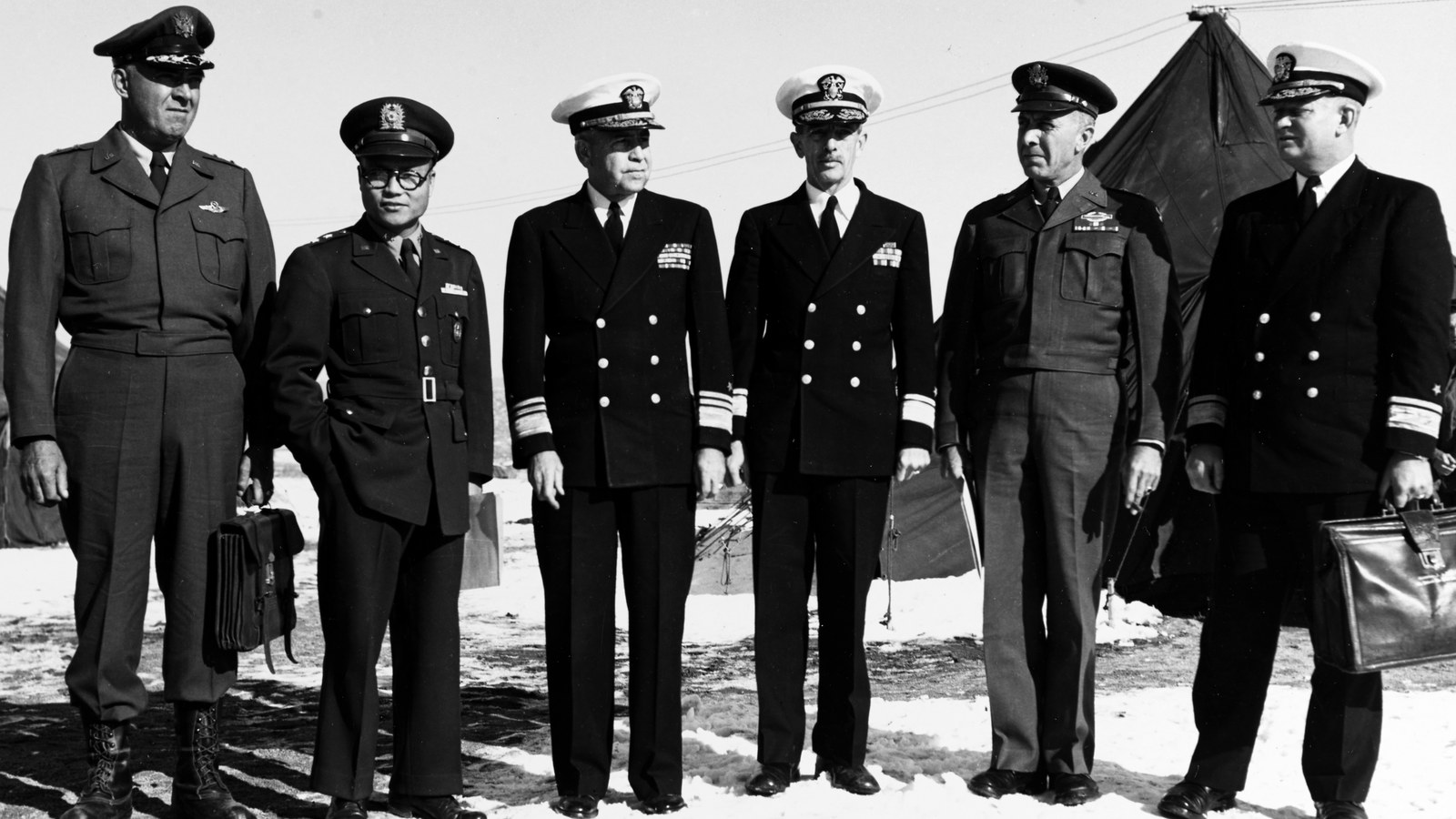
The Commander-in-Chief, United Nations Command, on the one hand, and the Supreme Commander of the Korean People’s Army and the Commander of the Chinese People’s Volunteers, on the other, signed at Panmunjom on 27 July 1953, at 10:00 hours, the Agreement concerning a Military Armistice in Korea. Equally authentic texts: English, Korean, Chinese. The terms are “purely military in character” and pertain solely to the belligerents in Korea, until a final peaceful settlement is achieved. Signatories at the table: General Nam Il, senior delegate of the KPA and the Volunteers; Lieutenant General William K. Harrison Jr., senior delegate of the UNC. It is not a peace treaty between States. The Republic of Korea does not sign: President Syngman Rhee refused. Mark W. Clark, Kim Il Sung and Peng Dehuai countersigned as commanders, not as heads of state on behalf of civilian governments.
Article I. A Military Demarcation Line, on the attached map. Each side withdraws two kilometres; the Demilitarized Zone is a buffer. The waters of the Han River Estuary are open to civil shipping where one bank is controlled by one side and the other by the other. No hostile act within, from, or against the Zone. No person shall cross the Line unless authorized by the Military Armistice Commission. Civil administration south of the Line: UNC; north: KPA and Volunteers jointly; not more than one thousand persons from either side. The Commission, Joint Observer Teams and the Neutral Nations Supervisory Commission have freedom of movement.
Article II. Complete cessation of all hostilities, ground, naval and air, twelve hours after signature. Withdrawal from the Demilitarized Zone within 72 hours; mines and hazards within 45 days. Withdrawal from the other side’s rear and coastal islands and waters within ten days; islands north and west of the Hwanghae-do / Kyonggi-do provincial line go to the KPA and Volunteers, except the groups Paengyong-do, Taechong-do, Sochong-do, Yonpyong-do and U-do, which remain UNC. No reinforcing personnel; rotation man-for-man, not more than 35,000 in any calendar month. Piece-for-piece replacement of combat aircraft, armored vehicles, weapons and ammunition destroyed. No blockade of any kind. Military Armistice Commission: ten senior officers, five from each side, headquarters near Panmunjom (37°57′29″N, 126°40′00″E), without a chairman. Neutral Nations Supervisory Commission: Sweden, Switzerland, Poland, Czechoslovakia.
Article III. Within sixty days, direct repatriation, in groups, of prisoners who insist on returning; the remainder handed to the Neutral Nations Repatriation Commission, chaired by India. Place of delivery: Panmunjom. No repatriated prisoner shall be employed again in the conflict. The sick and injured have priority. Article IV, paragraph 60: a recommendation to the governments that, within three months, a higher-level political conference settle the withdrawal of all foreign forces and the peaceful settlement of the Korean question. The Geneva Conference of 1954 produced no peace treaty.
Article V. Amendments by mutual agreement of the Commanders. The Articles remain in effect until expressly superseded. All provisions other than Paragraph 12 become effective at 2200 hours the same day. This is not a 1949 armistice convention, and not a treaty among Seoul, Pyongyang, Washington and Beijing. The cover is the negotiation hall at Panmunjom.
Sources: Korean Armistice Agreement; Agreement Concerning a Military Armistice in Korea, UN Peacemaker.











0 Comments
No comments on this article yet. Be the first!