


The American orbital-tracking firm LeoLabs said on 19 October that the Russian military satellite Kosmos 2612 had deliberately closed on ICEYE-X36, a commercial synthetic-aperture radar satellite run by the US arm of Finland’s ICEYE. It came in from hundreds of kilometres, manoeuvred around the target, stayed nearby, then began to move away. No collision was reported and no destruction of the commercial satellite was announced.
LeoLabs said that on Friday Kosmos 2612 was station-keeping 2–3 kilometres away, then shifted ahead of and behind ICEYE-X36. Over the weekend the gap fell to about 500 metres — an estimate with uncertainty, because of the repeated manoeuvres. Adam Marsh, a LeoLabs vice-president, told Ars Technica they were probably closer still. This was not a chance conjunction: a controlled approach, a hold, then a controlled departure.
Jonathan McDowell, an astrophysicist who tracks launches, wrote that, to his knowledge, it was the first low-Earth-orbit rendezvous of two active satellites without the owner’s consent. Marsh compared it with Russian tests on their own spacecraft and with approaches in geostationary orbit: not the same thing. Figures of 25–26 metres circulating online are not what LeoLabs stands on; the firm stays with about 500 metres, with a caveat.
ICEYE-X36 is owned by ICEYE US. The parent company is Finnish and flies a radar constellation used by military customers, including Ukraine, since 2022. The firm has not publicly confirmed that X36 is the satellite dedicated to Kyiv. An ICEYE US spokesperson said they were tracking the situation and that the constellation is built for continuity. By the Sunday retreat, no physical damage had been reported.
Kosmos 2612 launched in April on a Soyuz from northern Russia. Independent analyses say several satellites from that launch lined up their orbits with ICEYE-X36. On Monday Marsh said Kosmos 2612 was moving away at about 17 kilometres an hour relative speed. The list of things the manoeuvre could be used for — inspect, shadow, interfere — is LeoLabs describing capability, not proof that interference happened.
Ars Technica reported the LeoLabs notice on 19 October. CNN confirmed the same sequence: the 15–16 October close, the weekend hold, then the pull-back. What remains is a ground-tracked manoeuvre, not a space battle and not a destroyed satellite.
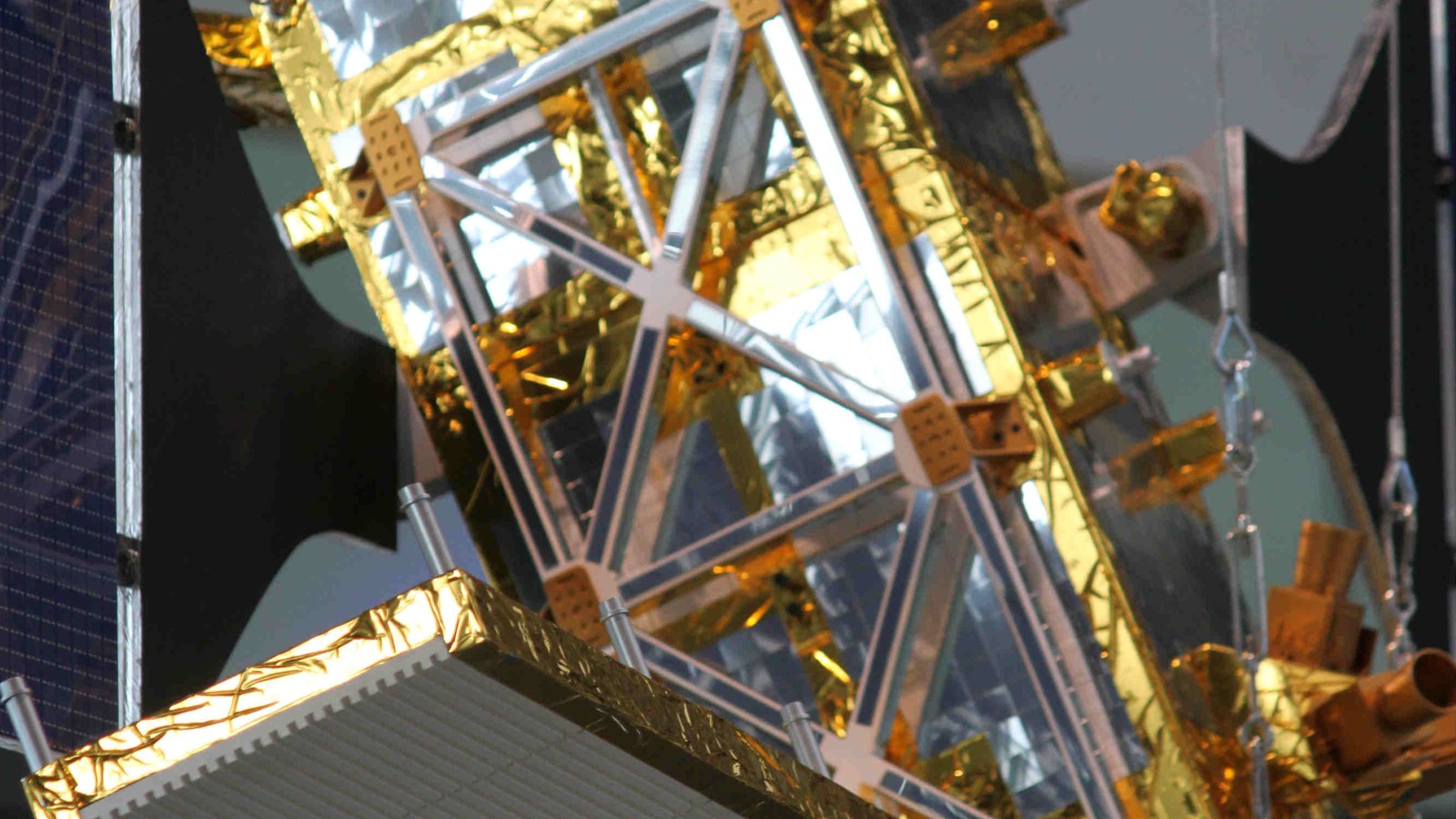
Image: DLR / Alejandro Morellon, Sentinel-1 model, 23 July 2012, CC BY 2.0, Wikimedia Commons; a SAR model, not ICEYE-X36 at the weekend.
Sources consulted: Russian spacecraft maneuvers in extreme proximity to satellite used by Ukraine - Ars Technica, 19 October 2026; Russian satellite approaches another spacecraft without permission - CNN, 19 October 2026.










0 Comments
No comments on this article yet. Be the first!