


After the 1918 victory Italy received no German colonies; Article 13 of the Treaty of London had promised compensation on the edges of British and French possessions. London ceded Jubaland, from Kenya, to Italian Somalia in 1924. Paris delayed. The assassination of Louis Barthou and King Alexander I, in Marseille on 9 October 1934, put Pierre Laval at the Quai d'Orsay. On 4 January 1935 Laval went to Rome, to keep Italy away from Hitler. Mussolini wanted Ethiopia and a rectification of Libya’s southern border.
The Rome Accords were signed on 7 January 1935, in Rome, by Laval and Benito Mussolini. The text, a bundle of engagements, sets a new southern frontier of Italian Libya and says the rectification “definitively settles” the questions left from Article 13 of the Treaty of London. The Aouzou Strip, with the village of Aozou, was to pass from French Chad to Libya; a triangle at Toummo also touches Niger. A patch of French Somaliland, south of Eritrean Rahayta, was to pass to Italian Eritrea; a 1938 map shows the northern border of French Somalia moved south of Bab el-Mandeb. The official status of Italians in French Tunisia was redefined. France hoped for Italian support against Germany. The invasion of Ethiopia came in October 1935; support against Berlin did not.
The French parliament authorised ratification by a law of 26 March 1935. The instruments of ratification were never exchanged. Italy declared the accords lapsed on 17 December 1938. In Chad’s memorial to the International Court of Justice the treaty “was never executed” and “never entered into force”. The UN Secretariat, in 1950, wrongly wrote that Libya’s southern frontier had been “fixed by the so-called Rome Agreement”; France had already protested. The Franco-Libyan Treaty of Friendship of 10 August 1955, in force after the exchange of ratifications on 20 February 1957, deliberately left 1935 off the list of frontier instruments.
The ICJ, on 3 February 1994, by 16 votes to 1, held the Chad–Libya frontier on the 1955 line, not the 1935 one. Libya had occupied the strip in 1973 and annexed it in 1975; the fighting ran through the Toyota War. For the Court, 1935 remains an agreement whose ratifications were not exchanged.
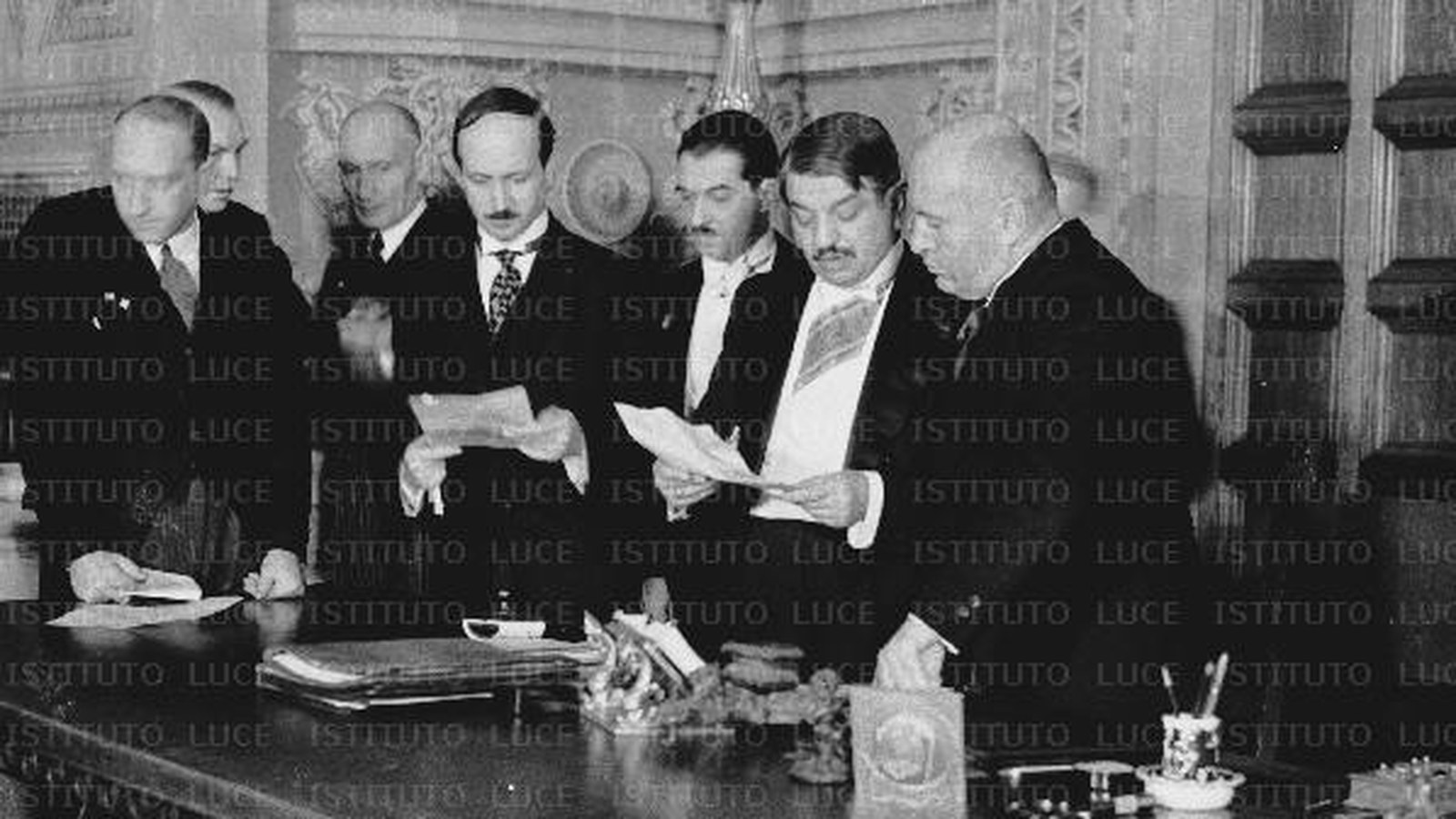
The 1935 photograph, in the public domain, shows Mussolini and Laval at the table, in Rome.
The accord was a colonial rectification that produced no boundary. It produced, instead, a file that the judges at The Hague closed sixty years later.
Sources: Franco-Italian Agreement of 1935; International Court of Justice, Territorial Dispute (Libyan Arab Jamahiriya/Chad).











0 Comments
No comments on this article yet. Be the first!