


On 15 November 1946, at Cirebon, the Netherlands and Republic of Indonesia delegations initialed the draft Linggadjati Agreement. The talks had been held at the hill station of Linggadjati, near Cirebon in West Java. Dutch and Indonesian, equally authentic. Formal signature followed at Batavia (Jakarta) on 25 March 1947. It is not the Renville Agreement of 1948 and not the Round Table Conference of 1949.
The preamble: a sincere desire to secure good relations between the peoples of the Netherlands and Indonesia in new forms of voluntary cooperation. The text would be submitted as soon as possible to the representative bodies. Article 1: the Netherlands Government recognises the Government of the Republic as exercising de facto authority over Java, Madura and Sumatra. Areas occupied by Allied or Netherlands troops shall gradually, by mutual cooperation, be incorporated into the Republican territory, completed by the date in article 12. The wording of the second paragraph was settled the same day at Batavia.
Article 2: cooperation toward the speedy establishment of a sovereign, democratic, federal state named the United States of Indonesia. Article 3: the entire territory of the Netherlands Indies, provided that if the population of any region democratically indicates that it does not, or not yet, wish to join, a special relationship with those states and the Kingdom of the Netherlands may be created. Article 4: constituent states shall be the Republic, Borneo and the Great East; the population of any region may democratically seek a different place in the federation; a special arrangement for the capital is allowed. Article 5: the constitution shall be adopted by a constituent assembly of democratically designated representatives.
Articles 6–8: a Netherlands-Indonesian Union, converting the Kingdom (the Netherlands, the Netherlands Indies, Suriname and Curaçao) into a Union of the Kingdom (the Netherlands, Suriname, Curaçao) on one side and the United States of Indonesia on the other. The Union shall have its own organs for foreign relations, defence, finance as necessary, and economic and cultural matters. The King of the Netherlands shall be Head of the Union; decisions on common interests shall be taken in the King’s name. Articles 9–11: High Commissioners; a statute covering reciprocal rights, citizenship, deadlock, assistance until the USI has its own organs, and the fundamental human rights referred to in the United Nations Charter; the statute shall be drafted by a conference and enter into force after approval by the representative bodies.
Article 12: the Parties shall strive to establish the United States of Indonesia and the Union before 1 January 1949. Article 13: after the Union is formed the Netherlands shall take steps for admission of the USI to the United Nations. Article 14: the Republic recognises the claims of all non-Indonesians to restoration of rights and return of property in the area where it exercises de facto authority; a mixed commission shall be set up. Article 16: immediately after the agreement both sides shall reduce troop strength and consult on the rate and on military cooperation. Article 17: an organisation of one delegation from each government with a joint secretariat; disputes not settled by consultation shall go to arbitration, with a chairman of another nationality appointed by agreement or by the President of the International Court of Justice, with a casting vote. The military operations of 1947 are not treated here.
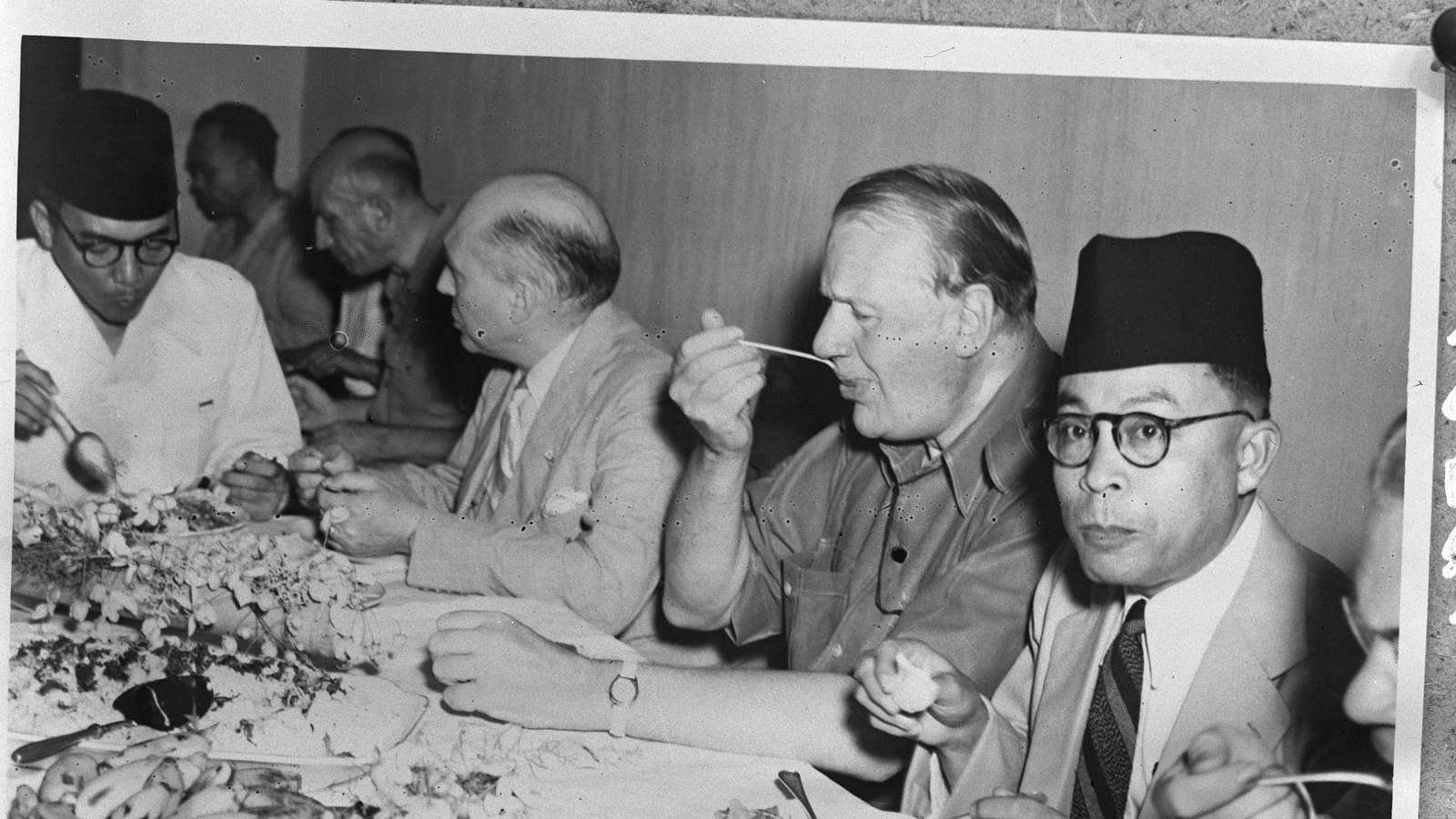
Participants at the Linggadjati conference, among them Sukarno, Schermerhorn, Lord Killearn and Hatta. A period photograph, not the confirmed Cirebon initialling room. Wikimedia Commons, CC0.
For context: Linggadjati Agreement. The text: Tekst der op 15 november 1946 geparafeerde ontwerp-overeenkomst van Linggadjati.











0 Comments
No comments on this article yet. Be the first!