


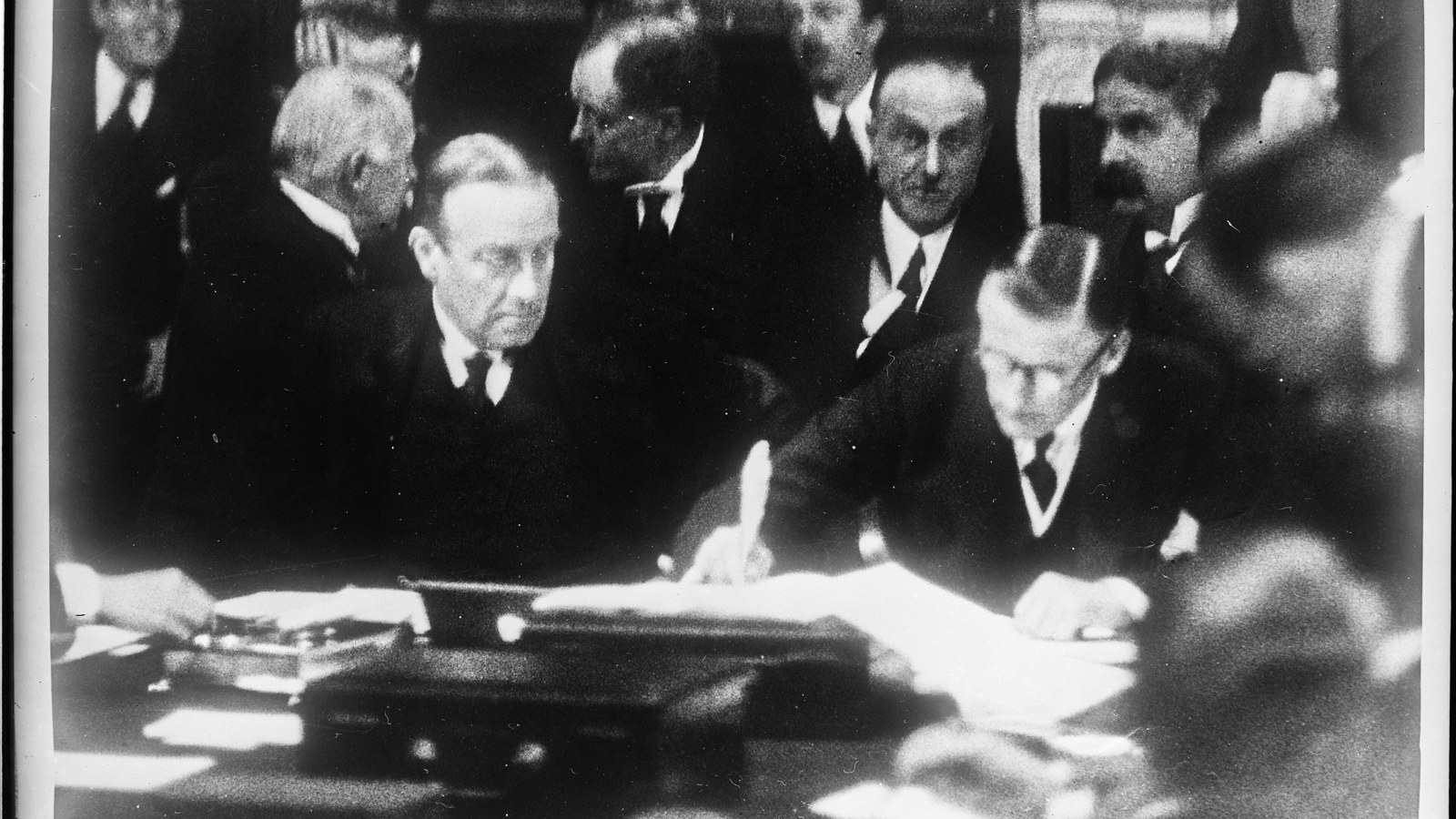
On 1 December 1925, at the Foreign Office in London, the plenipotentiaries of Germany, Belgium, France, Great Britain and Italy formally signed the Locarno Treaties, concluded on 16 October in Switzerland. The authentic texts are English and French, in a single copy deposited in the archives of the League of Nations at Geneva. It is not the Treaty of Versailles of 1919.
The Treaty of Mutual Guarantee (the Rhineland Pact) names as plenipotentiaries Hans Luther and Gustav Stresemann, Emile Vandervelde, Aristide Briand, Stanley Baldwin and Austen Chamberlain, and Vittorio Scialoja. Article 1: the High Contracting Parties collectively and severally guarantee the maintenance of the territorial status quo resulting from the frontiers between Germany and Belgium and between Germany and France, as fixed by or in pursuance of the Treaty of Versailles, and the observance of Articles 42 and 43 concerning the demilitarised zone.
Article 2: Germany and Belgium, and also Germany and France, mutually undertake that they will in no case attack or invade each other or resort to war against each other, except in three cases: the exercise of the right of legitimate defence, including resistance to a flagrant breach of Articles 42 or 43 if it constitutes an unprovoked act of aggression and the assembly of armed forces in the demilitarised zone makes immediate action necessary; action in pursuance of Article 16 of the Covenant of the League of Nations; and action as the result of a decision of the Assembly or the Council of the League or in pursuance of Article 15, paragraph 7, directed against a State which was the first to attack.
Article 3: questions as to respective rights shall be submitted to judicial decision; all other questions to a conciliation commission and then to the Council of the League; the detailed arrangements are the subject of special agreements signed this day. Article 4: an alleged violation shall be brought at once before the Council; as soon as the Council is satisfied that a violation has been committed, the signatories will come immediately to the assistance of the Power against whom the act is directed; in case of a flagrant violation, help is immediate, subject to the Council's subsequent findings. Article 5 places Article 3 under the same guarantee. Article 6: the Treaty does not affect the rights and obligations of the Parties under the Treaty of Versailles or under arrangements supplementary thereto, including the Agreements signed in London on 30 August 1924.
Article 7: the Treaty shall not be interpreted as restricting the duty of the League to safeguard the peace of the world. Article 8: it shall be registered with the League; it remains in force until the Council, acting on a request notified three months in advance and voting at least by a two-thirds majority, decides that the League ensures sufficient protection; the Treaty shall then cease to have effect on the expiration of one year. Article 9: no obligation upon any of the British dominions or upon India unless that Government signifies its acceptance. Article 10: ratifications shall be deposited at Geneva; the Treaty shall enter into force as soon as all the ratifications have been deposited and Germany has become a Member of the League of Nations, on 14 September 1926. The Secretary-General shall transmit certified copies.
In the same package: arbitration agreements between Germany and Belgium and between Germany and France; arbitration treaties between Germany and Poland and between Germany and Czechoslovakia; treaties of guarantee between France and Poland and between France and Czechoslovakia. The Collective Note to Germany regarding Article 16 of the Covenant, dated London, accompanies the instruments. The Rhineland Pact does not guarantee Germany's eastern frontiers. It is not the Kellogg-Briand Pact of 1928.
Image: Austen Chamberlain signing the Locarno Pact, London; Agence Rol, 1925; public domain, Wikimedia Commons. Cropped to 16:9.
Source consulted: Locarno Treaties. Treaty text: Treaty of Mutual Guarantee, Locarno, 16 October 1925, signed in London.











0 Comments
No comments on this article yet. Be the first!