


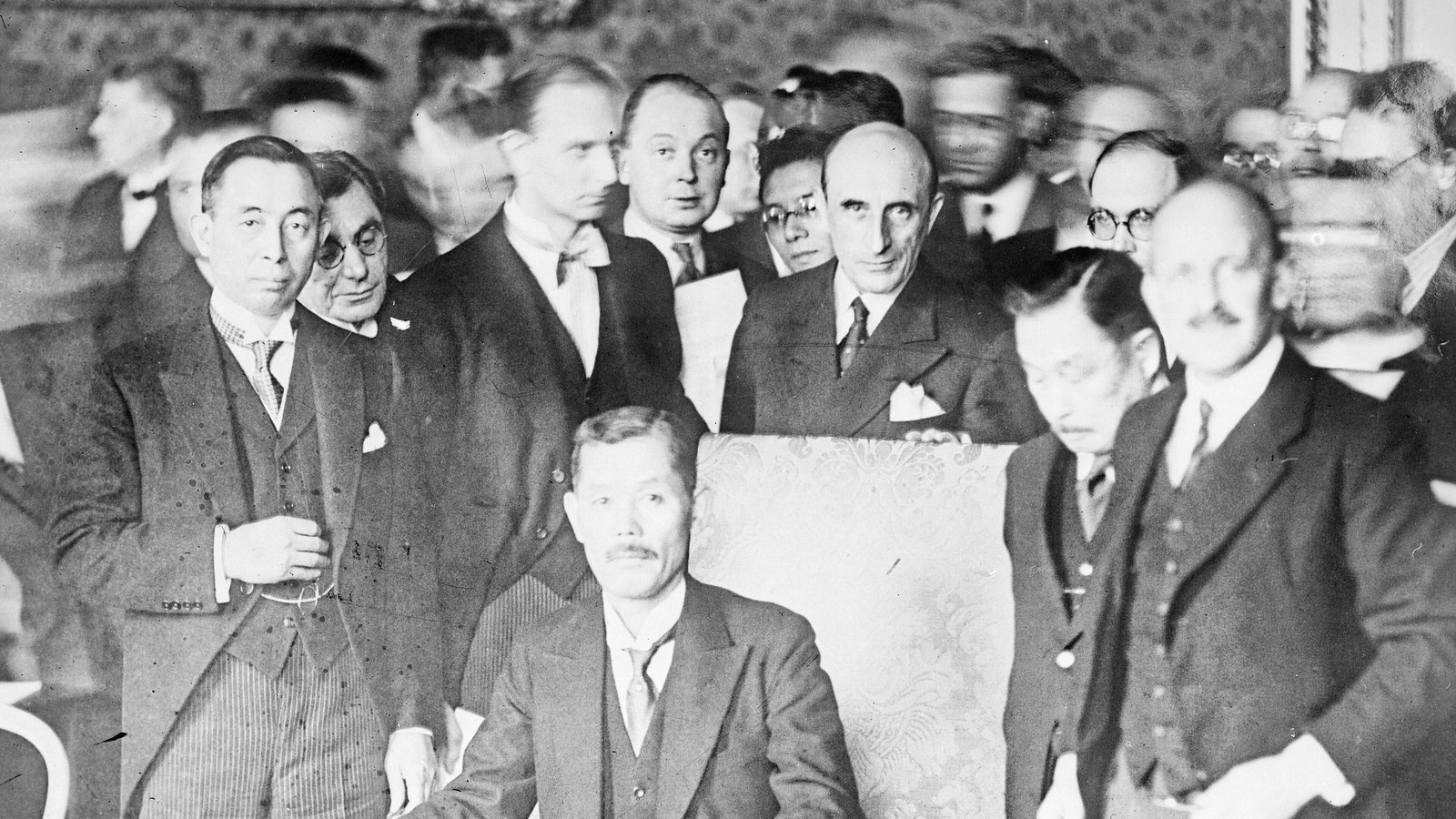
After Washington 1922, which cut the capital ships, cruisers and submarines still had no ceiling. The 1927 Geneva conference broke on Anglo-American tension. Hoover and MacDonald met at Rapidan in 1929. The Treaty for the Limitation and Reduction of Naval Armament, twenty-six articles, French and English of equal force, was signed on 22 April 1930, in London. The parties: the United States, France, the British Empire (with the dominions and India), Italy and Japan. Depositary: the British government.
Article 1: until 1936, no one lays the keels of the capital-ship replacement tonnage provided by Washington, save accidental loss. France and Italy may still build the replacement they were entitled to in 1927 and 1929. Article 2 requires disposal: Florida, Utah and Arkansas or Wyoming; Benbow, Iron Duke, Marlborough, Emperor of India and Tiger; Hiyei. Training ships may be kept: Arkansas or Wyoming, Iron Duke, Hiyei.
Article 7: new submarines, at most 2,000 tons and 5.1-inch guns; each party may keep three of up to 2,800 tons with 6.1-inch guns, and France one already-launched unit of 2,880 tons with 8-inch guns. Article 8 leaves unrestricted ships under 600 tons and, under strict conditions, those between 600 and 2,000. Hence, later, the torpedo boats the Italians, Japanese, French and British cut to the exemption.
Part III binds only the United States, the British Commonwealth and Japan. Article 16, ceilings on 31 December 1936: heavy cruisers (gun above 6.1 inches) 180,000 / 146,800 / 108,400 tons, at most 18, 15 and 12 units; light cruisers 143,500 / 192,200 / 100,450; destroyers 150,000 / 150,000 / 105,500; submarines 52,700 each. France and Italy stay outside these figures until a separate agreement.
Article 22, Part IV: a submarine, toward merchant ships, is bound by the same rules as a surface vessel; sinking, only after passengers, crew and papers are in a place of safety, except for persistent refusal to stop or active resistance. Article 23: the treaty holds until 31 December 1936, except Part IV, unlimited in time, and the aircraft-carrier clauses, tied to Washington. A 1935 conference is to write the successor.
The ratifications of the United States, the Commonwealth (without the Irish Free State) and Japan were deposited in London on 27 October 1930; Ireland, on 31 December. The American Senate advised on 21 July. Registration with the League of Nations, on 6 February 1931, series 112. The cover is Wakatsuki Reijirō at the signing table. The second London naval treaty followed in 1936.
Sources: London Naval Treaty; Office of the Historian, Treaty for the Limitation and Reduction of Naval Armament, Signed at London, April 22, 1930.











0 Comments
No comments on this article yet. Be the first!