


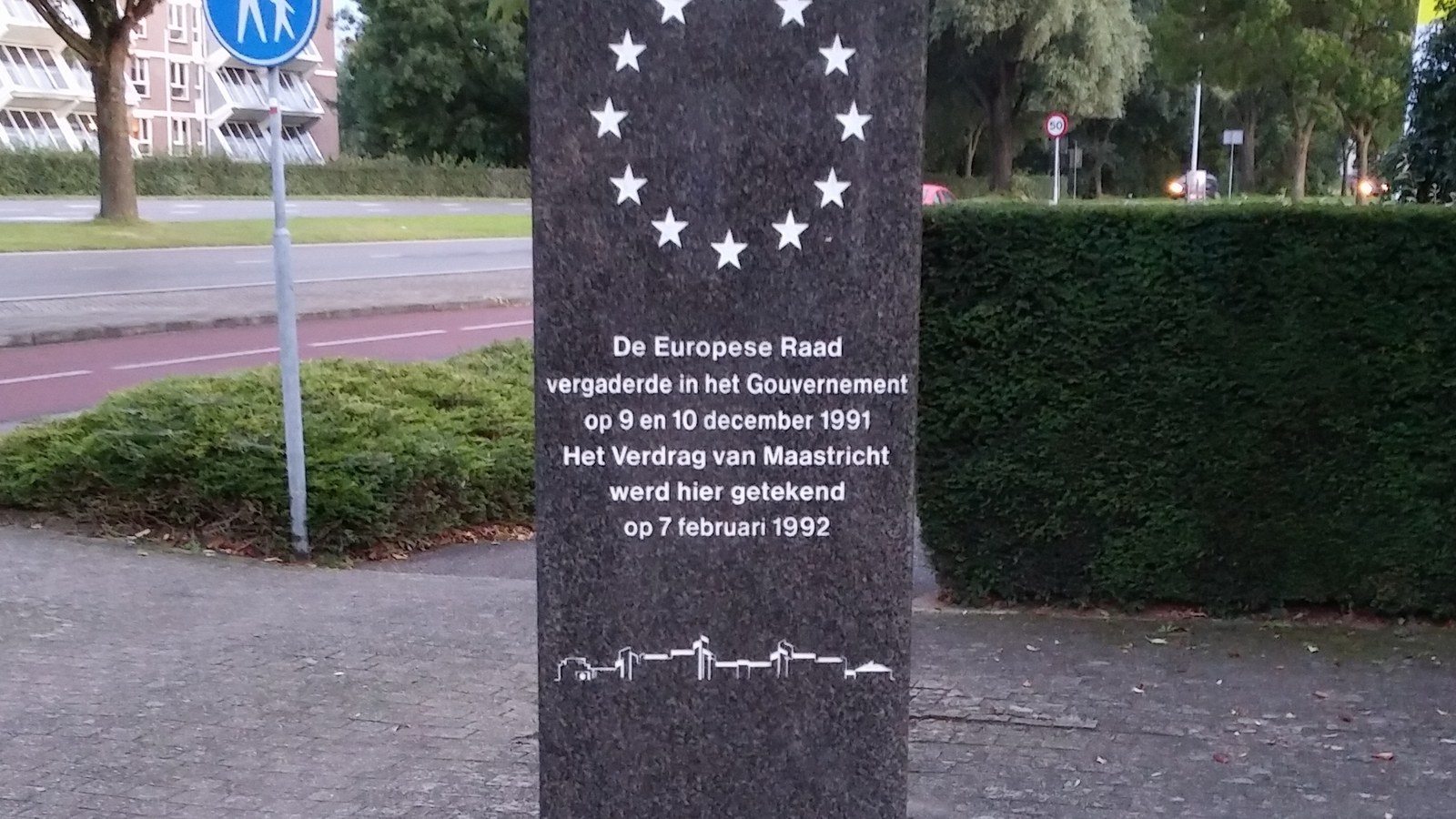
At Maastricht, on 7 February 1992, the twelve Member States of the European Communities — Belgium, Denmark, Germany, Greece, Spain, France, Ireland, Italy, Luxembourg, the Netherlands, Portugal and the United Kingdom — sign the Treaty on European Union. The texts in Spanish, Danish, German, Greek, English, French, Irish, Italian, Dutch and Portuguese are authentic; the Depositary is the Government of Italy.
The preamble resolves to mark a new stage in the process of creating an ever closer union among the peoples of Europe, to strengthen and converge their economies, to establish an economic and monetary union including, in accordance with the Treaty, a single and stable currency, to establish a citizenship common to nationals of their countries, and to implement a common foreign and security policy including the eventual framing of a common defence policy.
Article A establishes among the High Contracting Parties a European Union. The Treaty marks a new stage in the process of creating an ever closer union among the peoples of Europe, in which decisions are taken as closely as possible to the citizen. The Union shall be founded on the European Communities, supplemented by the policies and forms of cooperation established by this Treaty; its task shall be to organize, in a manner demonstrating consistency and solidarity, relations between the Member States and between their peoples.
Article B sets the Union’s objectives: to promote balanced and sustainable economic and social progress, in particular through an area without internal frontiers, the strengthening of economic and social cohesion and the establishment of economic and monetary union, ultimately including a single currency; to assert its identity on the international scene through a common foreign and security policy including the eventual framing of a common defence policy; to strengthen the protection of the rights and interests of the nationals of its Member States through the introduction of a citizenship of the Union; to develop close cooperation on justice and home affairs; and to maintain and build on the Community acquis.
The Title on citizenship of the Union introduces Union citizenship: every person holding the nationality of a Member State shall be a citizen of the Union, with rights and duties under the Treaty, including the right to move and reside freely, the right to vote and to stand as a candidate in municipal elections and elections to the European Parliament in the State of residence, diplomatic and consular protection, and the right to petition. The Title on a common foreign and security policy (Articles J et seq.) establishes CFSP covering all areas of foreign and security policy, with objectives including to safeguard the common values, fundamental interests and independence of the Union, to strengthen the security of the Union and its Member States, to preserve peace and to promote international cooperation.
The provisions on economic and monetary union set the stages toward a single currency, including the beginning of the second stage on 1 January 1994, the convergence criteria (prices, public finances, exchange rates, long-term interest rates) and the establishment of the European System of Central Banks. The Title on cooperation in the fields of justice and home affairs organises intergovernmental cooperation on asylum, external borders, immigration, combating drugs and international fraud, judicial cooperation and police cooperation.
Article R requires ratification in accordance with the respective constitutional requirements, the instruments being deposited with the government of the Italian Republic. The Treaty shall enter into force on 1 January 1993, provided that all the instruments of ratification have been deposited, or, failing that, on the first day of the month following the deposit of the instrument of ratification by the last signatory State to take this step. Article S deposits the single original, in the ten equally authentic languages, in the archives of the Italian government. The instrument signed at Maastricht is the 1992 Treaty on European Union, not later consolidated versions of the TEU.
Image: memorial to the signing of the Maastricht Treaty, Maastricht; CC BY-SA 4.0, Wikimedia Commons. Cropped to 16:9.
Source consulted: Maastricht Treaty. Treaty text: Treaty on European Union, Maastricht, 7 February 1992, OJ C 191, EUR-Lex 11992M/TXT.









0 Comments
No comments on this article yet. Be the first!