
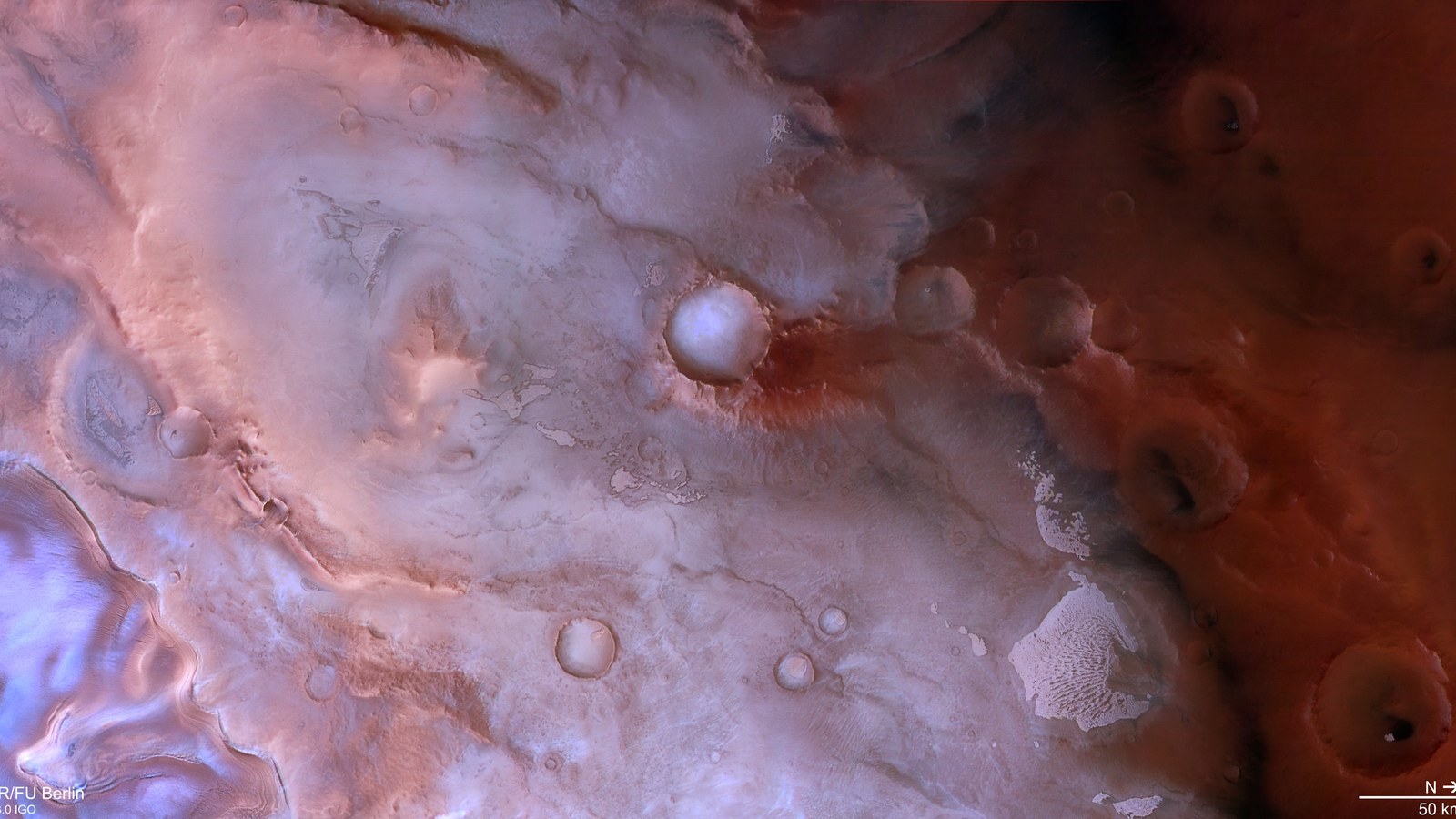
The European Space Agency published a new Mars Express image on 16 September showing an ice cliff near the south pole of Mars. The landscape has purple, pink and red swirls, far from the ochre and brown palette usually associated with the Red Planet.
The picture, taken with the High Resolution Stereo Camera, shows Thyles Rupes, a tectonic cliff system in the southern highlands. Some cliffs rise more than a kilometre. ESA links their formation to cooling and contraction of the planet’s interior billions of years ago; Mars no longer has Earth’s active plate tectonics.
Darker tones come from volcanic material rich in mafic minerals such as olivine and pyroxene. Paler areas are covered by frosty carbon-dioxide deposits that persist here even during martian spring. The frame also includes part of the south polar ice cap, sand dunes and craters, some cut by the cliff and others lying on top of it.
The overall berry-purple hue is a mix of morning light, airborne dust, ground frost and patches of mixed ice and dust. Colours in scientific imagery should not automatically be read as what a human observer would see from the surface; camera data can be used to highlight differences between materials.
Polar observations remain important for understanding how water ice and frozen carbon dioxide behave in the Martian climate as the seasons change.
Mars Express has been orbiting Mars since 2003. The HRSC camera was developed and is operated by DLR, and the image products were produced by the planetary science group at Freie Universität Berlin.
Image: ESA/DLR/FU Berlin (Mars Express, High Resolution Stereo Camera). ESA Standard Licence. Cropped to 16:9.
Source consulted: ESA — Purple swirls on the Red Planet.







0 Comments
No comments on this article yet. Be the first!