


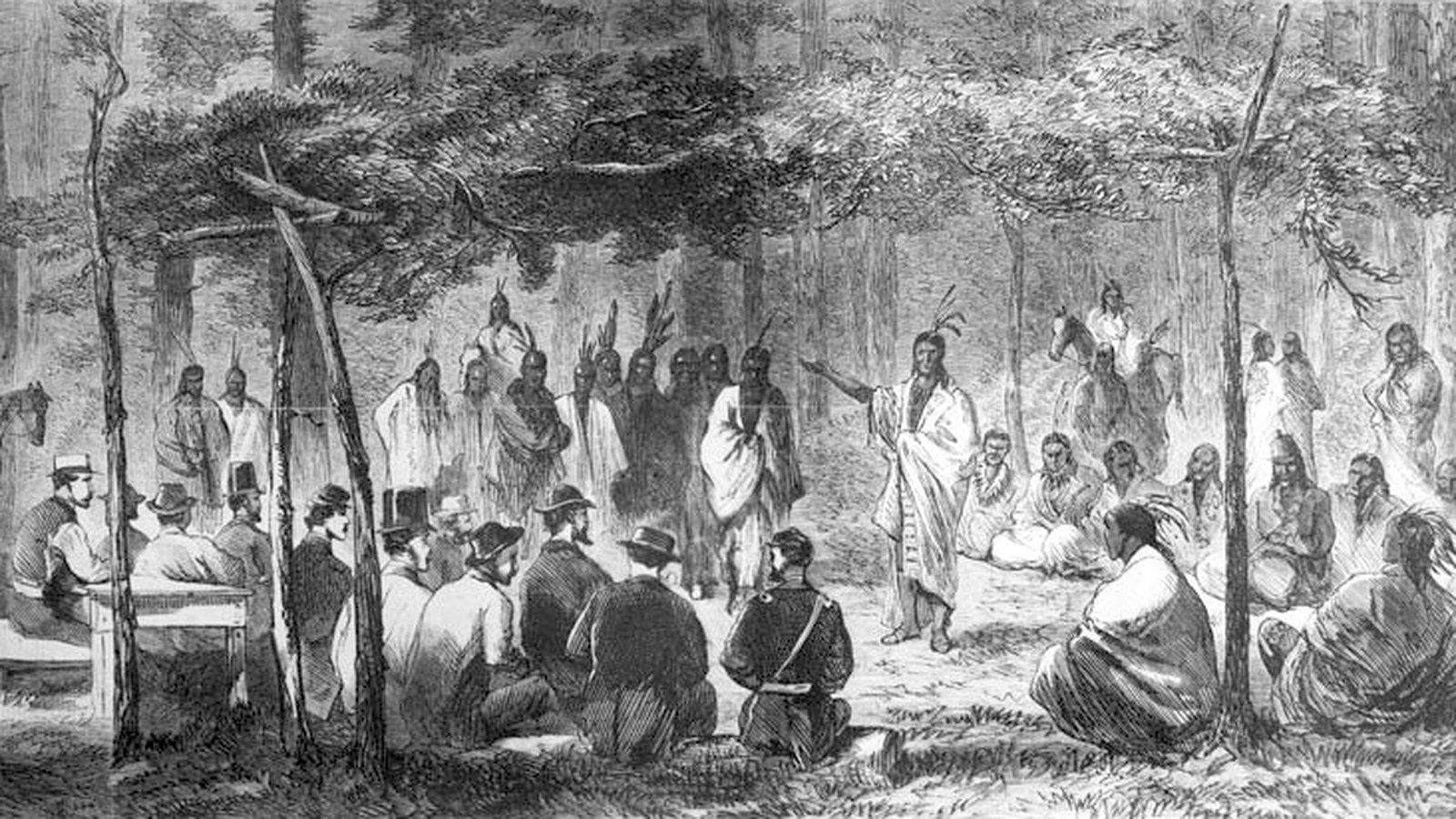
Congress set up the Indian Peace Commission on 20 July 1867, after the wars on the southern Plains. Its president was Nathaniel G. Taylor, Commissioner of Indian Affairs. With him sat William S. Harney, Alfred H. Terry, John B. Sanborn, Samuel F. Tappan, Senator John B. Henderson and, in Sherman’s place for a time, Christopher C. Augur. The commission reported in January 1868 that the wars could have been avoided had Washington kept its treaties. At the tribes’ request the council moved from Fort Larned to Medicine Lodge Creek, a ceremonial ground some seventy miles south of the fort, in Kansas. Serious work began on 19 October.
On 21 October 1867, at the Council Camp, two instruments were signed: the Treaty with the Kiowa and Comanche (15 Stat. 581) and, the same day, the one that confederated the Plains Apache (Kiowa-Apache) with the first. A third, with the Southern Cheyenne and Arapaho, followed on 28 October. Kappler’s text, published by Oklahoma State University, dates the first treaty, shows it ratified on 25 July 1868 and proclaimed on 25 August 1868. Kiowa signatories included Satank, Satanta and Kicking Bird; among the Comanche, Ten Bears.
Article 1 declares that war shall cease and that the United States pledges its honor to keep the peace. Article 2 sets out the Kiowa-Comanche reservation in the south-west corner of Indian Territory, between the Washita, the North Fork of the Red River and the 98th meridian, about three million acres, in exchange for more than 60,000 square miles of traditional lands. No one except authorised agents was to settle there.
Articles 4 to 10 provide agency buildings, a school, a mill, a physician, a farmer and a blacksmith, plus annual clothing for thirty years and 25,000 dollars for necessary goods. Children between six and sixteen were to attend school. Article 11 requires the tribes to give up permanent occupation outside the reservation, but keeps the right to hunt buffalo south of the Arkansas “so long as the buffalo may range thereon in such numbers as to justify the chase”. The tribes accept the railroads, the military posts and a ban on attacking trains or taking captives.
Article 12 requires, for any later cession of land held in common, the signatures of at least three-fourths of the adult men. The tribes never ratified the treaties by a vote of adult men, though the clause required it. In Lone Wolf v. Hitchcock (1903) the Supreme Court sided with Congress, which had reduced the reservation under the Dawes Act and the Cherokee Commission agreements of 1890–1892. In the twentieth century the Kiowa, Comanche and Arapaho won compensation of tens of millions of dollars.
The Senate ratified the acts in July 1868. The House challenged the Senate’s right to make treaties with Indian nations; in 1871 treaty-making with the tribes ended. Appropriations came late and fell short. Raiding continued, in part from hunger. Ten Bears told the commission he did not want houses on a reservation: he was born on the prairie, “where the wind blew free”.
Sources: Medicine Lodge Treaty; Kappler, Treaty with the Kiowa and Comanche, 1867.











0 Comments
No comments on this article yet. Be the first!