


On 12 March 1940, at Moscow, the Treaty of Peace is signed between the Republic of Finland and the Union of Soviet Socialist Republics, in Finnish, Swedish and Russian. For the Presidium of the Supreme Soviet: Vyacheslav Mikhailovich Molotov, chairman of the Council of People’s Commissars and People’s Commissar for Foreign Affairs, Andrei Aleksandrovich Zhdanov, member of the Presidium, Alexander Mikhailovich Vasilevsky, Brigade Commander. For the government of Finland: Risto Ryti, Prime Minister, Juho Kusti Paasikivi, Minister, General Rudolf Walden, Professor Väinö Voionmaa. Preamble: an end to the hostilities, lasting peaceful relations, precise conditions for reciprocal security, including the security of Leningrad, Murmansk and the Murmansk Railway. Article 9: the treaty enters into effect immediately upon being signed, subject to subsequent ratification; exchange of instruments within ten days in Moscow.
Article 1: hostilities cease immediately in accordance with the protocol appended. Protocol: both sides cease hostilities on 13 March at 12:00 noon Leningrad time; a one-kilometre neutral zone; withdrawal beyond the new state boundary from 15 March at 10:00 a.m. along the frontier from the Gulf of Finland to Lieksa, and from 16 March north of Lieksa; daily marches of not less than seven kilometres, with an interval of not less than seven kilometres between rear guard and advance units. Evacuation of Red Army troops from Petsamo by 10 April. Prisoners of war exchanged in the briefest possible time, on a special agreement.
Article 2: the state frontier runs along a new line so that there is included in the territory of the USSR the entire Karelian Isthmus with the city of Viipuri and Viipuri Bay with its islands, the western and northern shores of Lake Ladoga with Kexholm, Sortavala and Suojärvi, a number of islands in the Gulf of Finland, the area east of Märkäjärvi with Kuolajärvi, and part of the Rybachi and Sredni peninsulas, all in accordance with the map appended. A mixed commission, named within ten days of signing, shall determine the line in more detail. Article 3: each party undertakes to refrain from any attack upon the other and to make no alliance and to participate in no coalition directed against the other.
Article 4: Finland agrees to lease to the Soviet Union for thirty years, against an annual rental of eight million Finnish marks, Hanko Cape and the waters surrounding it in a radius of five miles to the south and east and three miles to the north and west, and the islands falling within that area, for a naval base capable of defending the mouth of the Gulf of Finland; the Soviet Union may maintain there, at its own expense, the necessary armed land and air forces. Within the days from the date this treaty enters into effect, Finland withdraws all its military forces from Hanko Cape, which together with its adjoining islands is transferred to the jurisdiction of the USSR.
Article 5: the USSR undertakes to withdraw its troops from the Petsamo area which the Soviet state voluntarily ceded to Finland under the peace treaty of 1920. Finland undertakes, as in 1920, to refrain from maintaining in the waters along its Arctic coast warships and other armed ships, excluding armed ships of less than one hundred tons, which Finland may maintain without restriction, and at most fifteen warships or other armed ships, none exceeding four hundred tons. No submarines or armed aircraft in those waters. No military ports, naval bases or repair shops of greater capacity than necessary for those ships. Article 6: free transit for the Soviet Union and its citizens across Petsamo to Norway and back; a Soviet consulate in Petsamo; merchandise in transit exempt from customs; unarmed Soviet aircraft between the Soviet Union and Norway via Petsamo.
Article 7: Finland grants the Soviet Union the right of transit for goods between the Soviet Union and Sweden; to develop this traffic along the shortest railway route, each party shall build, on its own territory and insofar as possible in 1940, a railway connecting Kantalahti (Kandalaksha) with Kemijärvi. Article 8: upon the coming into force of this treaty economic relations shall be restored, and the parties shall enter into negotiations for a trade agreement. Protocol, paragraph 6: while troops withdraw, cities, localities and establishments of defensive and economic importance — bridges, dams, airfields, barracks, storehouses, railway communications, industrial plants, telegraphs, electric power plants — shall be preserved from damage and destruction.
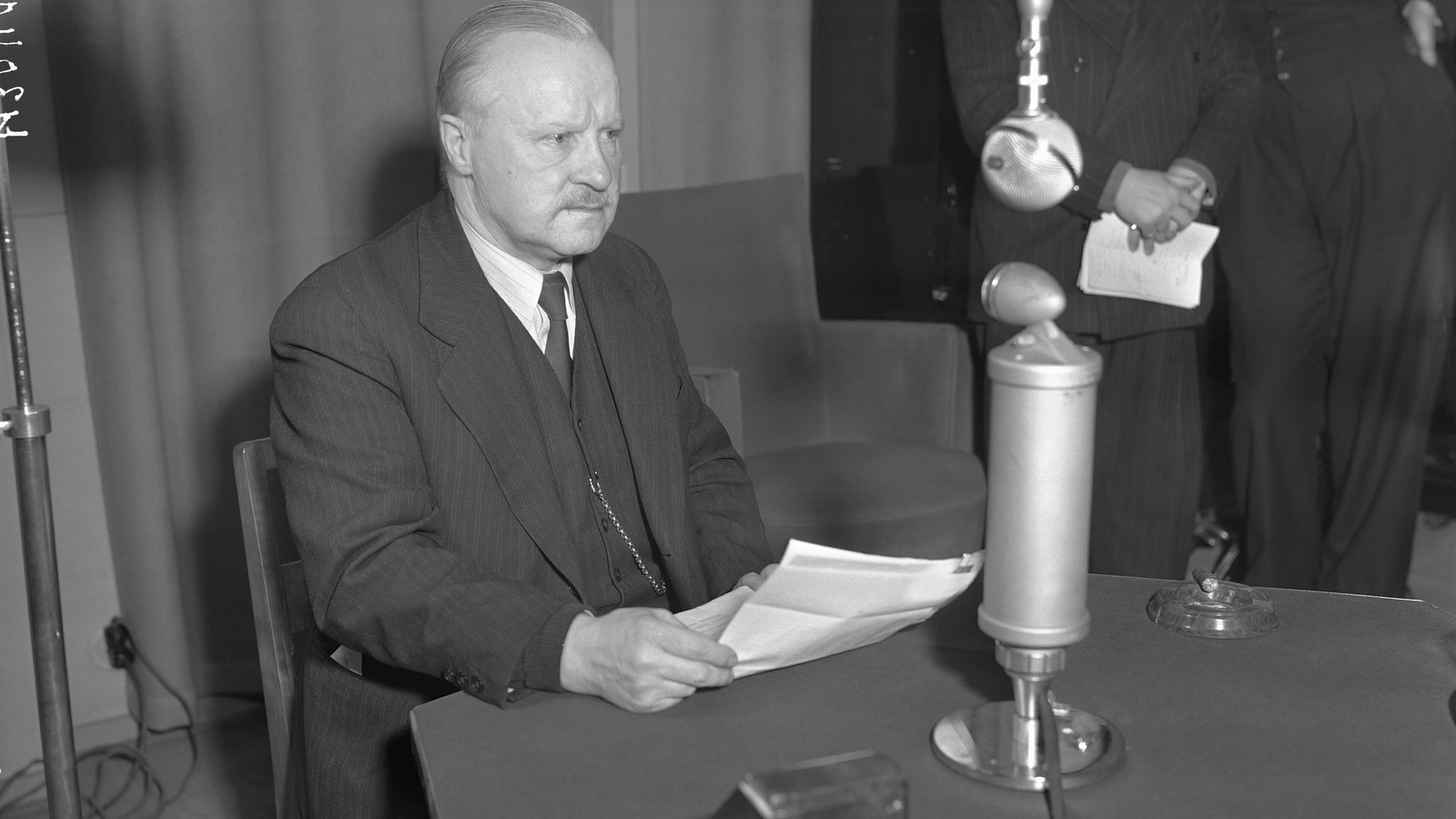
Signed: Molotov, Zhdanov, Vasilevsky; Ryti, Paasikivi, Walden, Voionmaa. Väinö Tanner reads the terms on the radio, in Helsinki, the next day. The treaty does not undo the Winter War opened on 30 November 1939; it closes it. This is not the Paris Peace Treaty of 1947.
Image: Otso Pietinen, Foreign Minister Väinö Tanner reading the terms of the Moscow Peace, Helsinki, 13 March 1940, CC BY 4.0, Museovirasto / Wikimedia Commons. Cropped to 16:9. The radio reading, not the Moscow signing.
Source consulted: Moscow Peace Treaty. Treaty text: Treaty of Peace between Finland and the USSR, Moscow, 12 March 1940.











0 Comments
No comments on this article yet. Be the first!